


Lifestyle-related factors, obesity, and incident microalbuminuria: the CARDIA (Coronary Artery Risk Development in Young Adults) study
- PMID: 23601954
- PMCID: PMC3720776
- DOI: 10.1053/j.ajkd.2013.02.363
Lifestyle-related factors, obesity, and incident microalbuminuria: the CARDIA (Coronary Artery Risk Development in Young Adults) study
Abstract
Background: Modifiable lifestyle-related factors are associated with risk of coronary heart disease and may also influence kidney disease risk.
Study design: Community-based prospective cohort study.
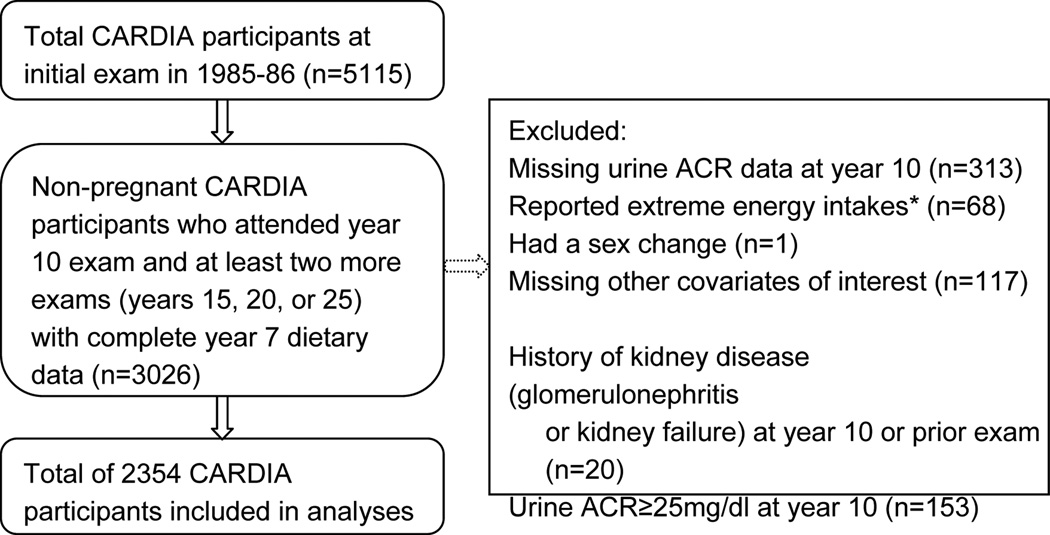
Setting & participants: 2,354 African American and white participants aged 28-40 years without baseline microalbuminuria or estimated glomerular filtration rate <60 mL/min/1.73 m² recruited from 4 US centers: Birmingham, AL; Chicago, IL; Minneapolis, MN; and Oakland, CA.
Factors: Current smoking, physical activity, fast food habits, obesity, and diet quality, which was based on 8 fundamental components of the Dietary Approaches to Stop Hypertension (DASH) diet, including increased intake of fruits, vegetables, low-fat dairy products, whole grains, and nuts and legumes and reduced intake of sodium, sugar-sweetened beverages, and red and processed meats.
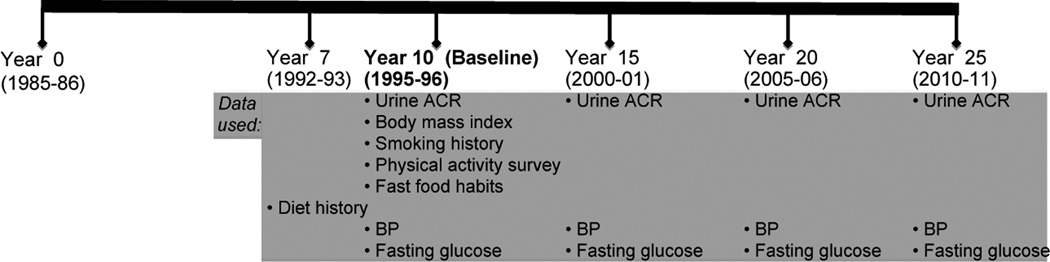
Outcomes & measurements: Spot urine albumin-creatinine ratios were obtained at baseline (1995-1996) and three 5-year follow-up examinations (5, 10, and 15 years' follow-up). Incident microalbuminuria was defined as the presence of age- and sex-adjusted albumin-creatinine ratio ≥25 mg/g at 2 or more of the successive follow-up examinations.
Results: During the 15-year follow-up, 77 (3.3%) individuals developed incident microalbuminuria. After multivariable adjustment, poor diet quality (OR, 2.0; 95% CI, 1.1-3.4) and obesity (OR, 1.9; 95% CI, 1.1-3.3) were associated significantly with microalbuminuria; current smoking (OR, 1.6; 95% CI, 0.9-2.8) was associated with microalbuminuria, although the CI crossed 1.0. Neither low physical activity (OR, 1.0; 95% CI, 0.5-1.8) nor fast food consumption (OR, 1.2; 95% CI, 0.7-2.3) was associated with microalbuminuria. Compared with individuals with no unhealthy lifestyle-related factors (poor diet quality, current smoking, and obesity), adjusted odds of incident microalbuminuria were 131%, 273%, and 634% higher for the presence of 1 (OR, 2.3; 95% CI, 1.3-4.3), 2 (OR, 3.7; 95% CI, 1.8-7.7), and 3 (OR, 7.3; 95% CI, 2.1-26.1) unhealthy lifestyle-related factors.
Limitations: Self-reported dietary history and physical activity, low number of outcomes.
Conclusions: Consuming an unhealthy diet and obesity are associated with incident microalbuminuria.
Keywords: DASH diet; kidney disease; lifestyle factors; microalbuminuria; obesity.
Copyright © 2013 National Kidney Foundation, Inc. Published by Elsevier Inc. All rights reserved.
Figures
References
-
- National Kidney Foundation. K/DOQI clinical practice guidelines for chronic kidney disease: Evaluation, classification, and stratification. Am J Kidney Dis. 2002;39(2 Suppl 1):S1–S266. - PubMed
-
- Arnlov J, Evans JC, Meigs JB, et al. Low-grade albuminuria and incidence of cardiovascular disease events in nonhypertensive and nondiabetic individuals: The framingham heart study. Circulation. 2005;112(7):969–975. - PubMed
-
- Gerstein HC, Mann JF, Yi Q, et al. Albuminuria and risk of cardiovascular events, death, and heart failure in diabetic and nondiabetic individuals. JAMA. 2001;286(4):421–426. - PubMed
-
- Hemmelgarn BR, Manns BJ, Lloyd A, et al. Relation between kidney function, proteinuria, and adverse outcomes. JAMA. 2010;303(5):423–429. - PubMed
Publication types
MeSH terms
Grants and funding
LinkOut - more resources
Full Text Sources
Other Literature Sources
Medical
