Comparative Study
. 2013 May 2;92(5):696-706.
doi: 10.1016/j.ajhg.2013.03.019. Epub 2013 Apr 18.

FOXP2 targets show evidence of positive selection in European populations

Affiliations
Comparative Study

FOXP2 targets show evidence of positive selection in European populations

Qasim Ayub et al. Am J Hum Genet. .

Abstract

Forkhead box P2 (FOXP2) is a highly conserved transcription factor that has been implicated in human speech and language disorders and plays important roles in the plasticity of the developing brain. The pattern of nucleotide polymorphisms in FOXP2 in modern populations suggests that it has been the target of positive (Darwinian) selection during recent human evolution. In our study, we searched for evidence of selection that might have followed FOXP2 adaptations in modern humans. We examined whether or not putative FOXP2 targets identified by chromatin-immunoprecipitation genomic screening show evidence of positive selection. We developed an algorithm that, for any given gene list, systematically generates matched lists of control genes from the Ensembl database, collates summary statistics for three frequency-spectrum-based neutrality tests from the low-coverage resequencing data of the 1000 Genomes Project, and determines whether these statistics are significantly different between the given gene targets and the set of controls. Overall, there was strong evidence of selection of FOXP2 targets in Europeans, but not in the Han Chinese, Japanese, or Yoruba populations. Significant outliers included several genes linked to cellular movement, reproduction, development, and immune cell trafficking, and 13 of these constituted a significant network associated with cardiac arteriopathy. Strong signals of selection were observed for CNTNAP2 and RBFOX1, key neurally expressed genes that have been consistently identified as direct FOXP2 targets in multiple studies and that have themselves been associated with neurodevelopmental disorders involving language dysfunction.


Figures

Figure 1
Figure 1
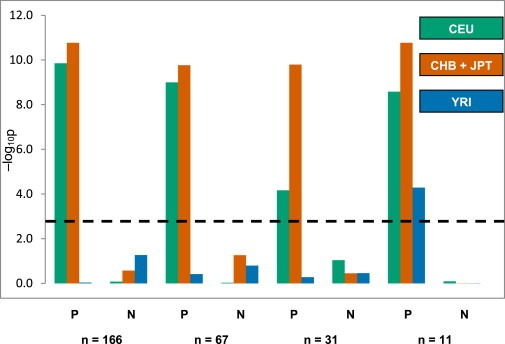
Selection Signals in Gene Sets of Positive and Negative Controls The negative log of combined p values for the matched permutation tests is shown along the y axis. Known positively selected gene sets (P) (n = 166, 67, or 31) lie in regions identified as being under selection in ≥7, ≥8, or 9 genomic scans or in a smaller data set of 11 genes shared among ≥7 genomic scans, a composite of multiple signals, and the 1000 Genomes Project. Gene lists of negative controls (N) were generated after exclusion of reported positively selected protein-coding genes from the Ensembl database. The dashed horizontal line depicts the threshold for multiple comparisons after application of the Bonferroni correction.
Figure 2
Figure 2
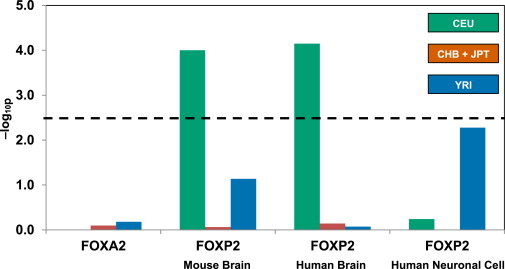
Evidence of Positive Selection in FOXP2 Targets from Three Separate ChIP-chip Screens FOXP2 targets identified by ChIP in mouse and human brain show evidence of positive selection in CEU. The dashed horizontal line depicts the threshold of the –log10p value for multiple comparisons after application of the Bonferroni correction. FOXA2 targets identified by ChIP-Seq do not show enrichment.
Figure 3
Figure 3
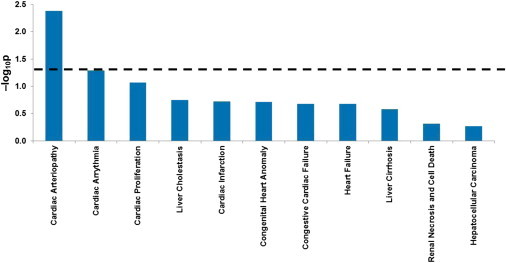
IPA of FOXP2 Targets Identified as Significant Outliers in CEU Shows Significant Association with Cardiac Arteriopathy
Figure 4
Figure 4
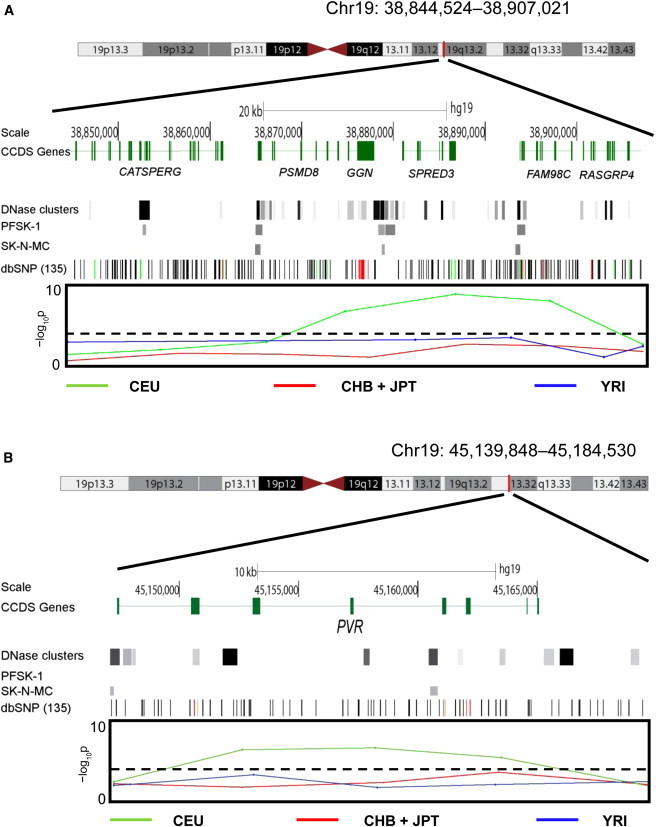
Genes under Selection in CEU (A) A chromosome 19 gene-rich region that harbors GGN. The signal is sustained over several 10 kb windows that also encompass nearby genes SPRED3 and FAM98C, which could also be the target of selection. (B) Another chromosome 19 region that harbors PVR. In both parts, tracks showing DNase clusters and FOXP2 binding sites determined by ChIP-Seq (ENCODE data from the HudsonAlpha Institute for Biotechnology) in two neural cell lines (PFSK-1 and SK-N-MC) provide additional support for the direct FOXP2 binding (bands) within this region. These represent enriched regions of high read density relative to total input chromatin control reads in the ChIP experiment. FOXP2 binding sites are observed in both cell lines in (A) but only in SK-N-MC in (B). The dbSNP (135) track shows variants identified in this region. The coding nonsynonymous and essential-splice-site variants are represented by vertical red lines, and coding synonymous variants are represented by vertical green lines. The –log10p of the combined p value (boxed area) was generated from the separate probabilities of Tajima’s D, Fay and Wu’s H, and CLR. The threshold represented by the dashed line incorporates the 5% FDR for each population. Peaks above the threshold in the graph represent regions under positive selection in CEU.

References

    1. Sabeti P.C., Schaffner S.F., Fry B., Lohmueller J., Varilly P., Shamovsky O., Palma A., Mikkelsen T.S., Altshuler D., Lander E.S. Positive natural selection in the human lineage. Science. 2006;312:1614–1620. - PubMed
    1. Akey J.M. Constructing genomic maps of positive selection in humans: where do we go from here? Genome Res. 2009;19:711–722. - PMC - PubMed
    1. Fisher S.E., Scharff C. FOXP2 as a molecular window into speech and language. Trends Genet. 2009;25:166–177. - PubMed
    1. Lai C.S., Fisher S.E., Hurst J.A., Vargha-Khadem F., Monaco A.P. A forkhead-domain gene is mutated in a severe speech and language disorder. Nature. 2001;413:519–523. - PubMed
    1. MacDermot K.D., Bonora E., Sykes N., Coupe A.-M., Lai C.S.L., Vernes S.C., Vargha-Khadem F., McKenzie F., Smith R.L., Monaco A.P., Fisher S.E. Identification of FOXP2 truncation as a novel cause of developmental speech and language deficits. Am. J. Hum. Genet. 2005;76:1074–1080. - PMC - PubMed

Publication types

LinkOut - more resources