


National trends in emergency department use of urinalysis, complete blood count, and blood culture for fever without a source among children aged 2 to 24 months in the pneumococcal conjugate vaccine 7 era
- PMID: 23603643
- PMCID: PMC3644309
- DOI: 10.1097/PEC.0b013e31828e56e1
National trends in emergency department use of urinalysis, complete blood count, and blood culture for fever without a source among children aged 2 to 24 months in the pneumococcal conjugate vaccine 7 era
Abstract
Objectives: The epidemiology of serious bacterial infections in children has changed since the introduction of the pneumococcal conjugate vaccine (PCV-7) in 2000. Whether emergency department (ED) physicians have changed diagnostic approaches to fever without a source (FWS) in response is unknown. We examine trends in rates of complete blood count (CBC), urinalysis (UA), and blood cultures among 2- to 24-month-old children with FWS since the introduction of PCV-7.
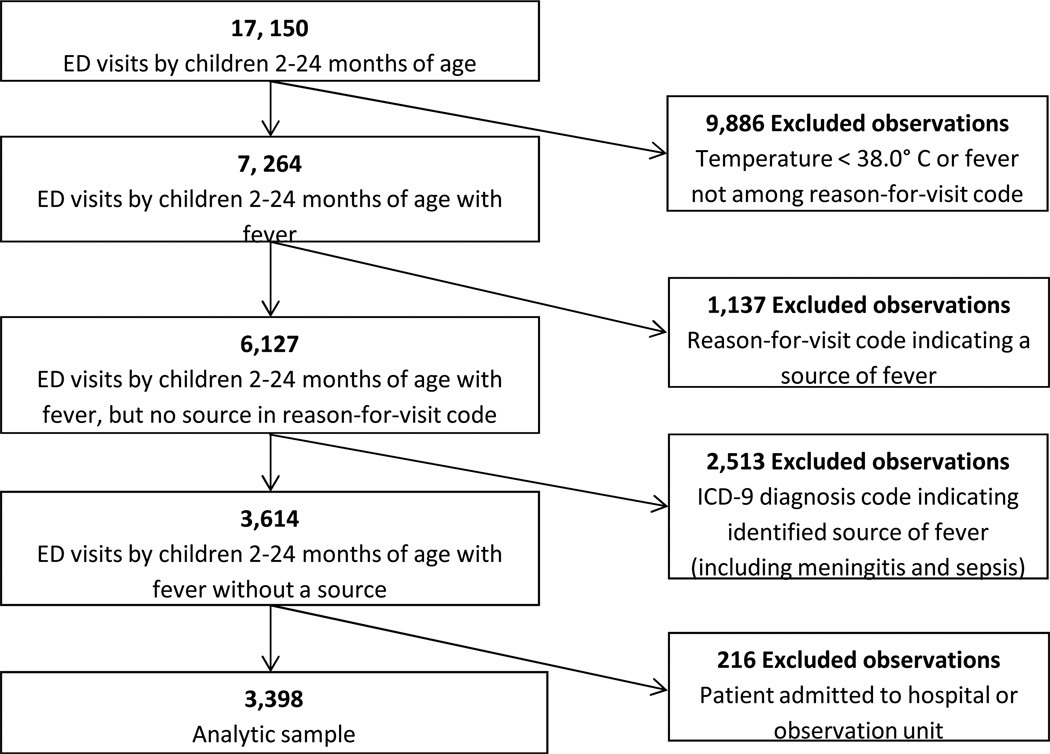
Methods: The National Hospital Ambulatory Medical Care Survey-Emergency Department, 2001-2009, was used to identify visits to the ED by 2- to 24-month-old children with FWS. Rates of CBC, UA, neither CBC nor UA, and blood culture were tracked across time. Trends were identified using Joinpoint regression and bivariate and multivariate logistic regressions with year as the independent variables and ordering of each test as the dependent variables.
Results: In bivariate and multivariate analyses, CBC orders declined between 2004 and 2009 for visits by all children 2 to 24 months, children 2 to 11 months, and boys 2 to 24 months (adjusted odds ratio [aOR], 0.88 per year [P < 0.01]; aOR, 0.88 [P < 0.05]; and aOR, 0.83 [P < 0.01], respectively). Between 2004 and 2009, ordering neither CBC nor UA increased among all children 2 to 24 months (aOR, 1.10; P < 0.05) and among boys (aOR, 1.16; P < 0.05). Orders for blood cultures declined across the time period in bivariate analysis, but not in multivariate analysis.
Conclusions: The rate of ordering a CBC for children in the 2- to 24-month age group presenting to the ED with FWS declined, a change coincident with the changing epidemiology of serious bacterial infection since the PCV-7 vaccine was introduced.
Conflict of interest statement
Figures
References
-
- Carstairs KL, Tanen DA, Johnson AS, et al. Pneumococcal bacteremia in febrile infants presenting to the emergency department before and after the introduction of the heptavalent pneumococcal vaccine. Ann Emerg Med. 2007;49:772–777. - PubMed
-
- Invasive pneumococcal disease in children 5 years after conjugate vaccine introduction--eight states, 1998–2005. MMWR Morb Mortal Wkly Rep. 2008;57:144–148. - PubMed
-
- Wilkinson M, Bulloch B, Smith M. Prevalence of occult bacteremia in children aged 3 to 36 months presenting to the emergency department with fever in the postpneumococcal conjugate vaccine era. Acad Emerg Med. 2009;16:220–225. - PubMed
-
- Byington CL, Samore MH, Stoddard GJ, et al. Temporal trends of invasive disease due to Streptococcus pneumoniae among children in the intermountain west: emergence of nonvaccine serogroups. Clin Infect Dis. 2005;41:21–29. - PubMed
-
- Whitney CG, Farley MM, Hadler J, et al. Decline in invasive pneumococcal disease after the introduction of protein-polysaccharide conjugate vaccine. N Engl J Med. 2003;348:1737–1746. - PubMed
Publication types
MeSH terms
Substances
Grants and funding
LinkOut - more resources
Full Text Sources
Other Literature Sources
Medical
