. 2013 Jun;41(11):5604-13.
doi: 10.1093/nar/gkt244. Epub 2013 Apr 19.

Computational identification of functional introns: high positional conservation of introns that harbor RNA genes

Affiliations

Computational identification of functional introns: high positional conservation of introns that harbor RNA genes

Michal Chorev et al. Nucleic Acids Res. 2013 Jun.

Abstract

An appreciable fraction of introns is thought to have some function, but there is no obvious way to predict which specific intron is likely to be functional. We hypothesize that functional introns experience a different selection regime than non-functional ones and will therefore show distinct evolutionary histories. In particular, we expect functional introns to be more resistant to loss, and that this would be reflected in high conservation of their position with respect to the coding sequence. To test this hypothesis, we focused on introns whose function comes about from microRNAs and snoRNAs that are embedded within their sequence. We built a data set of orthologous genes across 28 eukaryotic species, reconstructed the evolutionary histories of their introns and compared functional introns with the rest of the introns. We found that, indeed, the position of microRNA- and snoRNA-bearing introns is significantly more conserved. In addition, we found that both families of RNA genes settled within introns early during metazoan evolution. We identified several easily computable intronic properties that can be used to detect functional introns in general, thereby suggesting a new strategy to pinpoint non-coding cellular functions.


Figures
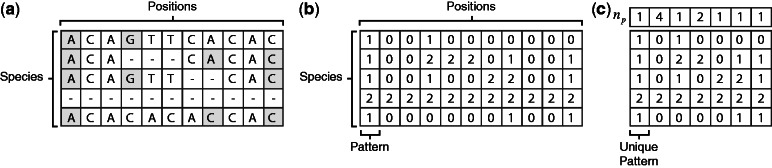
Figure 1.
Figure 1.
Ternary representation of multiple alignments. (a) A toy example of a multiple sequence alignment of an orthologous group. The rows stand for species, and the columns represent the position along the alignment. The last nucleotide of an exon is highlighted. (b) A ternary representation of the same alignment: 1 stands for the last nucleotide of an exon, 0 stands for all other nucleotides and 2 stands for gaps or missing orthologs. (c) The same data are represented by a list of unique patterns, and by the number of times each of them appears in the data (formula image).
Figure 2.
Figure 2.
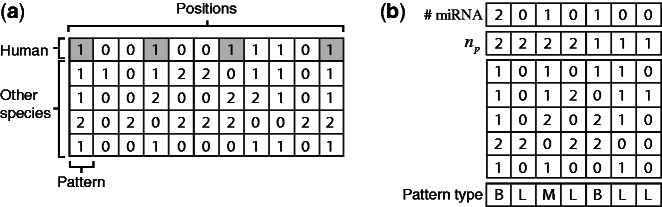
Types of unique patterns. (a) A ternary representation of a multiple sequence alignment. Human introns—depicted as 1 in the first row—that bear miRNAs are highlighted. (b) The same data are represented by a list of unique patterns, by the number of times each of them appears in the data (formula image), and by the number of times each pattern contains miRNAs in the human intron. The last row specifies the pattern type: ‘B’ for miRNA-bearing, ‘L’ for miRNA-lacking and ‘M’ for miRNA-mixed.
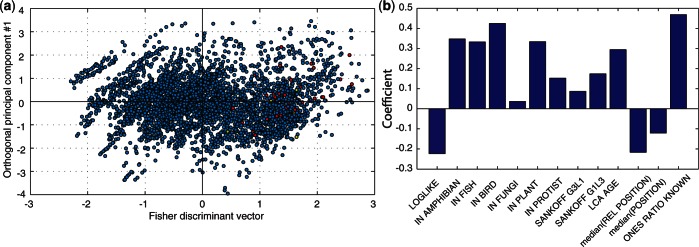
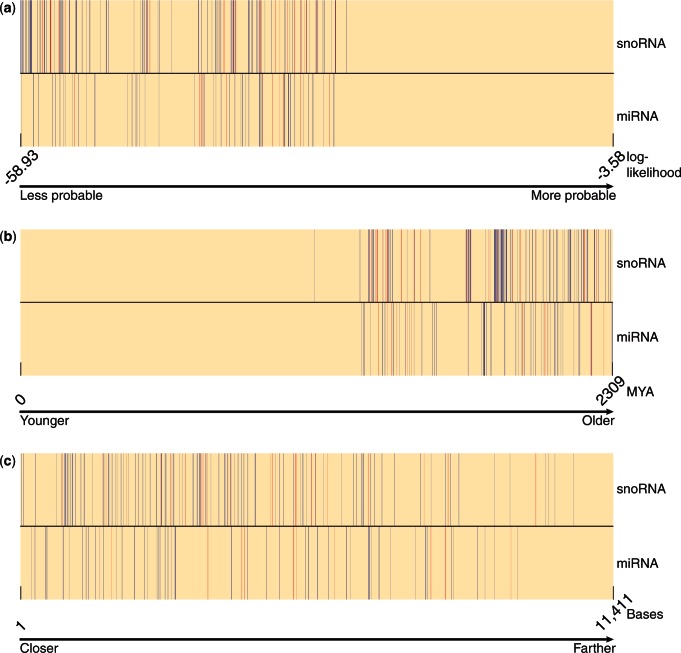
Figure 3.
Figure 3.
Fisher discriminant analysis for miRNA-bearing versus miRNA-lacking unique patterns. (a) Scatter plot of all unique patterns: (red) miRNA-bearing, (yellow) miRNA-mixed and (blue) miRNA-lacking unique patterns. The x-axis is the Fisher discriminant vector, and the y-axis was computed—for visualization only—as the first principal component that is constrained to be orthogonal to the Fisher discriminant vector. (b) The contribution of each of the 13 features to the Fisher discriminant vector. The y-axis is the coefficient of the respective feature in the linear combination that makes up the Fisher discriminant vector.
Figure 4.
Figure 4.
Ranking of unique patterns. (Top rows) snoRNA-bearing (blue), snoRNA-mixed (red) and snoRNA-lacking (beige) unique patterns. (Bottom rows) miRNA-bearing (blue), miRNA-mixed (red) and miRNA-lacking (beige) unique patterns. The unique patterns are ranked according to (a) their log-likelihood; (b) the antiquity of the intron; and (c) their distance from CDS start.
Figure 5.
Figure 5.
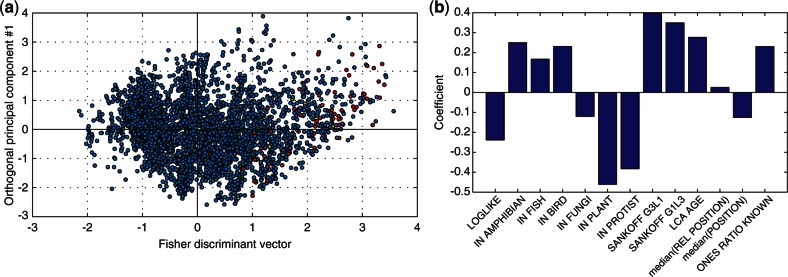
Fisher discriminant analysis for snoRNA-bearing versus snoRNA-lacking unique patterns. (a) Scatter plot of all unique patterns: (red) snoRNA-bearing, (yellow) snoRNA-mixed and (blue) snoRNA-lacking unique patterns. The x-axis is the Fisher discriminant vector, and the y-axis was computed—for visualization only—as the first principal component that is constrained to be orthogonal to the Fisher discriminant vector. (b) The contribution of each of the 13 features to the Fisher discriminant vector. The y-axis is the coefficient of the respective feature in the linear combination that makes up the Fisher discriminant vector.

References

    1. Hughes AL, Yeager M. Comparative evolutionary rates of introns and exons in murine rodents. J. Mol. Evol. 1997;45:125–130. - PubMed
    1. Graur D, Li WH. Fundamentals of Molecular Evolution. 2nd edn. Sunderland, MA, USA: Sinauer Associates; 2000.
    1. Rogozin IB, Wolf YI, Sorokin AV, Mirkin BG, Koonin EV. Remarkable interkingdom conservation of intron positions and massive, lineage-specific intron loss and gain in eukaryotic evolution. Curr. Biol. 2003;13:1512–1517. - PubMed
    1. Carmel L, Rogozin IB, Wolf YI, Koonin EV. Patterns of intron gain and conservation in eukaryotic genes. BMC Evol. Biol. 2007;7:192. - PMC - PubMed
    1. Chorev M, Carmel L. The function of introns. Front. Genet. 2012;3:55. - PMC - PubMed

Publication types