


Ineffective erythropoiesis in β -thalassemia
- PMID: 23606813
- PMCID: PMC3628659
- DOI: 10.1155/2013/394295
Ineffective erythropoiesis in β -thalassemia
Abstract
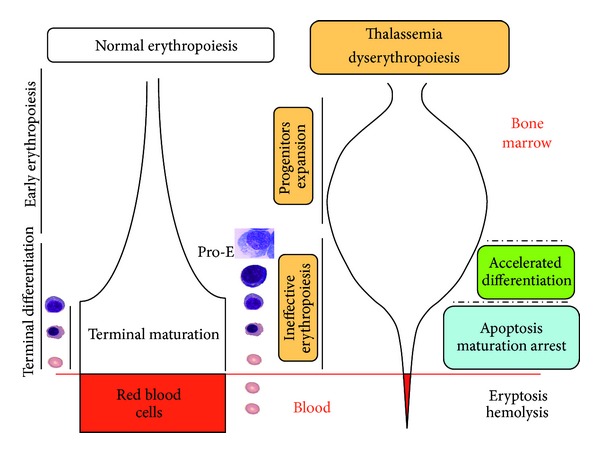
In humans, β -thalassemia dyserythropoiesis is characterized by expansion of early erythroid precursors and erythroid progenitors and then ineffective erythropoiesis. This ineffective erythropoiesis is defined as a suboptimal production of mature erythrocytes originating from a proliferating pool of immature erythroblasts. It is characterized by (1) accelerated erythroid differentiation, (2) maturation blockade at the polychromatophilic stage, and (3) death of erythroid precursors. Despite extensive knowledge of molecular defects causing β -thalassemia, less is known about the mechanisms responsible for ineffective erythropoiesis. In this paper, we will focus on the underlying mechanisms leading to premature death of thalassemic erythroid precursors in the bone marrow.
Figures
References
-
- Weatherall DJ. Phenotype-genotype relationships in monogenic disease: lessons from the thalassaemias. Nature Reviews Genetics. 2001;2(4):245–255. - PubMed
-
- Rund D, Rachmilewitz E. β-thalassemia. The New England Journal of Medicine. 2005;353(11):1135–1146. - PubMed
-
- Schrier SL. Pathophysiology of thalassemia. Current Opinion in Hematology. 2002;9(2):123–126. - PubMed
Publication types
MeSH terms
LinkOut - more resources
Full Text Sources
Other Literature Sources
Medical
