Randomized Controlled Trial
. 2013 Apr;10(2):98-107.
doi: 10.1513/AnnalsATS.201209-080OC.

Immunophenotyping and protein profiling of Fontan-associated plastic bronchitis airway casts

Affiliations
Randomized Controlled Trial

Immunophenotyping and protein profiling of Fontan-associated plastic bronchitis airway casts

Jennifer Racz et al. Ann Am Thorac Soc. 2013 Apr.

Abstract

Rationale: Plastic bronchitis (PB) is a rare and deadly condition that is characterized by the formation of airway casts. It most frequently occurs in children with underlying congenital heart disease that has been surgically palliated by the Fontan procedure. The Fontan circulation results in above-normal central venous pressure, and it has been hypothesized that the formation of airway casts is due to lymph leak. Knowledge of plastic bronchitis pathogenesis is poor and stems mostly from published case reports.

Objectives: To garner information about cast pathogenesis by characterizing inflammatory cell phenotypes in existing formalin-preserved, paraffin-embedded samples and generating protein and cytokine-chemokine profiles of airway cast homogenates.

Methods: We used immunofluorescence confocal microscopy, state-of-the-science proteomics, and a cytokine array assay to immunophenotype cellular content and to generate protein and cytokine profiles of plastic bronchitis airway casts, respectively.

Measurements and main results: Neutrophils, eosinophils, macrophages, and B lymphocytes were identified in cast samples; there were notably fewer T lymphocytes. Fibrin(ogen) was an abundant protein in the cast proteome. Histone H4 was also abundant, and immunofluorescence microscopy demonstrated it to be mostly extracellular. The cytokine profile of plastic bronchitis casts was proinflammatory.

Conclusions: Plastic bronchitis airway casts from children with Fontan physiology are composed of fibrin and are cellular and inflammatory in nature, providing evidence that their formation cannot be explained simply by lymph leak into the airways. Consequences of cellular necrosis including extracellular histones and the apparent low number of T cells indicate that a derangement in inflammation resolution likely contributes to cast formation.


Figures
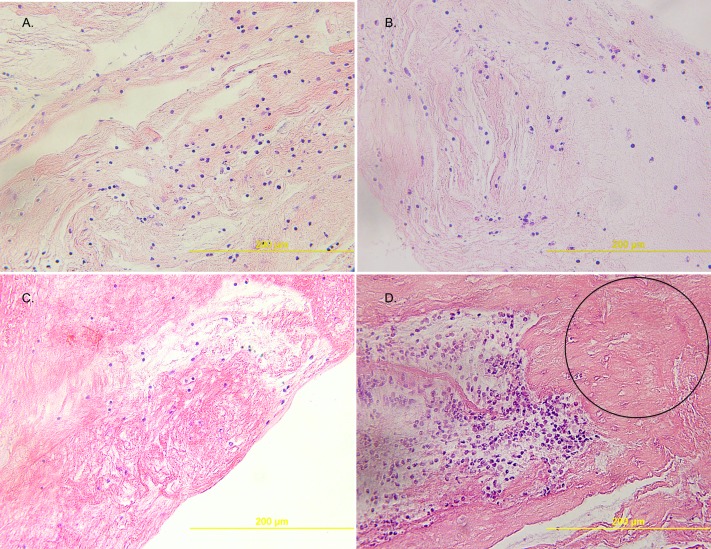
Figure 1.
Figure 1.
(AC) Representative hematoxylin–eosin (H&E)-stained sections (original magnification, ×40) that show the diffuse uniform distribution of mononuclear cells of plastic bronchitis (PB) airway casts and one (D) that shows a region of cell clusters and an acellular zone (circle). Each image is from one of the four studied patients.
Figure 2.
Figure 2.
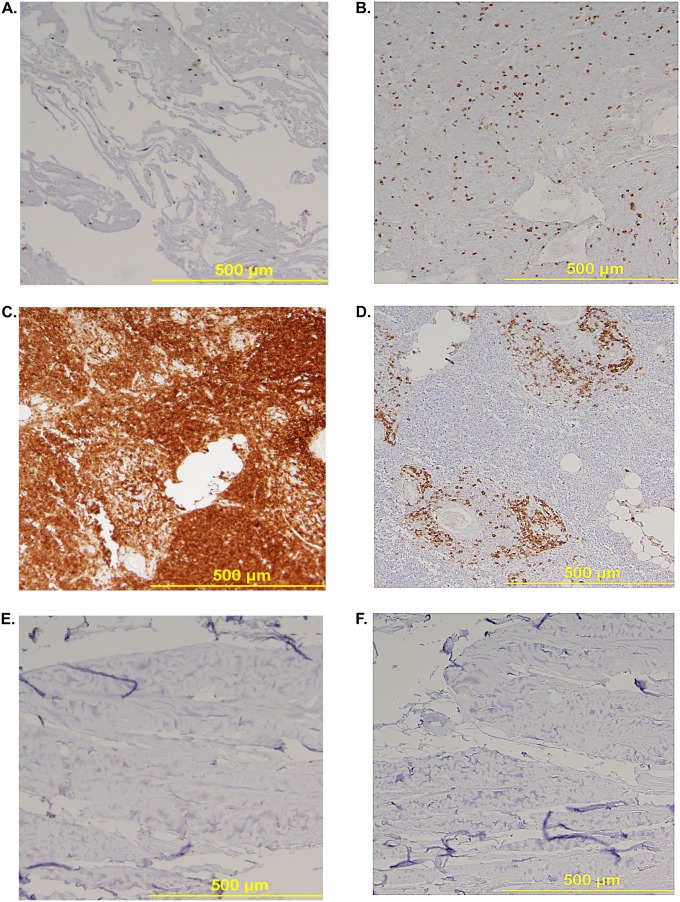
Representative sections of plastic bronchitis (PB) airway casts stained for (A) CD3 (T) cells and (B) CD20 (B) cells, showing that the uniform distribution of mononuclear cells is attributable primarily to B cells and that there are fewer T cells. CD3 and CD20 staining was confirmed by the staining of sections of (C and D) thymus and (E and F) sternum, respectively.
Figure 3.
Figure 3.
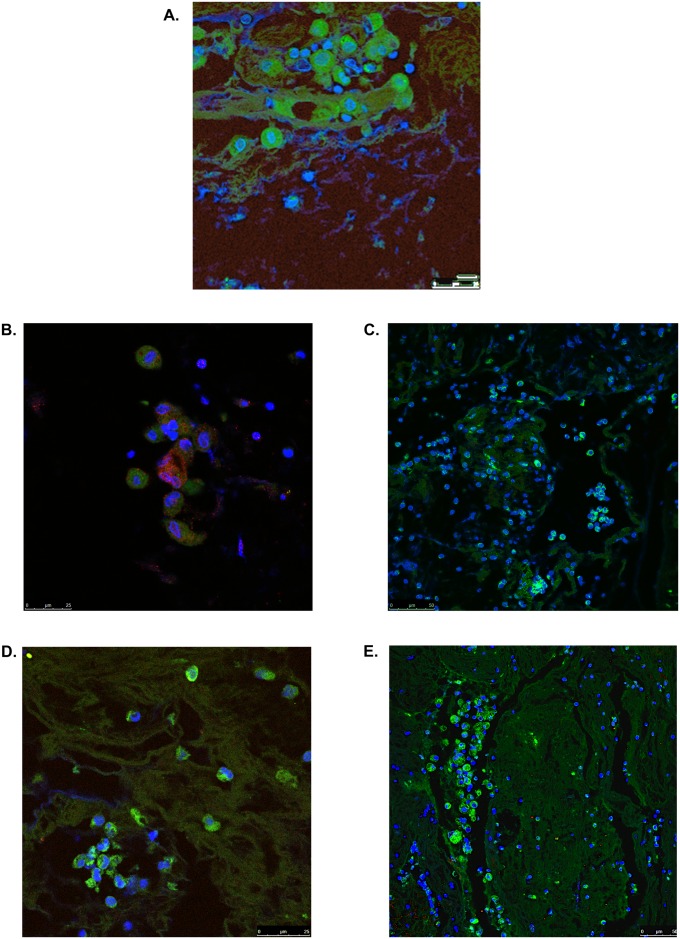
Plastic bronchitis airway casts from children with Fontan physiology contain immune cells. Immunofluorescence (IF) confocal microscopy revealed positive staining for clusters of cells expressing (A) myeloperoxidase (green), indicative of neutrophils (original magnification, ×100; zoom factor 2.0); (B) eosinophilic peroxidase (red), which colocalized with CD4 (green) (original magnification, ×100; zoom factor 2.0); and (C) CD14 (green) and CD11b (red), indicative of macrophages (original magnification, ×40). (D) The presence of B lymphocytes was detected by CD20 (green) staining (original magnification, ×100; zoom factor 1.14). (E) CD4 staining (green) revealed clusters of eosinophils and lymphocytes and CD8 staining (red) was sparse. Samples were counterstained with 4′,6-diamidino-2-phenylindole (DAPI; blue) to visualize nuclei. Images are representative of at least one cast sample from four patients. The presence of T cells in cast samples was confirmed by immunohistochemistry (IHC) for CD3 (see Figure 2 and Figure E1). Representative IF and IHC of control slides that demonstrate antibody specificity and performance can be found in Figure 2 and in Figure E1.
Figure 4.
Figure 4.
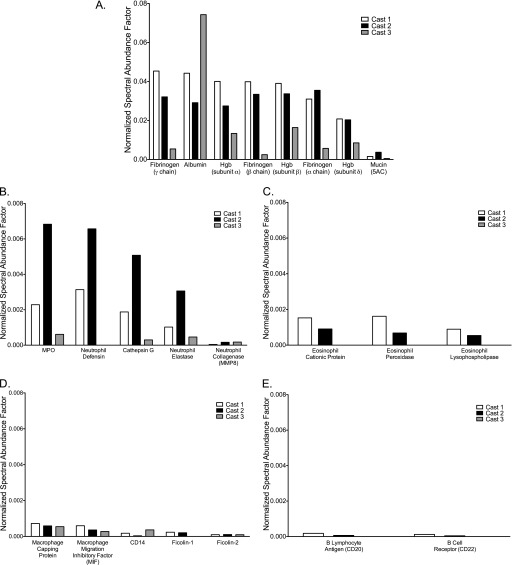
Fibrin(ogen) is abundant and proteins of immune cells are present in the proteome of plastic bronchitis airway casts. (A) Fibrin(ogen) is an abundant protein in the airway cast proteome. Mucin proteins were detected but at much lower levels relative to the most abundant proteins in the casts (also see Figure E4). Consistent with the results of the immunophenotyping studies, immune cell proteins were detected in the cast proteome. (B) Neutrophil proteins were the most abundant followed by (C) eosinophil, (D) monocyte/macrophage, and (E) lymphocyte proteins. Eosinophil proteins were not detected in one of the three cast samples and detected lymphocyte proteins were those associated with B cells; no T-cell proteins were detected. Data are the normalized spectral abundance factors of each respective protein in each of three plastic bronchitis airway casts.
Figure 5.
Figure 5.
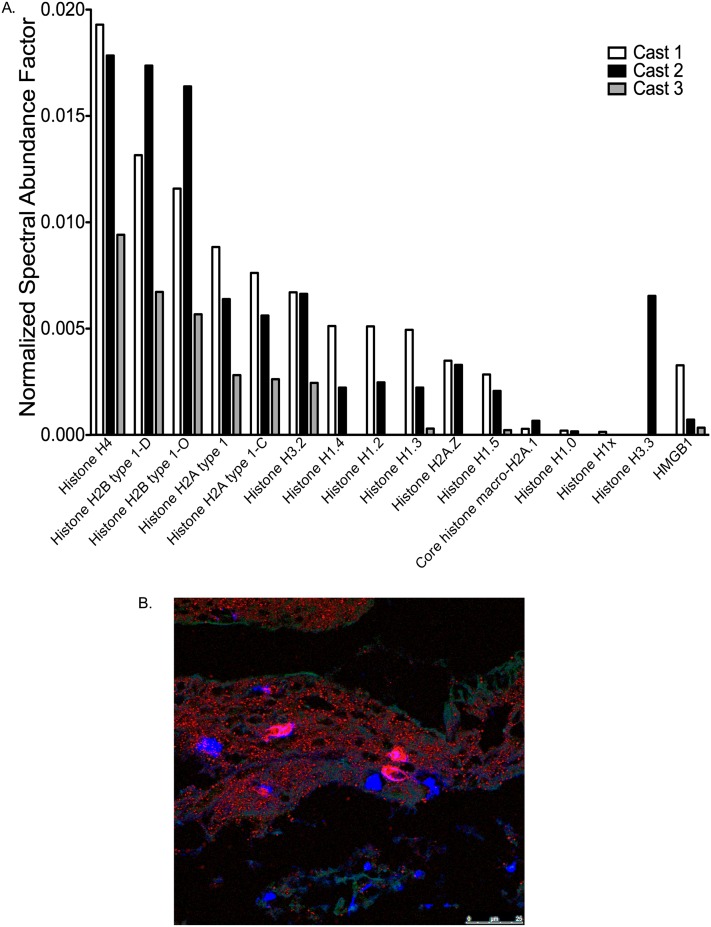
Histones are abundant in the plastic bronchitis airway cast proteome, and histone H4 is evident by immunofluorescence (IF) staining. (A) Histone H4 is the most abundant of the histones and is the eighth most abundant protein in the airway cast proteome. Another nuclear protein, high mobility group protein B1 (HMGB1), which is indicative of cell necrosis, had a similar abundance to histones in the cast proteome. (B) Representative IF micrograph (original magnification, ×100) of an airway cast section stained for histone H4 (red), DNA (blue), and annexin A5 (green) that illustrates the distribution of intracellular and nuclear material in plastic bronchitis airway casts. Representative IF of control slides that demonstrate antibody specificity and performance can be found in Figure E2. Data represented in (A) are the normalized spectral abundance factors of each respective protein in each of three plastic bronchitis airway casts.
Figure 6.
Figure 6.
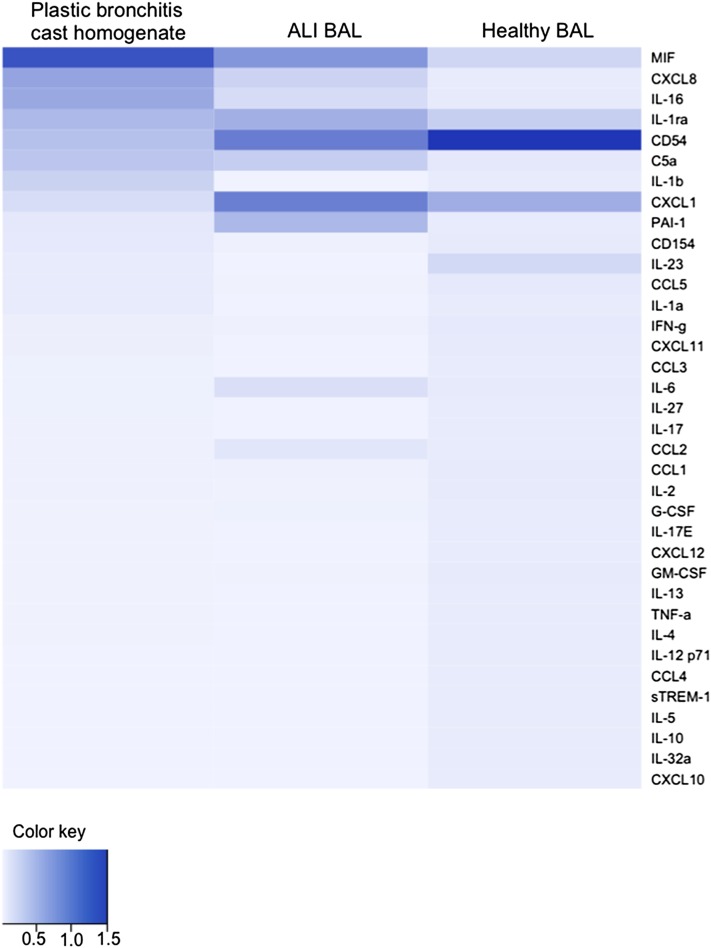
Heat map of the 36 measured analytes, based on descending mean signal intensity in plastic bronchitis cast homogenates relative to the bronchoalveolar lavage (BAL) of patients with acute lung injury (ALI) and healthy control subjects. Data were generated from four plastic bronchitis homogenate samples, two of which were also used for the acquisition of proteomic data, and four BAL samples from patients with ALI and healthy control subjects. Statistical comparisons between analytes in plastic bronchitis cast homogenates compared with ALI BAL or BAL from healthy control subjects are shown in Figures E5 and E6.

References

    1. Healy F, Hanna BD, Zinman R. Pulmonary complications of congenital heart disease. Paediatr Respir Rev. 2012;13:10–15. - PubMed
    1. Goldberg DJ, Dodds K, Rychik J. Rare problems associated with the Fontan circulation. Cardiol Young. 2010;20:113–119. - PubMed
    1. Heath L, Ling S, Racz J, Mane G, Schmidt L, Myers JL, Tsai WC, Caruthers RL, Hirsch JC, Stringer KA. Prospective, longitudinal study of plastic bronchitis cast pathology and responsiveness to tissue plasminogen activator. Pediatr Cardiol. 2011;32:1182–1189. - PMC - PubMed
    1. Madsen P, Shah SA, Rubin BK. Plastic bronchitis: new insights and a classification scheme. Paediatr Respir Rev. 2005;6:292–300. - PubMed
    1. Seear M, Hui H, Magee F, Bohn D, Cutz E. Bronchial casts in children: a proposed classification based on nine cases and a review of the literature. Am J Respir Crit Care Med. 1997;155:364–370. - PubMed

Publication types

LinkOut - more resources