Review
. 2013 May;182(5):1462-73.
doi: 10.1016/j.ajpath.2013.02.002.

Going forward with genetics: recent technological advances and forward genetics in mice

Affiliations
Review

Going forward with genetics: recent technological advances and forward genetics in mice

Eva Marie Y Moresco et al. Am J Pathol. 2013 May.

Abstract

Forward genetic analysis is an unbiased approach for identifying genes essential to defined biological phenomena. When applied to mice, it is one of the most powerful methods to facilitate understanding of the genetic basis of human biology and disease. The speed at which disease-causing mutations can be identified in mutagenized mice has been markedly increased by recent advances in DNA sequencing technology. Creating and analyzing mutant phenotypes may therefore become rate-limiting in forward genetic experimentation. We review the forward genetic approach and its future in the context of recent technological advances, in particular massively parallel DNA sequencing, induced pluripotent stem cells, and haploid embryonic stem cells.


Figures

Figure 1
Figure 1
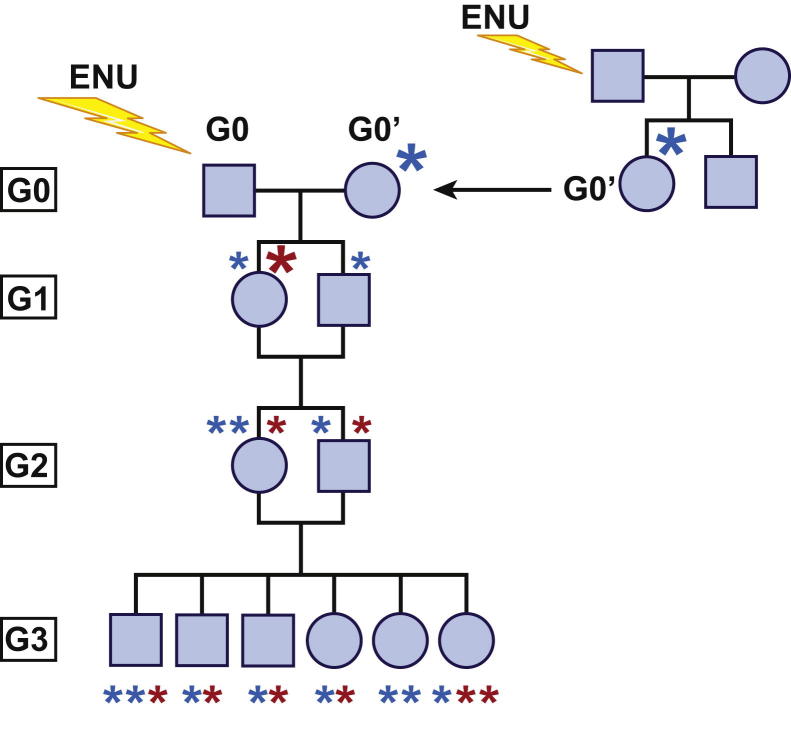
Inbreeding protocol for generating G3 mice with homozygous ENU-induced mutations. Mutagenized G0 males are bred to G0′ females, which carry germline mutations derived from other mutagenized males. G1 mice are either intercrossed as shown here or crossed to wild-type C57BL/6J females. Siblings in the G2 generation are intercrossed. G3 mice are subjected to screening. Small asterisks represent mutations derived from the G0 male (red) and G0′ female (blue); large asterisks indicate initial germline transmission of the mutation.
Figure 2
Figure 2
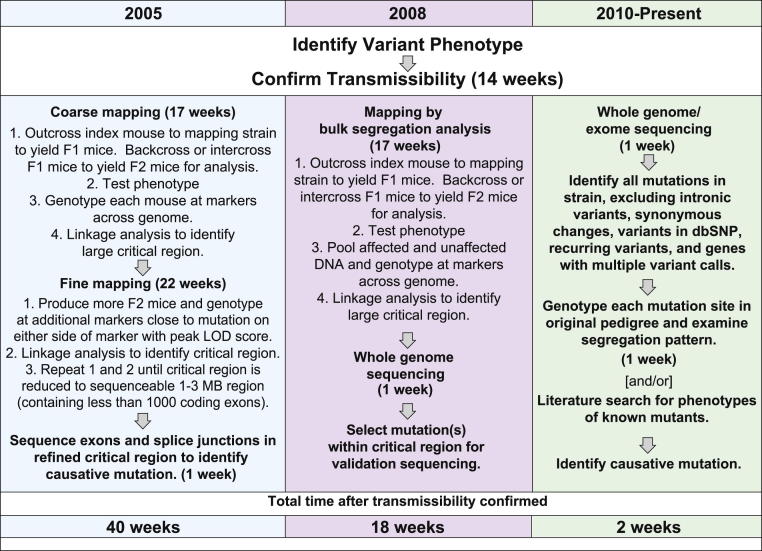
Workflow typical in 2005, 2008, and currently for identifying a mutation responsible for a variant phenotype. Estimated time requirements are indicated for each major step. Left panel: Around 2005, identifying a mutation causative for a particular phenotype by genetic mapping and capillary sequencing of critical region coding sequences commonly required approximately 1 year. Center panel: More efficient mapping by bulk segregation analysis (BSA) and massively parallel genome sequencing were implemented for mutation finding beginning around 2008 and reduced by approximately 55% the time needed to find a causative mutation (counting the time from confirmation of transmissibility). Right panel: Identification of causative mutations without genetic mapping has recently been demonstrated, made possible by the high accuracy of massively parallel sequencers and the use of multiple data filters to exclude false-positive mutation calls. This process results in the identification of only a few mutations per strain, which can be tested for linkage with the affected phenotype. Rapid mutation finding by BSA and/or massively parallel sequencing permits the simultaneous investigation of many more phenotypes than was previously possible. In every case, confirmation of causality depends on knowledge of the effect of a second mutant allele or on transgenic rescue of the mutant phenotype with the wild-type allele.
Figure 3
Figure 3
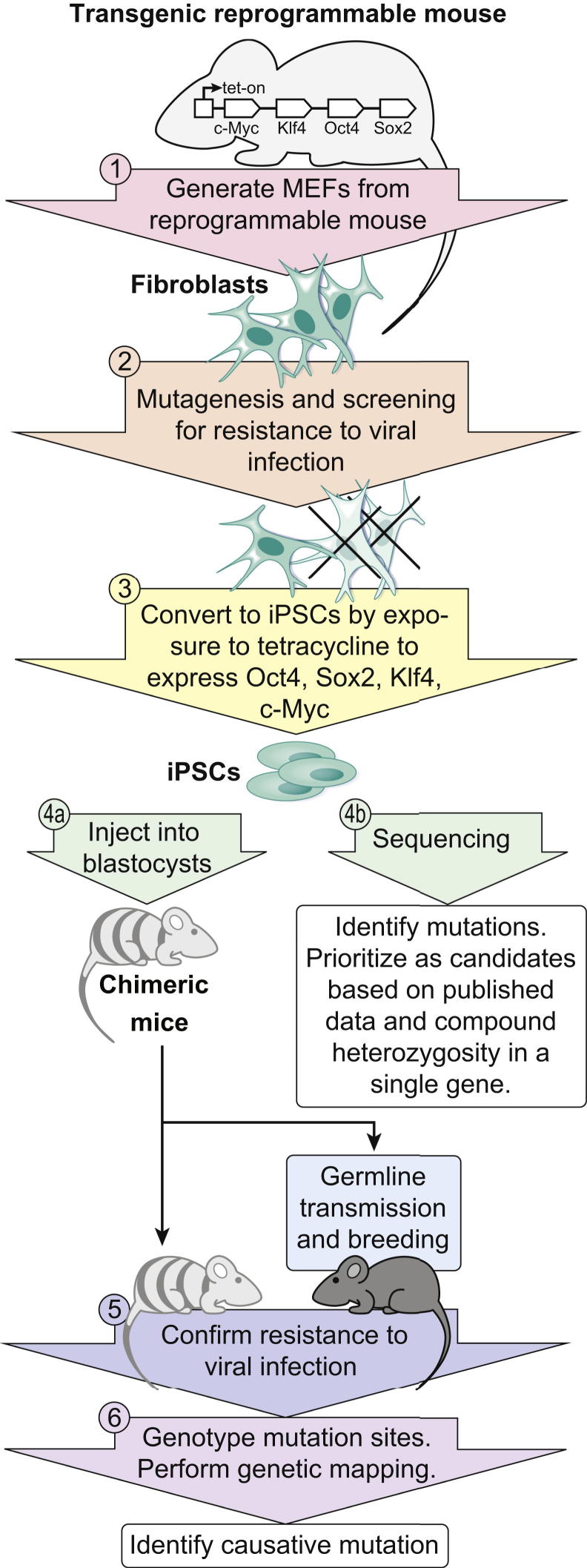
Somatic cell mutagenesis and recovery of mutations in iPSCs. Somatic cells, such as fibroblasts, derived from transgenic reprogrammable mice that inducibly express Oct4, Sox2, Klf4, and c-Myc (1) are mutagenized and then screened for phenotypes of interest, such as resistance to viral infection (2). Surviving cells are converted to iPSCs (3) and used to generate chimeric mice (4a). Resistance to viral infection is tested in chimeric mice or in mice fully derived from the germline-transmitted iPS clone (5). iPSCs are also sequenced to identify all induced mutations (4b). The causative mutation can be identified by genotyping fully iPSC-derived mice at all mutation sites and examining segregation patterns for concordance of the phenotype with homozygosity for a particular mutation (6). For a recessive phenotype, any single gene that sustained compound heterozygous mutations in the iPSCs is a strong candidate for causation. Other genes may be prioritized as candidates for causation based on published information on function/phenotype.
Figure 4
Figure 4
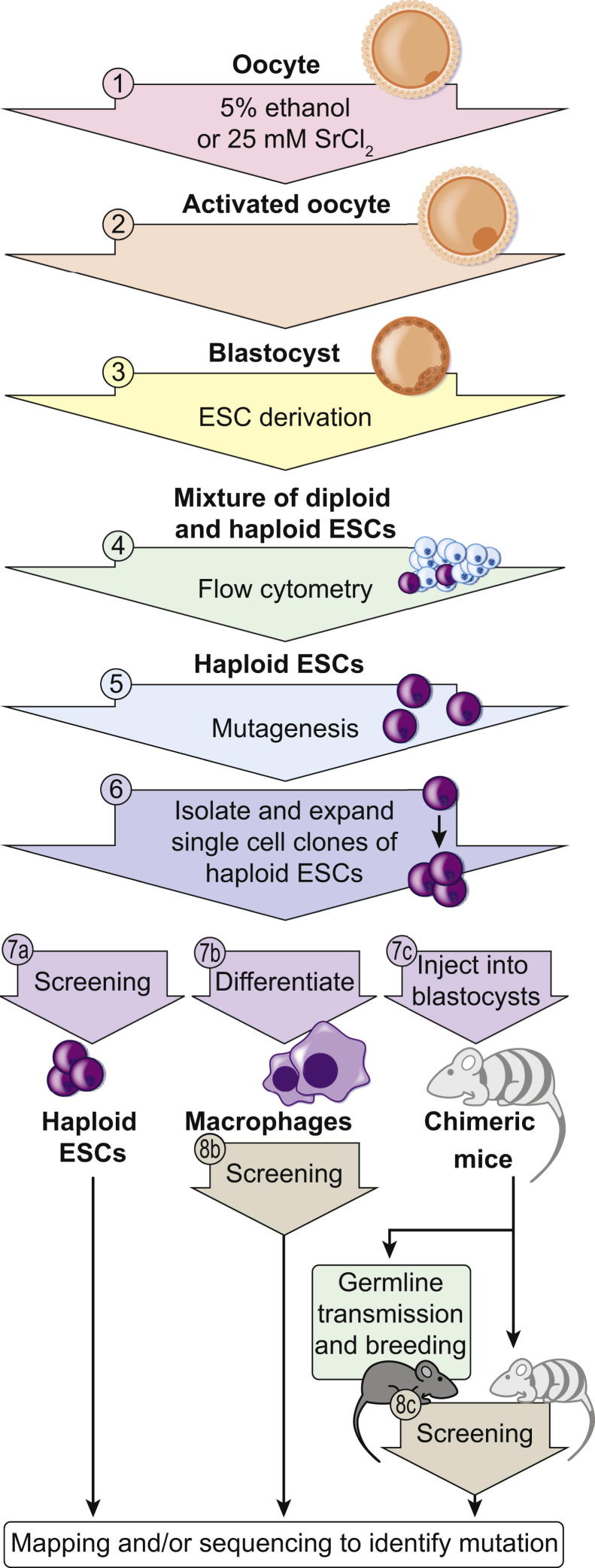
Use of mouse haploid ESCs for forward genetics. The first four steps are for the derivation of haploid ESCs, which can be mutagenized (5), such as with ENU or gene trap vectors. Single cell clones of mutagenized haploid ESCs can be expanded (6) and then screened for phenotypes of interest (7a). They may also be differentiated into specialized cell types, such as macrophages (7b), or injected into recipient blastocysts to generate chimeric mice (7c); both of these processes result in diploidization of the haploid ESCs. The resulting differentiated cells and chimeric mice thus carry the induced mutations in homozygous state, permitting screening for recessive phenotypes (8b and 8c). Mutations may be identified by mapping and/or sequencing as appropriate.

References

    1. Waterston R.H., Lindblad-Toh K., Birney E., Rogers J., Abril J.F., Agarwal P., Mouse Genome Sequencing Consortium Initial sequencing and comparative analysis of the mouse genome. Nature. 2002;420:520–562. - PubMed
    1. Church D.M., Goodstadt L., Hillier L.W., Zody M.C., Goldstein S., She X., Bult C.J., Agarwala R., Cherry J.L., DiCuccio M., Hlavina W., Kapustin Y., Meric P., Maglott D., Birtle Z., Marques A.C., Graves T., Zhou S., Teague B., Potamousis K., Churas C., Place M., Herschleb J., Runnheim R., Forrest D., Amos-Landgraf J., Schwartz D.C., Cheng Z., Lindblad-Toh K., Eichler E.E., Ponting C.P., Mouse Genome Sequencing Consortium Lineage-specific biology revealed by a finished genome assembly of the mouse. PLoS Biol. 2009;7:e1000112. - PMC - PubMed
    1. Austin C.P., Battey J.F., Bradley A., Bucan M., Capecchi M., Collins F.S. The knockout mouse project. Nat Genet. 2004;36:921–924. - PMC - PubMed
    1. Skarnes W.C., von Melchner H., Wurst W., Hicks G., Nord A.S., Cox T., Young S.G., Ruiz P., Soriano P., Tessier-Lavigne M., Conklin B.R., Stanford W.L., Rossant J., International Gene Trap Consortium A public gene trap resource for mouse functional genomics. Nat Genet. 2004;36:543–544. - PMC - PubMed
    1. Andrews T.D., Whittle B., Field M.A., Balakishnan B., Zhang Y., Shao Y., Cho V., Kirk M., Singh M., Xia Y., Hager J., Winslade S., Sjollema G., Beutler B., Enders A., Goodnow C.C. Massively parallel sequencing of the mouse exome to accurately identify rare, induced mutations: an immediate source for thousands of new mouse models. Open Biol. 2012;2:120061. - PMC - PubMed

Publication types

LinkOut - more resources