


Health Care Provider Adoption of eHealth: Systematic Literature Review
- PMID: 23608679
- PMCID: PMC3628149
- DOI: 10.2196/ijmr.2468
Health Care Provider Adoption of eHealth: Systematic Literature Review
Abstract
Background: eHealth is an application of information and communication technologies across the whole range of functions that affect health. The benefits of eHealth (eg, improvement of health care operational efficiency and quality of patient care) have previously been documented in the literature. Health care providers (eg, medical doctors) are the key driving force in pushing eHealth initiatives. Without their acceptance and actual use, those eHealth benefits would be unlikely to be reaped.
Objective: To identify and synthesize influential factors to health care providers' acceptance of various eHealth systems.
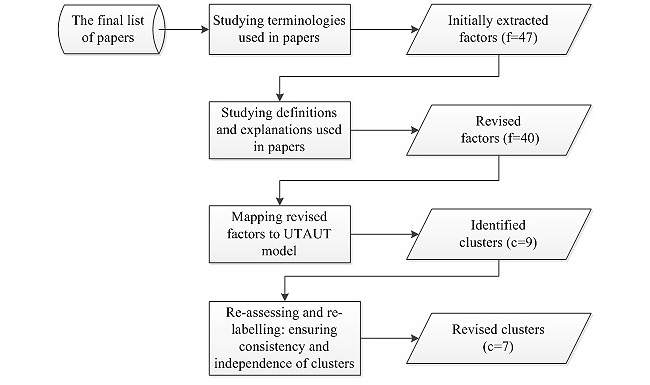
Methods: This systematic literature review was conducted in four steps. The first two steps facilitated the location and identification of relevant articles. The third step extracted key information from those articles including the studies' characteristics and results. In the last step, identified factors were analyzed and grouped in accordance with the Unified Theory of Acceptance and Use of Technology (UTAUT).
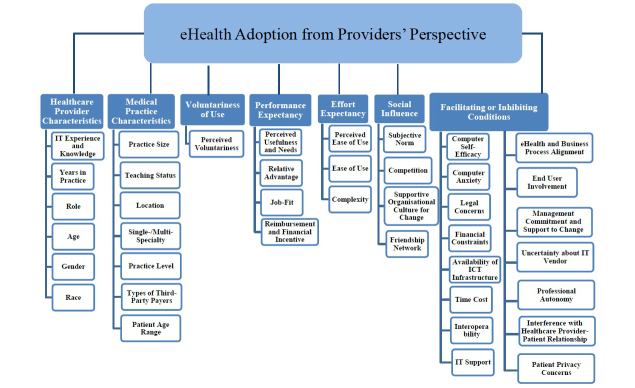
Results: This study included 93 papers that have studied health care providers' acceptance of eHealth. From these papers, 40 factors were identified and grouped into 7 clusters: (1) health care provider characteristics, (2) medical practice characteristics, (3) voluntariness of use, (4) performance expectancy, (5) effort expectancy, (6) social influence, and (7) facilitating or inhibiting conditions.
Conclusions: The grouping results demonstrated that the UTAUT model is useful for organizing the literature but has its limitations. Due to the complex contextual dynamics of health care settings, our work suggested that there would be potential to extend theories on information technology adoption, which is of great benefit to readers interested in learning more on the topic. Practically, these findings may help health care decision makers proactively introduce interventions to encourage acceptance of eHealth and may also assist health policy makers refine relevant policies to promote the eHealth innovation.
Conflict of interest statement
Conflicts of Interest: None declared.
Figures
References
-
- World Health Organization. [2013-03-21]. Global tuberculosis control: surveillance, planning, financing: WHO report 2008 http://www.who.int/tb/publications/global_report/2008/en/index.html.
-
- New Delhi: Central TB Division, DGHS, Ministry of Health and Family Welfare. [2013-03-21]. RNTCP Status report 2010 http://tbcindia.nic.in/pdfs/TB%20India%202010.pdf.
-
- Silber D. European Commission, Information Society, eHealth Conference. Atlanta, Belgium: 2003. [2013-03-21]. The case for ehealth http://ec.europa.eu/information_society/eeurope/ehealth/conference/2003/....
-
- Grieger DL, Cohen SH, Krusch DA. A pilot study to document the return on investment for implementing an ambulatory electronic health record at an academic medical center. J Am Coll Surg. 2007 Jul;205(1):89–96. doi: 10.1016/j.jamcollsurg.2007.02.074. http://www.sciencedirect.com.viviena.library.unsw.edu.au/science/journal... - DOI - PubMed
-
- Schade CP, Sullivan FM, de Lusignan S, Madeley J. e-Prescribing, efficiency, quality: lessons from the computerization of UK family practice. J Am Med Inform Assoc. 2006;13(5):470–5. doi: 10.1197/jamia.M2041. http://jamia.bmj.com/cgi/pmidlookup?view=long&pmid=16799129 - DOI - PMC - PubMed
LinkOut - more resources
Full Text Sources
Other Literature Sources
