


Attitudes of African Americans toward return of results from exome and whole genome sequencing
- PMID: 23610051
- PMCID: PMC3635144
- DOI: 10.1002/ajmg.a.35914
Attitudes of African Americans toward return of results from exome and whole genome sequencing
Abstract
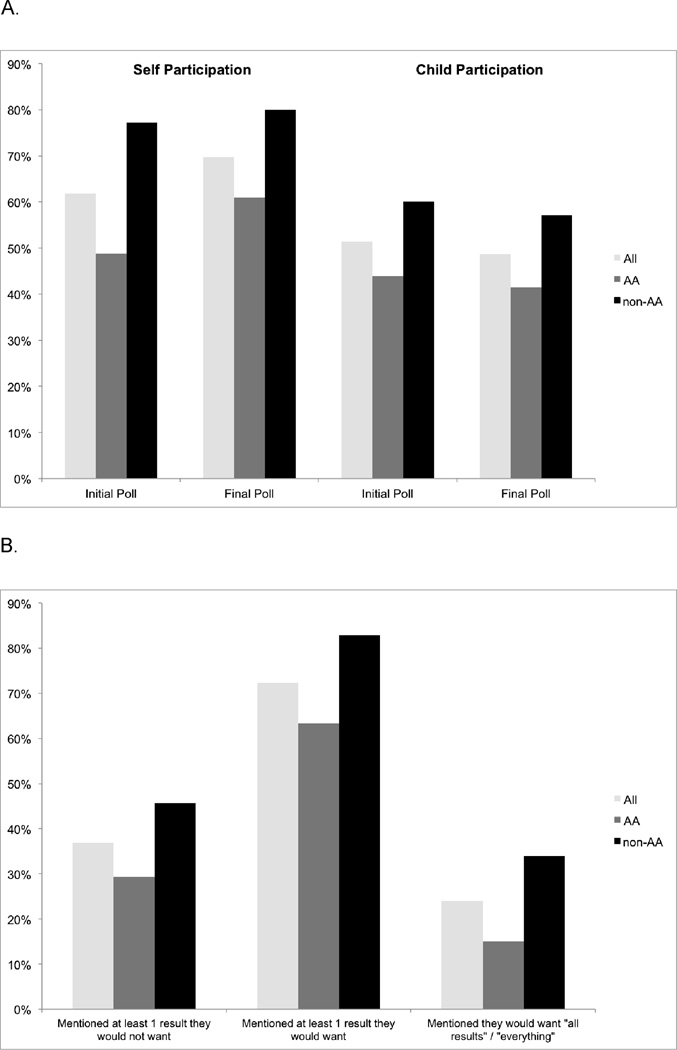
Exome sequencing and whole genome sequencing (ES/WGS) present patients and research participants with the opportunity to benefit from a broad scope of genetic results of clinical and personal utility. Yet, this potential for benefit also risks disenfranchising populations such as African Americans (AAs) that are already underrepresented in genetic research and utilize genetic tests at lower rates than other populations. Understanding a diverse range of perspectives on consenting for ES/WGS and receiving ES/WGS results is necessary to ensure parity in genomic health care and research. We conducted a series of 13 focus groups (n = 76) to investigate if and how attitudes toward participation in ES/WGS research and return of results from ES/WGS differ between self-described AAs and non-AAs. The majority of both AAs and non-AAs were willing to participate in WGS studies and receive individual genetic results, but the fraction not interested in either was higher in AAs. This is due in part to different expectations of health benefits from ES/WGS and how results should be managed. Our results underscore the need to develop and test culturally tailored strategies for returning ES/WGS results to AAs.
Copyright © 2013 Wiley Periodicals, Inc.
Conflict of interest statement
We have no conflicts of interest to disclose.
Figures
References
-
- American College of Medical Genetics and Genomics. Policy Statement Points to Consider in the Clinical Application of Genomics Sequencing. 2012
-
- Armstrong K, Micco E, Carney A, Stopfer J, Putt M. Racial differences in the use of BRCA1/2 testing among women with a family history of breast or ovarian cancer. JAMA. 2005;293(14):1729–1736. - PubMed
-
- Bamshad MJ, Ng SB, Bigham AW, Tabor HK, Emond MJ, Nickerson DA, Shendure J. Exome sequencing as a tool for Mendelian disease gene discovery. Nat Rev Genet. 2011;12(11):745–755. - PubMed
-
- Bamshad MJ, Shendure JA, Valle D, Hamosh A, Lupski JR, Gibbs RA, Boerwinkle E, Lifton RP, Gerstein M, Gunel M, Mane S, Nickerson DA Centers for Mendelian Genomics. The Centers for Mendelian Genomics: A new large-scale initiative to identify the genes underlying rare Mendelian conditions. Am J Med Genet A. 2012;158A(7):1523–1525. - PMC - PubMed
Publication types
MeSH terms
Grants and funding
LinkOut - more resources
Full Text Sources
Other Literature Sources
