


Temporal trends in survival among infants with critical congenital heart defects
- PMID: 23610203
- PMCID: PMC4471949
- DOI: 10.1542/peds.2012-3435
Temporal trends in survival among infants with critical congenital heart defects
Abstract
Objective: To evaluate the trends in survival for infants with critical congenital heart defects (CCHDs) and to examine the potential impact of timing of diagnosis and other prognostic factors on survival.
Methods: We performed a retrospective population-based cohort study in infants born with structural congenital heart defects (CHDs) between 1979 and 2005 and ascertained by the Metropolitan Atlanta Congenital Defects Program. We estimated Kaplan-Meier survival probabilities for 12 CCHD phenotypes by birth era and timing of diagnosis among infants without noncardiac defects or chromosomal disorders and used stratified Cox proportional hazards models to assess potential prognostic factors.
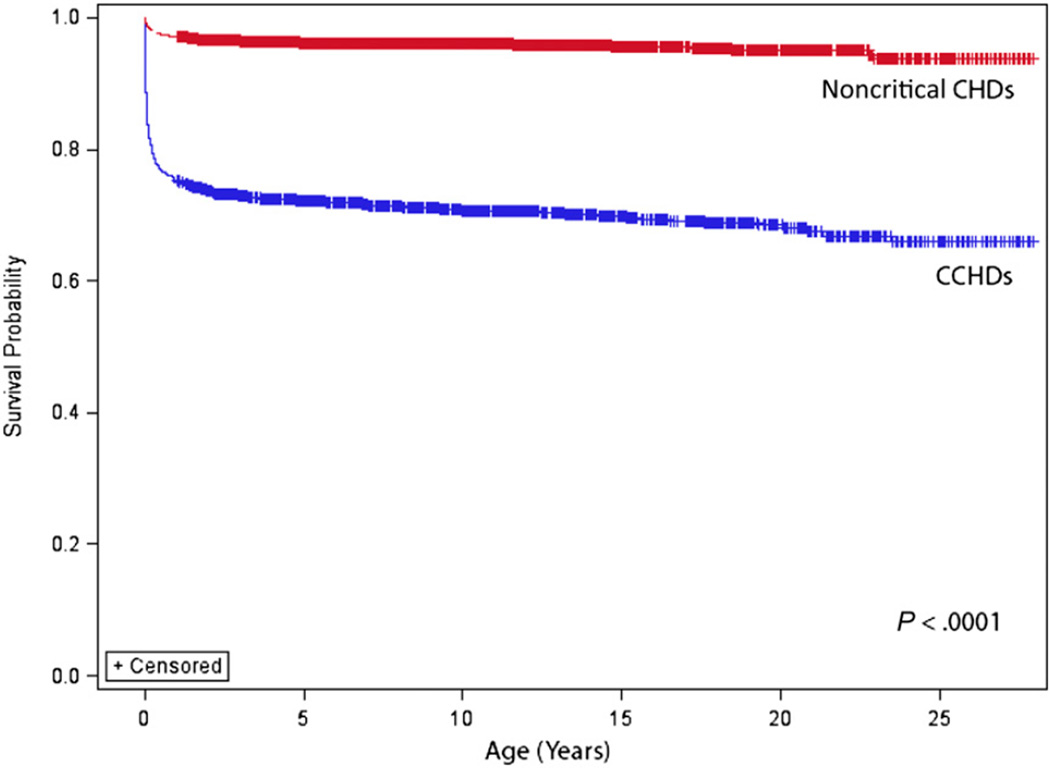
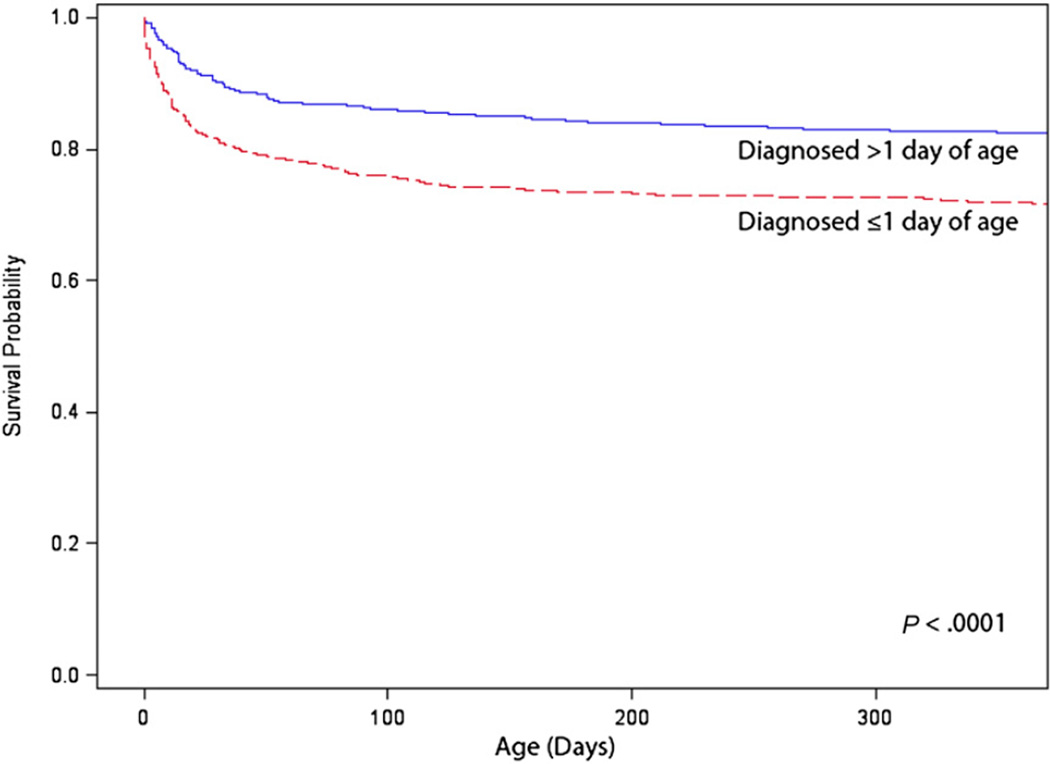
Results: Of 1 056 541 births, there were 6965 infants with CHDs (1830 with CCHDs). One-year survival was 75.2% for those with CCHDs (n = 1336) vs 97.1% for those with noncritical CHDs (n = 3530; P < .001). One-year survival for infants with CCHDs improved from 67.4% for the 1979-1993 birth era to 82.5% for the 1994-2005 era (P < .001). One-year survival was 71.7% for infants with CCHDs diagnosed at ≤1 day of age (n = 890) vs 82.5% for those with CCHDs diagnosed at >1 day of age (n = 405; P < .001). There was a significantly higher risk of 1-year mortality for infants with an earlier birth era, earlier diagnosis, and low birth weight and whose mothers were <30 years old.
Conclusions: One-year survival for infants with CCHDs has been improving over time, yet mortality remains high. Later diagnosis is associated with improved 1-year survival. These benchmark data and identified prognostic factors may aid future evaluations of the impact of pulse oximetry screening on survival from CCHDs.
Keywords: congenital heart disease/defects; epidemiology; neonatal; pulse oximetry; screening; survival rate.
Figures
References
-
- Botto LD, Correa A, Erickson JD. Racial and temporal variations in the prevalence of heart defects. Pediatrics. 2001;107(3):E32. Available at: www.pediatrics.org/cgi/content/full/107/3/e32. - PubMed
-
- Bonnet D, Coltri A, Butera G, et al. Detection of transposition of the great arteries in fetuses reduces neonatal morbidity and mortality. Circulation. 1999;99(7):916–918. - PubMed
-
- Soongswang J, Adatia I, Newman C, Smallhorn JF, Williams WG, Freedom RM. Mortality in potential arterial switch candidates with transposition of the great arteries. J Am Coll Cardiol. 1998;32(3):753–757. - PubMed
-
- Kuehl KS, Loffredo CA, Ferencz C. Failure to diagnose congenital heart disease in infancy. Pediatrics. 1999;103(4 Pt 1):743–747. - PubMed
Publication types
MeSH terms
Grants and funding
LinkOut - more resources
Full Text Sources
Other Literature Sources
Medical
