. 2013 May 7;110(19):7636-41.
doi: 10.1073/pnas.1215966110. Epub 2013 Apr 22.

Synthesis of customized petroleum-replica fuel molecules by targeted modification of free fatty acid pools in Escherichia coli

Affiliations

Synthesis of customized petroleum-replica fuel molecules by targeted modification of free fatty acid pools in Escherichia coli

Thomas P Howard et al. Proc Natl Acad Sci U S A. .

Abstract

Biofuels are the most immediate, practical solution for mitigating dependence on fossil hydrocarbons, but current biofuels (alcohols and biodiesels) require significant downstream processing and are not fully compatible with modern, mass-market internal combustion engines. Rather, the ideal biofuels are structurally and chemically identical to the fossil fuels they seek to replace (i.e., aliphatic n- and iso-alkanes and -alkenes of various chain lengths). Here we report on production of such petroleum-replica hydrocarbons in Escherichia coli. The activity of the fatty acid (FA) reductase complex from Photorhabdus luminescens was coupled with aldehyde decarbonylase from Nostoc punctiforme to use free FAs as substrates for alkane biosynthesis. This combination of genes enabled rational alterations to hydrocarbon chain length (Cn) and the production of branched alkanes through upstream genetic and exogenous manipulations of the FA pool. Genetic components for targeted manipulation of the FA pool included expression of a thioesterase from Cinnamomum camphora (camphor) to alter alkane Cn and expression of the branched-chain α-keto acid dehydrogenase complex and β-keto acyl-acyl carrier protein synthase III from Bacillus subtilis to synthesize branched (iso-) alkanes. Rather than simply reconstituting existing metabolic routes to alkane production found in nature, these results demonstrate the ability to design and implement artificial molecular pathways for the production of renewable, industrially relevant fuel molecules.

Keywords: branched fatty acid biosynthesis; lux genes; metabolic engineering; synthetic biology.


Conflict of interest statement

The authors declare no conflict of interest.

Figures
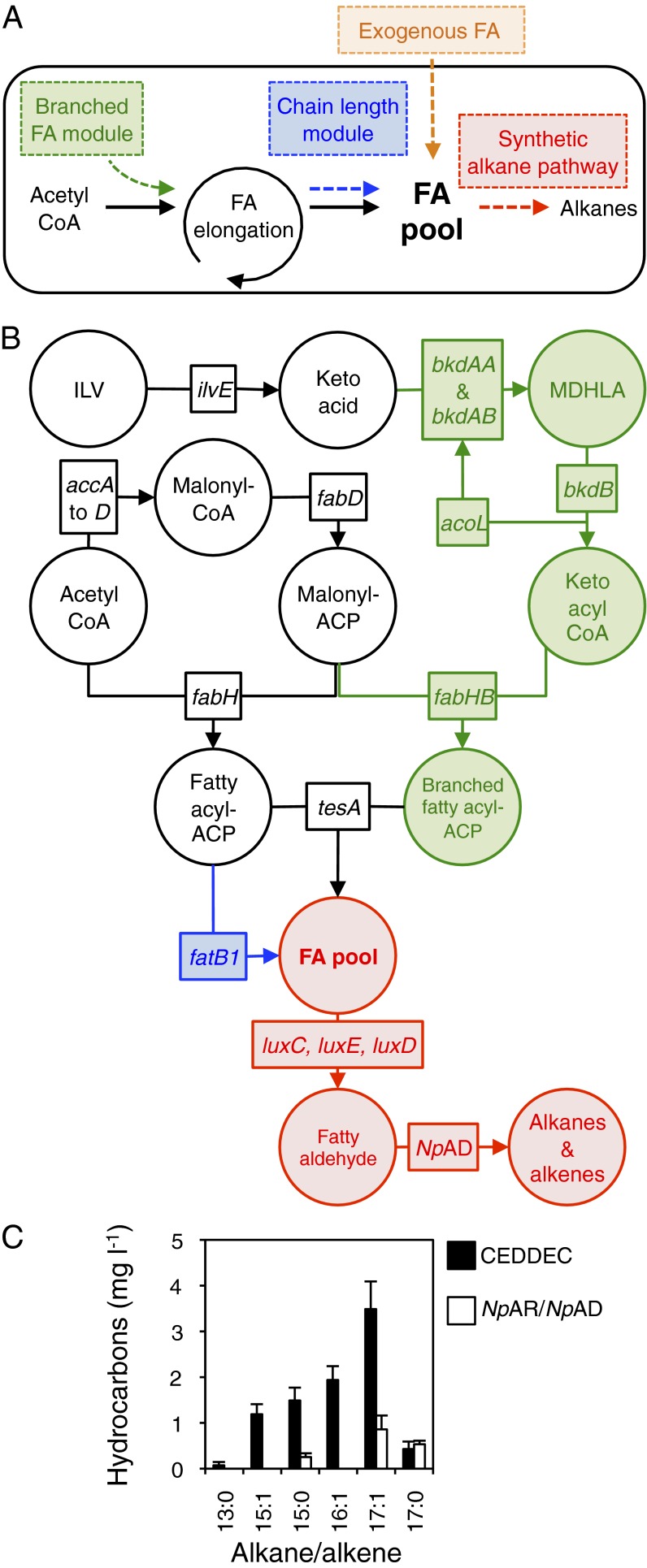
Fig. 1.
Fig. 1.
Production of fuel-grade alkanes from FAs by engineered E. coli. (A) Overview: three independent modifications to the FA pool (two genetic and one by exogenous supplementation) resulted in predictable changes to the output of cells engineered to produce alkane fuels via the artificial pathway. (B) Details of the genetic modifications implemented: the synthetic alkane biosynthetic pathway (red) was engineered through the coexpression of the reductase (luxC), synthetase (luxE), and transferase (luxD) genes coding for the FAR complex from the P. luminescens luciferase operon and the gene encoding NpAD. For construct details, see Fig. S1. Branched-chain FAs (green) were produced by expression of genes coding for the BCKD complex (bkdAA, bkdAB, bkdB, and acoL, which code for E1α, E1β, E2, and E3 subunits, respectively) and fabHB encoding KASIII. Isoleucine, leucine, and valine (ILV) can be converted to α-keto acids through endogenous branched-chain amino acid aminotransferase activity (encoded by ilvE). MDHLA represents either S-(3-methylbutanoyl)-dihydrolipoamide E, S-(2-methylpropanoyl)-dihdrolipoamide E, or S-(2-methylbutanoyl)-dihydrolipoamide E, the products of isoleucine, leucine, or valine breakdown, respectively (Fig. S2). The E1α, E1β, and E2 subunits convert keto acids to keto acyl-CoA, whereas the E3 subunit recycles the lipoamide-E cofactor. All branched-chain components were from B. subtilis. FA chain length was altered through expression of the FatB1 thioesterase from C. camphora (blue). (C) Hydrocarbons produced by cells expressing the synthetic alkane pathway (CEDDEC) or the cyanobacterial alkane pathway (AR and AD from N. punctiforme) without modifications to the fatty acid pool. n = 6 biological replicates; error bars represent SE of mean. Cells were grown and induced as detailed in Experimental Procedures.
Fig. 2.
Fig. 2.
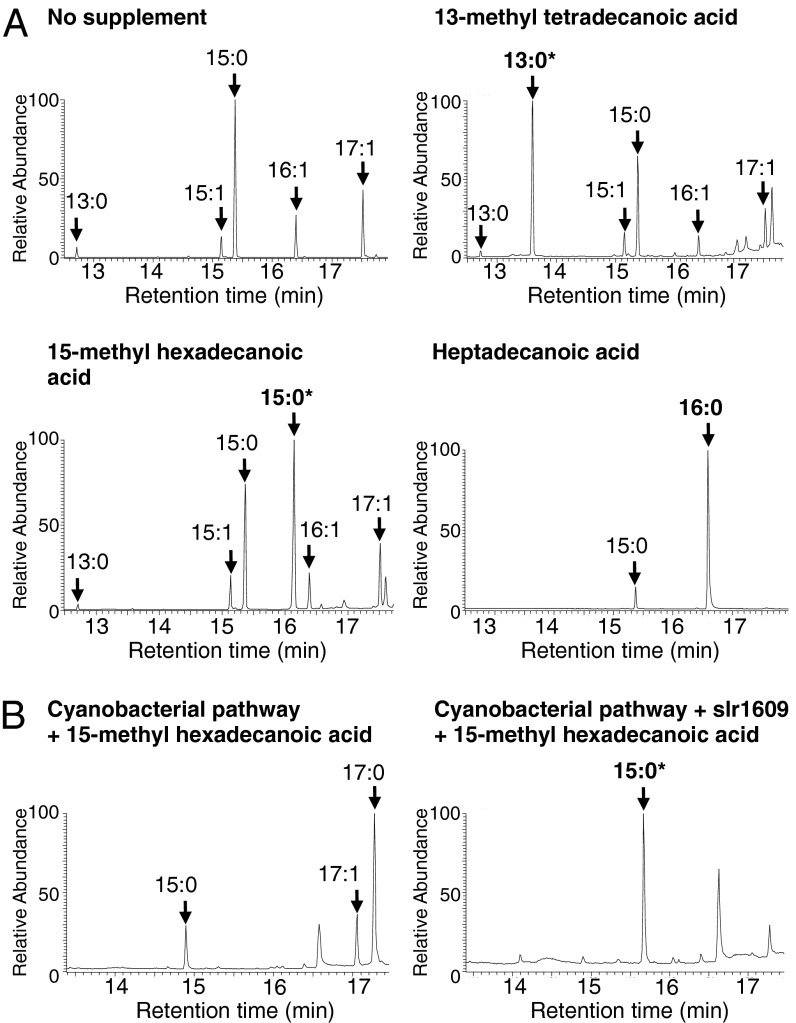
Predictable modifications to the alkane output from engineered E. coli cells in media supplemented with exogenous fatty acids. (A) Typical GC-MS total ion chromatograms (TIC) of alkanes extracted from E. coli cells that express the CEDDEC pathway, grown and induced as described in Experimental Procedures with 100 μg⋅mL−1 FA supplementation as indicated. *Branched alkane products. Branched alkanes were identified by retention time and comparison with the mass spectral library. Branched alkanes are more likely to fragment at the position where the branch is located, giving a smaller molecular ion (e.g., m/z 197 is indicative of methyl pentadecane) with a larger molecular ion peak than straight chain alkanes. Total alkanes recovered: CEDDEC, 5.8 mg⋅L−1 ± 0.3; 13-methyl tetradecanoic acid supplement, 5.9 mg⋅L−1 ± 0.3; 15-methyl hexadecanoic acid supplement, 4.3 mg⋅L−1 ± 0.3; heptadecanoic acid supplement, 7.4 mg⋅L−1 ± 0.4. (B) GC-MS TIC of hydrocarbons extracted from E. coli cells expressing the cyanobacterial NpAR/NpAD pathway alone (Left) or in conjunction with the cyanobacterial (Synechocystis sp. PCC 6803) slr1609 ORF (Right). Cells were grown and induced as described in Experimental Procedures and supplemented with 100 μg⋅mL−1 15-methyl hexadecanoic acid. Total alkanes recovered: cyanobacterial pathway alone, 1.5 mg⋅L−1 ± 0.03; in combination with slr1609, 0.8 mg⋅L−1 ± 0.02.
Fig. 3.
Fig. 3.
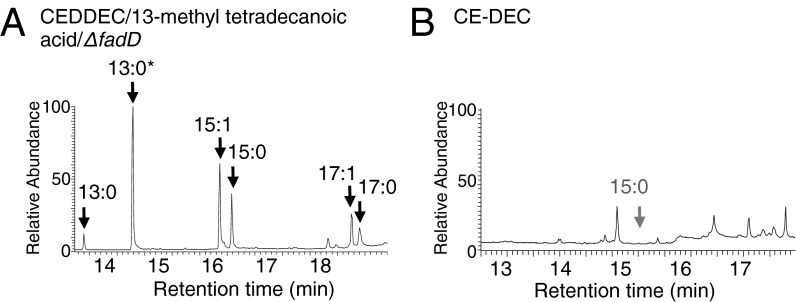
LuxD is an essential component of the artificial alkane biosynthetic (CEDDEC) pathway. (A) GC-MS TIC of hydrocarbons extracted from E. coli cells expressing CEDDEC in ΔfadD BL21* (DE3) in the presence of 100 μg⋅mL−1 13-methyl tetradecanoic acid. (B) GC-MS TIC of hydrocarbons extracted from WT E. coli cells expressing CE-DEC (luxC, luxE, and NpAD with the luxD gene removed from the operon; Fig. S1). The absence of pentadecane is indicated by the gray arrow. All cells were grown and induced as described in Experimental Procedures.
Fig. 4.
Fig. 4.
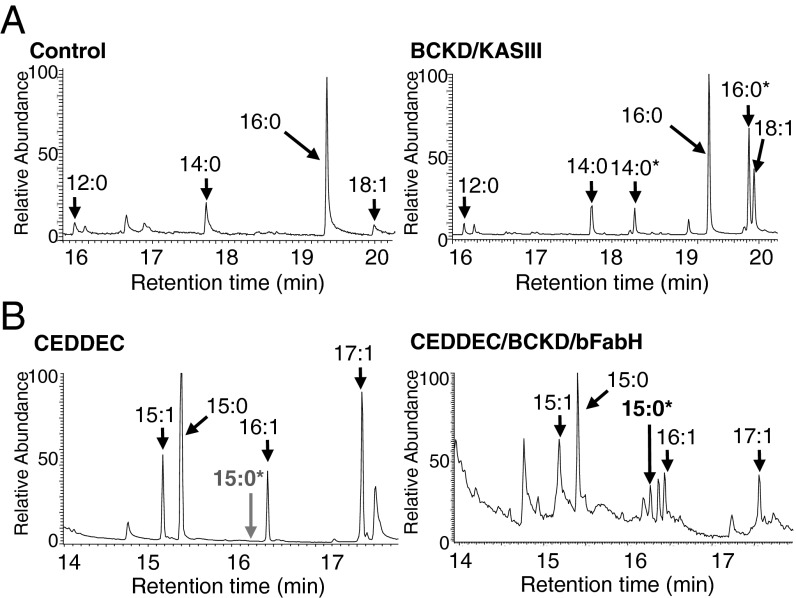
De novo production of branched fatty acids and alkanes in E. coli. (A) Typical GC-MS TIC of FAs extracted from control cells without BCKD/KASIII expression (Left) or from cells expressing BCKD/KASIII (Right). *Branched FA products [methyl tetradecanoic acid (14:0*) and methyl hexadecanoic acid (16:0*)]. Total FA recovered from control cells, 0.6 mg⋅L−1 ± 0.2 in control lines; for cells expressing BCKD/KASIII, 2.5 mg⋅L−1 ± 0.4. (B) Typical GC-MS TIC of alkanes extracted from control cells expressing CEDDEC (Left) and cells coexpressing BCKD/KASIII and CEDDEC (Right). *Branched alkane product [methyl pentadecane (15:0*) absent in CEDDEC]. Mass spectral data for methyl pentadecane are given in Fig. S3.
Fig. 5.
Fig. 5.
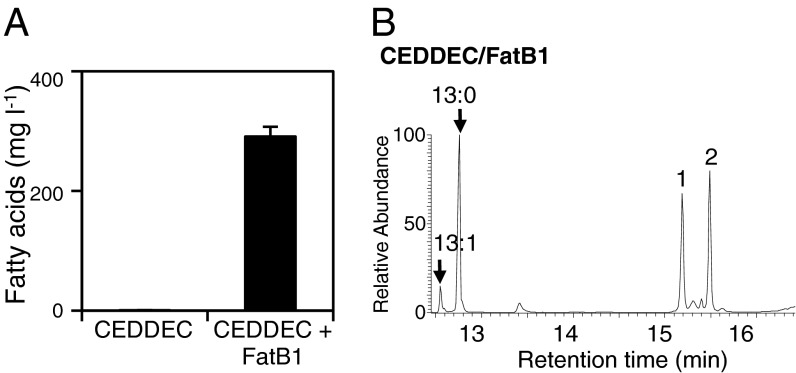
Production of tridecane in E. coli. (A) Total FAs extracted from cells expressing CEDDEC alone or CEDDEC in conjunction with the FatB1 thioesterase from C. camphora. n = 3 biological replicates; error bars represent SE of the mean. Cells were grown and induced as detailed in Experimental Procedures. Typical GC-MS TIC is given in Fig. S4. (B) Typical GC-MS TIC of hydrocarbons extracted from cells expressing CEDDEC and FatB1. Putative identification of trans-5-dodecanal or tetradecanal (peak 1) and tridecanone (peak 2) were identified in cells expressing FatB1 with and without CEDDEC. Mass spectral data for tridecane are given in Fig. S3. Total alkanes recovered from cells expressing CEDDEC/FatB1, 2.9 mg⋅L−1 ± 0.1.
Fig. 6.
Fig. 6.
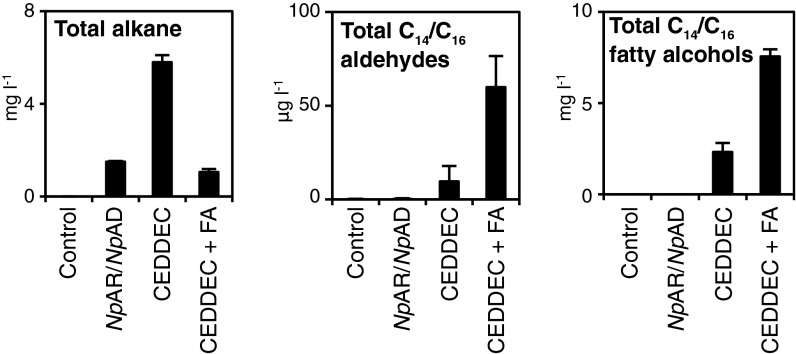
Identification of alkane biosynthesis limitations in the E. coli host. Total alkane, aldehyde (C14 and C16), and fatty alcohols (C14 and C16) extracted from control cells [BL21* (DE3)], cells expressing the cyanobacterial pathway (NpAR/NpAD), the artificial CEDDEC pathway, and the artificial CEDDEC pathway supplemented with tetradecanoic acid (+ FA). n = 3 biological replicates; error bars represent SE of the mean. Cells were grown and induced as detailed in Experimental Procedures.

Comment in

References

    1. International Energy Agency . Key World Statistics. Paris, France: 2011.
    1. International Energy Agency . World Energy Outlook. Paris, France: 2008.
    1. European Directive (2009) Council Directive (EC) 2009/28/EC of 23 April 2009 on the promotion of the use of energy from renewable sources and amending and subsequently repealing Directives 2001/77/EC and 2003/30/EC.
    1. National Renewable Energy Laboratory . Biodiesel Handling and User Guide. 4th Ed. US Department of Commerce: Oak Ridge, TN; 2009.
    1. Yuksel F, Yuksel B. The use of ethanol-gasoline blend as a fuel in an SI engine. Renew Energy. 2004;29:1181–1191.

Publication types

Associated data