. 2013 May 14;110(20):8194-9.
doi: 10.1073/pnas.1303037110. Epub 2013 Apr 22.

Bats are a major natural reservoir for hepaciviruses and pegiviruses

Affiliations

Bats are a major natural reservoir for hepaciviruses and pegiviruses

Phenix-Lan Quan et al. Proc Natl Acad Sci U S A. .

Abstract

Although there are over 1,150 bat species worldwide, the diversity of viruses harbored by bats has only recently come into focus as a result of expanded wildlife surveillance. Such surveys are of importance in determining the potential for novel viruses to emerge in humans, and for optimal management of bats and their habitats. To enhance our knowledge of the viral diversity present in bats, we initially surveyed 415 sera from African and Central American bats. Unbiased high-throughput sequencing revealed the presence of a highly diverse group of bat-derived viruses related to hepaciviruses and pegiviruses within the family Flaviridae. Subsequent PCR screening of 1,258 bat specimens collected worldwide indicated the presence of these viruses also in North America and Asia. A total of 83 bat-derived viruses were identified, representing an infection rate of nearly 5%. Evolutionary analyses revealed that all known hepaciviruses and pegiviruses, including those previously documented in humans and other primates, fall within the phylogenetic diversity of the bat-derived viruses described here. The prevalence, unprecedented viral biodiversity, phylogenetic divergence, and worldwide distribution of the bat-derived viruses suggest that bats are a major and ancient natural reservoir for both hepaciviruses and pegiviruses and provide insights into the evolutionary history of hepatitis C virus and the human GB viruses.


Conflict of interest statement

The authors declare no conflict of interest.

Figures
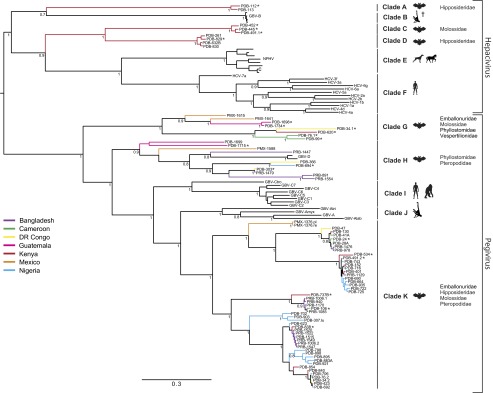
Fig. 1.
Fig. 1.
Bayesian phylogenetic tree of a 300-nt conserved region of the RdRp gene of the bat-derived viruses and selected members of the Hepacivirus and Pegivirus genera. The 83 bat-derived viruses identified in this study are shown along with the clade designations (A to K); an asterisk indicates viruses for which the near full-length genome was obtained. The countries of origin for the sequences generated in this study are indicated by the branch color; the host and the bat families associated with each clade are indicated next to the clade name. Bayesian posterior probabilities are shown only for nodes with significant support (>0.7). The scale bar indicates the average number of nucleotide substitutions per site. The virus names corresponding to the abbreviations and GenBank accession numbers are provided in SI Appendix, Table S10. C, canine hepacivirus; †, experimentally infected New World monkeys.
Fig. 2.
Fig. 2.
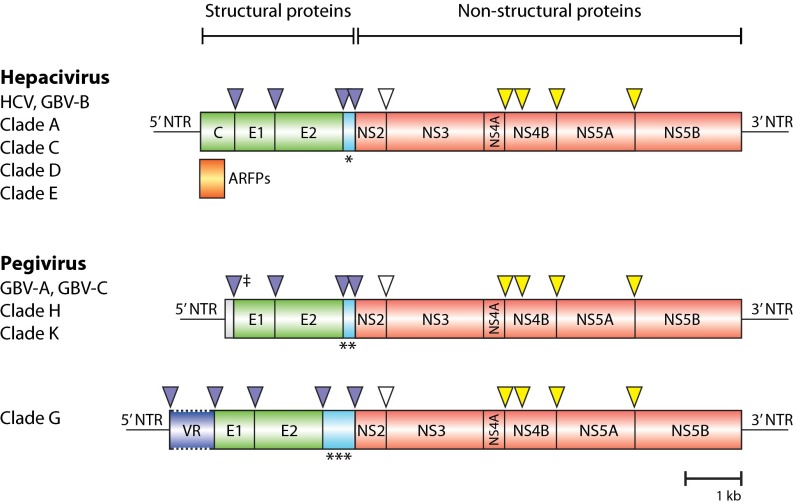
Comparison of the genome organization and putative proteomic map of the bat-derived viruses with representative members of the Hepacivirus and Pegivirus genera. The putative genomic organization of the bat-derived viruses is shown for each clade and was predicted using sequence comparisons with known hepaciviruses and pegiviruses. The HCV genomic RNA contains a unique ORF that encodes a precursor polyprotein that is cleaved by viral and cellular proteases into structural proteins [core (C), envelope glycoproteins (E1, E2)], and nonstructural proteins (NS2, NS3, NS4A, NS4B, NS5A, and NS5B). The HCV ARFPs are translated in an alternate reading frame overlapping C and represented in orange. The structural and nonstructural proteins are shown in green and red, respectively; the region between E2 and NS2 is shown in light blue, and the variable region (VR) identified in viruses from clade G is represented by the dark blue jagged box. Arrowheads indicate putative host peptidase (purple) and viral NS2-NS3 (white) and NS3-NS4A (yellow) peptidase cleavage sites. A predicted protein of 7–28 kDa is present between E2 and NS2 in the BHVs and BPgVs. *, HCV p7 (41, 42) and GBV-B p13 (43); **, predicted proteins of 21 kDa for GBV-A and 6 kDa for GBV-C (19); ***, predicted proteins of 27–28 kDa; NTR, nontranslated region; ‡, signal peptidase cleavage site predicted for GBV-C (19).
Fig. 3.
Fig. 3.
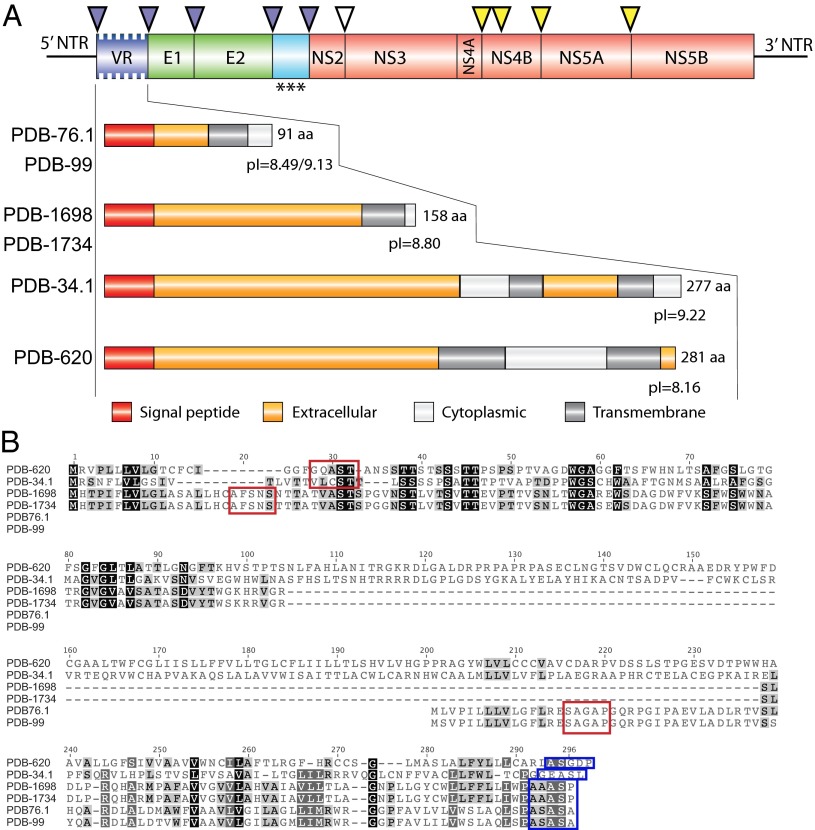
Schematic representation of the genomic organization of viruses from clade G. (A) Overall genomic organization and expanded diagram of the predicted variable region (VR). The putative gene products after polyprotein cleavage are indicated in green for the structural proteins, red for the nonstructural proteins, light blue for the region analogous to the HCV-p7, and dark blue for the variable region (VR). ***, predicted proteins of 27–28 kDa. (B) Amino acid sequence alignment of the predicted VR of viruses from clade G. Putative AUG initiator codons were chosen based on the presence of predicted signal peptidase cleavage sites identified 18–21 aa downstream as indicated in red open box. Predicted signal peptidase cleavage sites between VR and E1 are shown in blue open box. Strictly conserved and similar aa are indicated by black or gray shades, respectively.
Fig. 4.
Fig. 4.
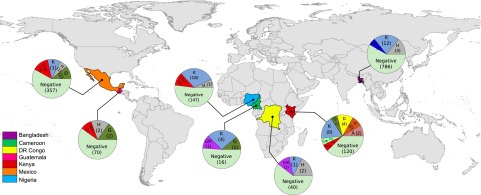
Geographic distribution of the bat-derived hepaciviruses and pegiviruses from specimens collected between 2007–2011. The proportion of the different clades of bat-derived hepaciviruses and pegiviruses is represented in pie charts for each country. Numbers of samples were log converted. The number of samples tested is indicated in parentheses. Map and pie charts were produced using the statistical software R (44).

References

    1. Jones KE, et al. Global trends in emerging infectious diseases. Nature. 2008;451(7181):990–993. - PMC - PubMed
    1. Teeling EC, et al. A molecular phylogeny for bats illuminates biogeography and the fossil record. Science. 2005;307(5709):580–584. - PubMed
    1. Zhang G, et al. Comparative analysis of bat genomes provides insight into the evolution of flight and immunity. Science. 2013;339(6118):456–460. - PMC - PubMed
    1. Newman SH, Field HE, de Jong CE, Epstein JH, editors. eds (2011) Investigating the Role of Bats in Emerging Zoonoses: Balancing Ecology, Conservation and Public Health Interests (FAO Animal Production and Health Manual No. 12) (Food and Agriculture Organization of the United Nations, Rome)
    1. Calisher CH, Childs JE, Field HE, Holmes KV, Schountz T. Bats: Important reservoir hosts of emerging viruses. Clin Microbiol Rev. 2006;19(3):531–545. - PMC - PubMed

Publication types