


Dynamic self-stiffening in liquid crystal elastomers
- PMID: 23612280
- PMCID: PMC3648875
- DOI: 10.1038/ncomms2772
Dynamic self-stiffening in liquid crystal elastomers
Abstract
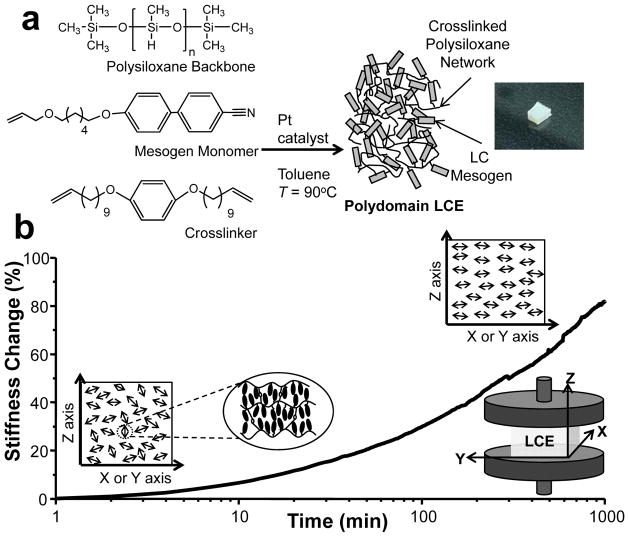
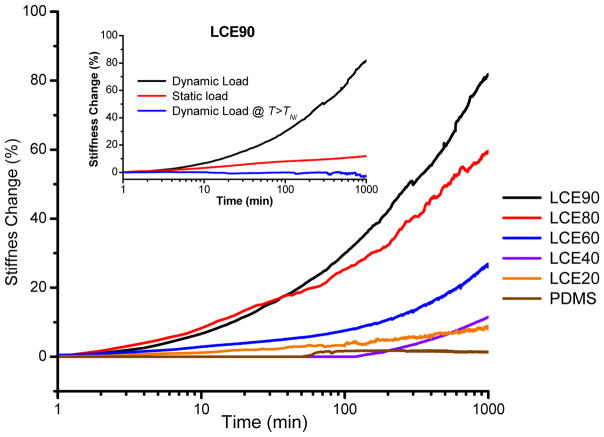
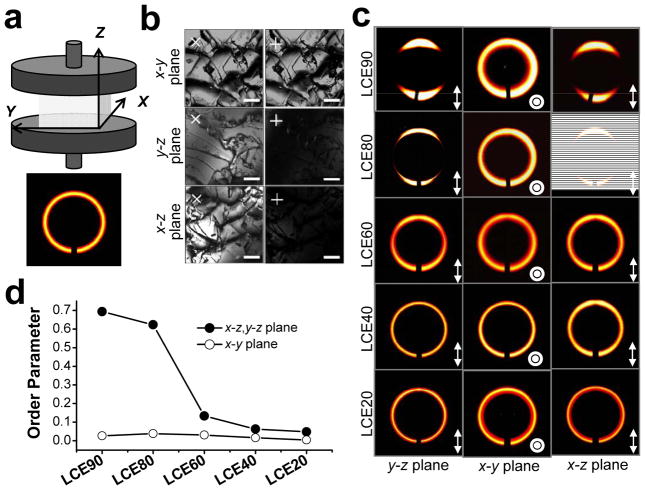
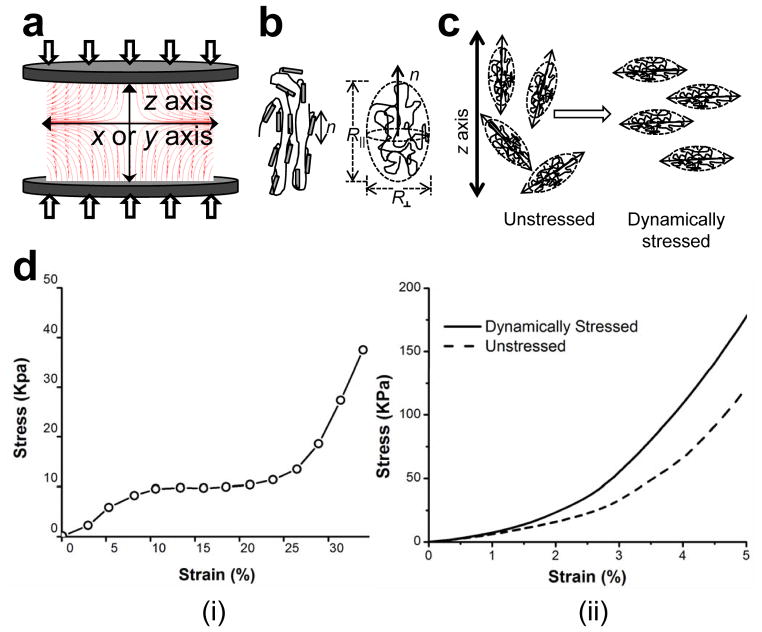
Biological tissues have the remarkable ability to remodel and repair in response to disease, injury and mechanical stresses. Synthetic materials lack the complexity of biological tissues, and man-made materials that respond to external stresses through a permanent increase in stiffness are uncommon. Here we report that polydomain nematic liquid crystal elastomers increase in stiffness by up to 90% when subjected to a low-amplitude (5%), repetitive (dynamic) compression. Elastomer stiffening is influenced by liquid crystal content, the presence of a nematic liquid crystal phase and the use of a dynamic as opposed to static deformation. Through rheological and X-ray diffraction measurements, stiffening can be attributed to a mobile nematic director, which rotates in response to dynamic compression. Stiffening under dynamic compression has not been previously observed in liquid crystal elastomers and may be useful for the development of self-healing materials or for the development of biocompatible, adaptive materials for tissue replacement.
Conflict of interest statement
The authors declare no competing financial interests.
Figures
References
-
- Fung YC. Biomechanics: Mechanical Properties of Living Tissues. 2. Springer; New York: 1993.
-
- Jones GW, Chapman SJ. Modeling growth in biological materials. Siam Rev. 2012;54:52–118.
-
- Humphrey JD. Review Paper: Continuum biomechanics of soft biological tissues. R Soc Lond Proc Ser A Math Phys Eng Sci. 2003;459:3–46.
-
- Cowin SC. Bone Mechanics Handbook. 2. CRC Press; Boca Raton: 2001.
-
- Helmlinger G, Netti PA, Lichtenbeld HC, Melder RJ, Jain RK. Solid stress inhibits the growth of multicellular tumor spheroids. Nat Biotechnol. 1997;15:778–783. - PubMed
Publication types
MeSH terms
Substances
Grants and funding
LinkOut - more resources
Full Text Sources
Other Literature Sources
