


Comment
doi: 10.1038/emboj.2013.94.
Epub 2013 Apr 23.
Control of Ig gene assembly: lessons from premature activation
Affiliations
- PMID: 23612612
- PMCID: PMC3655476
- DOI: 10.1038/emboj.2013.94
Item in Clipboard
Comment
Control of Ig gene assembly: lessons from premature activation
EMBO J.
.
Abstract
EMBO J (2013) 32 10, 1381–1392. doi:; DOI: 10.1038/emboj.2013.42
A new study by Bevington and Boyes reports that expression of the IRF4 transcription factor is sufficient to prematurely activate assembly of immunoglobulin light chain loci in pro-B cells. Using this in vivo model, they provide evidence that transcription-coupled disruption of nucleosome cores may be a key event in unlocking DNA substrates for recognition and assembly by V(D)J recombinase.
Conflict of interest statement
The authors declare that they have no conflict of interest.
Figures
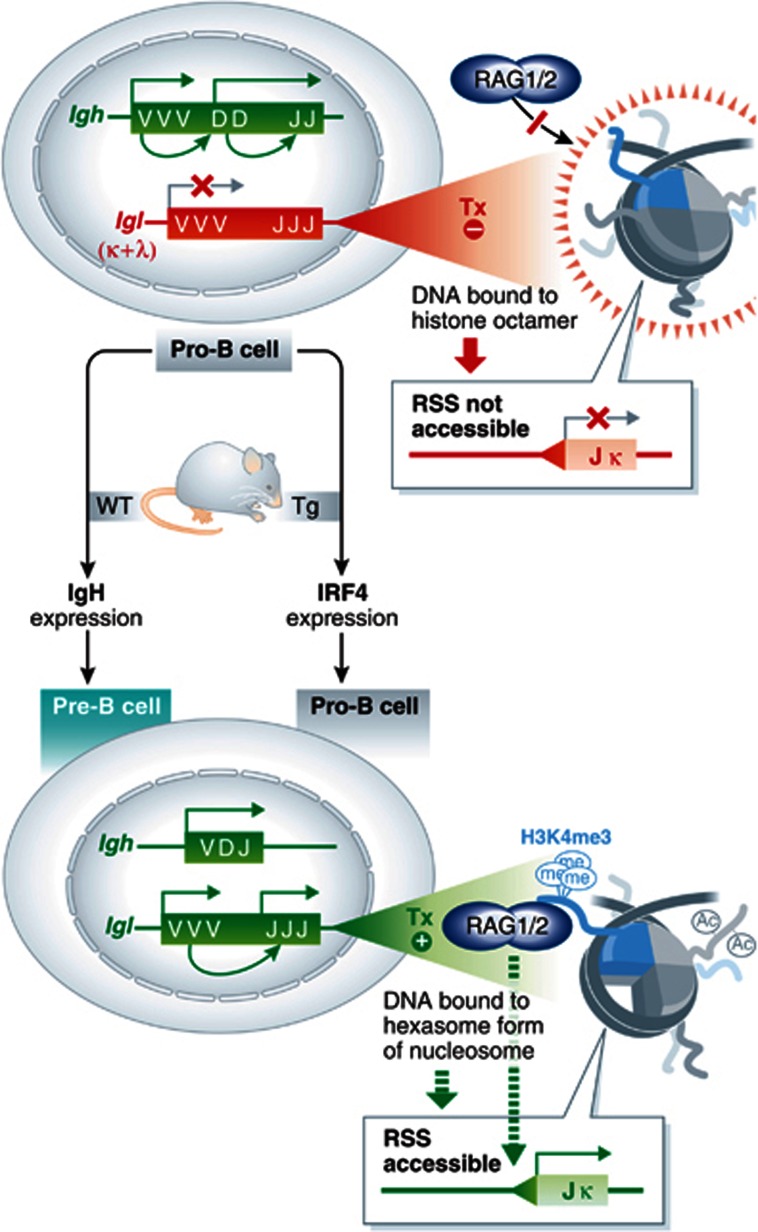
(Left) Developmental control of Ig gene rearrangements. Pro-B cells normally undergo Igh recombination (active, green), but repress assembly of Igk and Igl light chain genes (inactive, red). Upon functional assembly and expression of Igh, wild-type (WT, left arrow) pro-B cells differentiate into pre-B cells and activate Igk/l recombination. Bevington and Boyes show that the developmental block in Igk/l activation can be overcome by transgene-driven expression of IRF4 in pro-B cells (Tg, right arrow). (Right) Authors’ model of recombinase accessibility. RSSs (triangle) flanking Igk/l gene segments are transcriptionally inert (Tx –) in wild-type pro-B cells (top) and associate with conventional nucleosome octamers, which block access to the RAG complex. In pre-B cells or pro-B cells expressing IRF4, transcriptional activation decorates histone tails with acetylation (Ac) and H3K4me3, the latter of which serves as a platform for stable docking of RAG complexes. Transcription also leads to the expulsion of histone dimers, resulting in a hexasome form of nucleosomes, which may unmask RSSs for cleavage by RAG.
Comment on
-
Transcription-coupled eviction of histones H2A/H2B governs V(D)J recombination.EMBO J. 2013 May 15;32(10):1381-92. doi: 10.1038/emboj.2013.42. Epub 2013 Mar 5. EMBO J. 2013. PMID: 23463099 Free PMC article.
References
-
- Abarrategui I, Krangel MS (2006) Regulation of T cell receptor-alpha gene recombination by transcription. Nat Immunol 7: 1109–1115 - PubMed
-
- Cobb RM, Oestreich KJ, Osipovich OA, Oltz EM (2006) Accessibility control of V(D)J recombination. Adv Immunol 91: 45–109 - PubMed
-
- Feeney AJ (2009) Genetic and epigenetic control of V gene rearrangement frequency. Adv Exp Med Biol 650: 73–81 - PubMed
Publication types
MeSH terms
Substances
Grants and funding
LinkOut - more resources
Full Text Sources
Other Literature Sources
