


Putative pore-loops of TMEM16/anoctamin channels affect channel density in cell membranes
- PMID: 23613533
- PMCID: PMC3731609
- DOI: 10.1113/jphysiol.2013.251660
Putative pore-loops of TMEM16/anoctamin channels affect channel density in cell membranes
Abstract
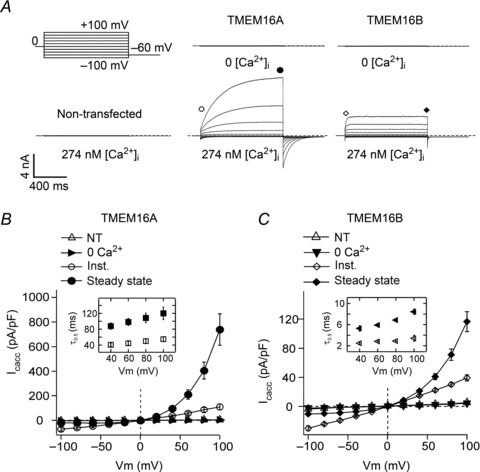
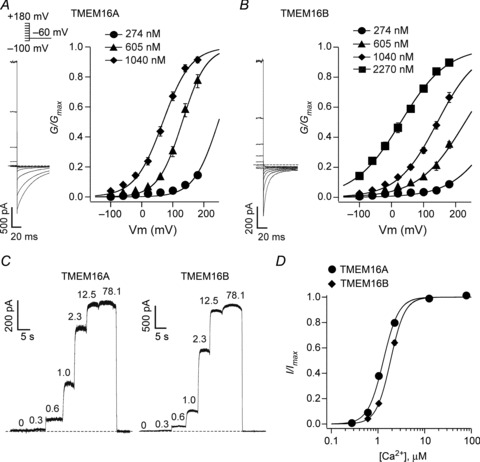
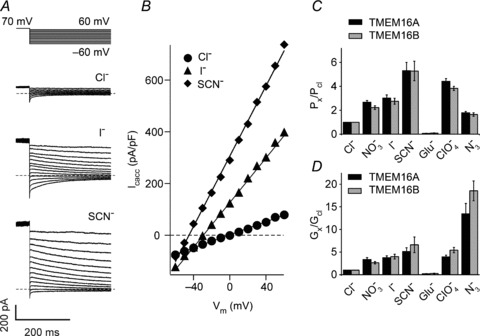
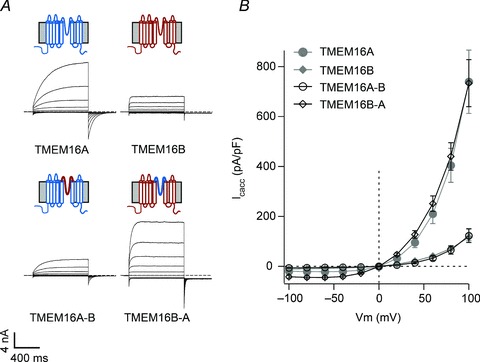
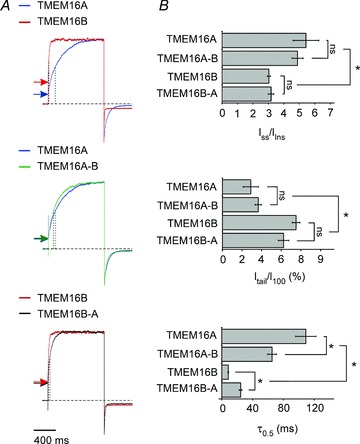
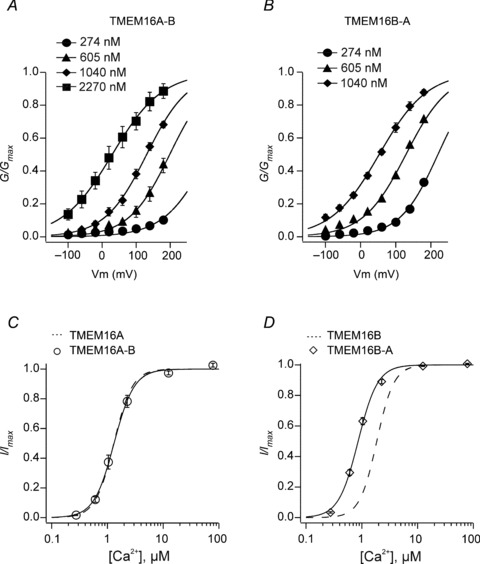
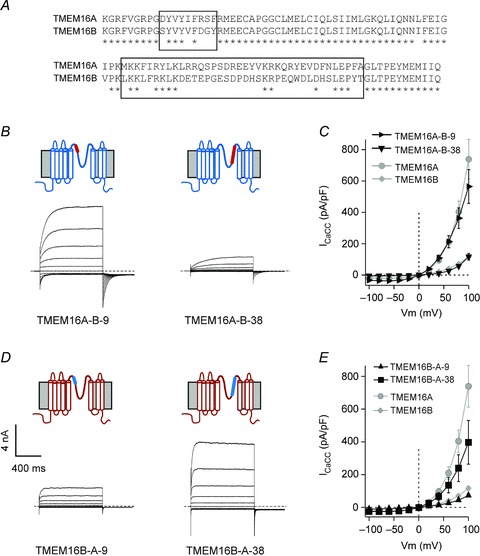
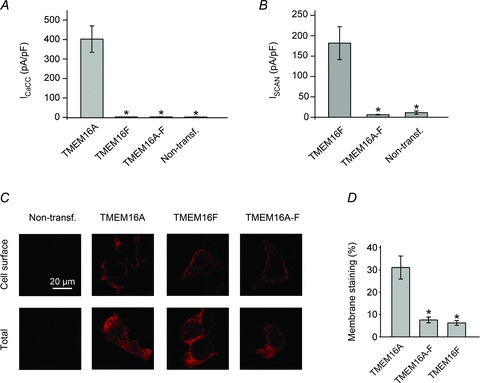
The recently identified TMEM16/anoctamin protein family includes Ca(2+)-activated anion channels (TMEM16A, TMEM16B), a cation channel (TMEM16F) and proteins with unclear function. TMEM16 channels consist of eight putative transmembrane domains (TMs) with TM5-TM6 flanking a re-entrant loop thought to form the pore. In TMEM16A this region has also been suggested to contain residues involved in Ca(2+) binding. The role of the putative pore-loop of TMEM16 channels was investigated using a chimeric approach. Heterologous expression of either TMEM16A or TMEM16B resulted in whole-cell anion currents with very similar conduction properties but distinct kinetics and degrees of sensitivity to Ca(2+). Furthermore, whole-cell currents mediated by TMEM16A channels were ∼six times larger than TMEM16B-mediated currents. Replacement of the putative pore-loop of TMEM16A with that of TMEM16B (TMEM16A-B channels) reduced the currents by ∼six-fold, while the opposite modification (TMEM16B-A channels) produced a ∼six-fold increase in the currents. Unexpectedly, these changes were not secondary to variations in channel gating by Ca(2+) or voltage, nor were they due to changes in single-channel conductance. Instead, they depended on the number of functional channels present on the plasma membrane. Generation of additional, smaller chimeras within the putative pore-loop of TMEM16A and TMEM16B led to the identification of a region containing a non-canonical trafficking motif. Chimeras composed of the putative pore-loop of TMEM16F transplanted into the TMEM16A protein scaffold did not conduct anions or cations. These data suggest that the putative pore-loop does not form a complete, transferable pore domain. Furthermore, our data reveal an unexpected role for the putative pore-loop of TMEM16A and TMEM16B channels in the control of the whole-cell Ca(2+)-activated Cl(-) conductance.
Figures

Comment in
-
Pore directions for the expression of a Ca2+-activated chloride channel.J Physiol. 2013 Jul 15;591(14):3453-4. doi: 10.1113/jphysiol.2013.258160. J Physiol. 2013. PMID: 23858040 Free PMC article. No abstract available.
References
-
- Barry PH, Lynch JW. Liquid junction potentials and small cell effects in patch-clamp analysis. J Membr Biol. 1991;121:101–117. - PubMed
-
- Bezanilla F. The voltage sensor in voltage-dependent ion channels. Physiol Rev. 2000;80:555–592. - PubMed
-
- Billig GM, Pal B, Fidzinski P, Jentsch TJ. Ca2+-activated Cl− currents are dispensable for olfaction. Nat Neurosci. 2011;14:763–769. - PubMed
Publication types
MeSH terms
Substances
Grants and funding
LinkOut - more resources
Full Text Sources
Other Literature Sources
Molecular Biology Databases
Miscellaneous
