


Comment
doi: 10.2337/db12-1839.
New insights and new conundrums in neonatal hypoglycemia: enigmas wrapped in mystery
Affiliations
- PMID: 23613554
- PMCID: PMC3636644
- DOI: 10.2337/db12-1839
Item in Clipboard
Comment
New insights and new conundrums in neonatal hypoglycemia: enigmas wrapped in mystery
Diabetes.
2013 May.
No abstract available
Figures
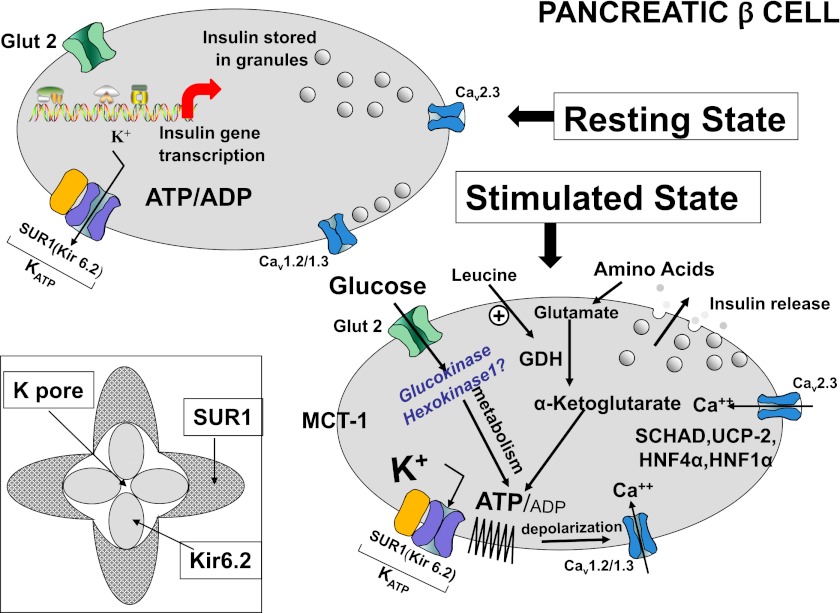
The question mark following hexokinase I indicates that the current article suggests but has not proven this mutation to be responsible for the syndrome described. Glucose and amino acids stimulate insulin release by generating ATP, which leads to closure of ATP-sensitive plasma membrane potassium channels, plasma membrane depolarization, activation of voltage-sensitive calcium channels, an increase of cytosolic calcium, and release of insulin from storage granules. Leucine is an allosteric activator of glutamate dehydrogenase that enables protein metabolism. Inactivating mutations in the KATP channel lead to closure and hence excessive unregulated insulin secretion causing hypoglycemia—these mutations may respond to diazoxide, an agent that promotes the opening of these channels. By contrast, activating mutations of the KATP keep the channel open, preventing insulin secretion and hence causing diabetes of varying degrees. These defects may be amenable to therapy with sulfonylureas that act on the sulfonylurea receptor 1 regulatory component to overcome the open state, induce closure, and hence restore insulin secretion. GDH, glutamate dehydrogenase; HK1, hexokinase I; HNF4α, hepatic nuclear factor 4α; HNF1α, hepatic nuclear factor 1α; Kir 6.2, inwardly rectifying potassium channel 6.2; MCT-1, monocarboxylic acid transporter 1; SCHAD, short-chain 3-OH acyl-CoA dehydrogenase; SUR1, sulfonylurea receptor 1; UCP2, uncoupling protein 2.
Comment on
-
Congenital hyperinsulinism caused by hexokinase I expression or glucokinase-activating mutation in a subset of β-cells.Diabetes. 2013 May;62(5):1689-96. doi: 10.2337/db12-1414. Epub 2012 Dec 28. Diabetes. 2013. PMID: 23274908 Free PMC article.
References
-
- Dekelbab BH, Sperling MA. Hypoglycemia in newborns and infants. Adv Pediatr 2006;53:5–22 - PubMed
-
- De León DD, Stanley CA. Mechanisms of Disease: advances in diagnosis and treatment of hyperinsulinism in neonates. Nat Clin Pract Endocrinol Metab 2007;3:57–68 - PubMed
-
- Murphy R, Ellard S, Hattersley AT. Clinical implications of a molecular genetic classification of monogenic beta-cell diabetes. Nat Clin Pract Endocrinol Metab 2008;4:200–213 - PubMed
Publication types
MeSH terms
Substances
LinkOut - more resources
Full Text Sources
Other Literature Sources
Miscellaneous
