


Associations between APOE genotypes and disease susceptibility, joint damage and lipid levels in patients with rheumatoid arthritis
- PMID: 23613766
- PMCID: PMC3629235
- DOI: 10.1371/journal.pone.0060970
Associations between APOE genotypes and disease susceptibility, joint damage and lipid levels in patients with rheumatoid arthritis
Abstract
Objective: Apolipoprotein E (APOE) genotypes are associated with cardiovascular disease (CVD) and lipid levels. In rheumatoid arthritis (RA), an association has been found with disease activity. We examined the associations between APOE genotypes and disease susceptibility and markers of disease severity in RA, including radiographic joint damage, inflammatory markers, lipid levels and cardiovascular markers.
Method: A Norwegian cohort of 945 RA patients and 988 controls were genotyped for two APOE polymorphisms. We examined longitudinal associations between APOE genotypes and C-reactive protein (CRP), erythrocyte sedimentation rate (ESR) as well as hand radiographs (van der Heijde Sharp Score(SHS)) in 207 patients with 10 year longitudinal data. Lipid levels, cardiovascular markers and history of CVD were compared across genotypes in a cross sectional study of 136 patients. Longitudinal radiological data of cohorts from Lund and Leiden were available for replication. (N = 935, with 4799 radiographs).
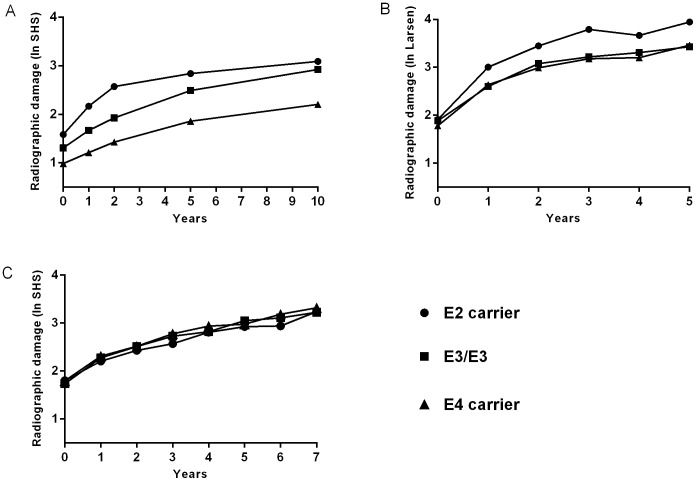
Results: In the Norwegian cohort, associations between APOE genotypes and total cholesterol (TC) and low-density lipoproteins (LDL) were observed (ε2 < ε3/ε3 < ε4, p = 0.03 and p = 0.02, respectively). No association was present for acute phase reactant or CVD markers, but a longitudinal linear association between APOE genotypes and radiographic joint damage was observed (p = 0.007). No association between APOE genotypes and the severity of joint destruction was observed in the Lund and Leiden cohorts, and a meta- analysis combining all data was negative.
Conclusion: APOE genotypes are associated with lipid levels in patients with RA, and may contribute to dyslipidemia in some patients. APOE genotypes are not consistently associated with markers of inflammation or joint destruction in RA.
Conflict of interest statement
Figures
References
-
- Marinou I, Maxwell JR, Wilson AG (2010) Genetic influences modulating the radiological severity of rheumatoid arthritis. Ann Rheum Dis. 69: 476–82. - PubMed
-
- van der Helm-van Mil AH, Kern M, Gregersen PK, Huizinga TW (2006) Variation in radiologic joint destruction in rheumatoid arthritis differs between monozygotic and dizygotic twins and pairs of unrelated patients. Arthritis Rheum. 54: 2028–30. - PubMed
-
- Odegard S, Landewe R, van der HD, Kvien TK, Mowinckel P, et al. (2006) Association of early radiographic damage with impaired physical function in rheumatoid arthritis: a ten-year, longitudinal observational study in 238 patients. Arthritis Rheum. 54: 68–75. - PubMed
-
- Welsing PM, van Gestel AM, Swinkels HL, Kiemeney LA, van Riel PL (2001) The relationship between disease activity, joint destruction, and functional capacity over the course of rheumatoid arthritis. Arthritis Rheum. 44: 2009–17. - PubMed
-
- Provan SA, Semb AG, Hisdal J, Stranden E, Agewall S, et al. (2011) Remission is the goal for cardiovascular risk management in patients with rheumatoid arthritis: a cross-sectional comparative study. Ann Rheum Dis. 70: 812–7. - PubMed
Publication types
MeSH terms
Substances
LinkOut - more resources
Full Text Sources
Other Literature Sources
Medical
Research Materials
Miscellaneous
