


Cascading effects of ocean acidification in a rocky subtidal community
- PMID: 23613994
- PMCID: PMC3628223
- DOI: 10.1371/journal.pone.0061978
Cascading effects of ocean acidification in a rocky subtidal community
Abstract
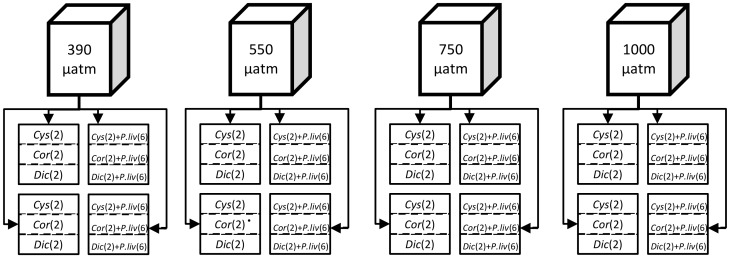
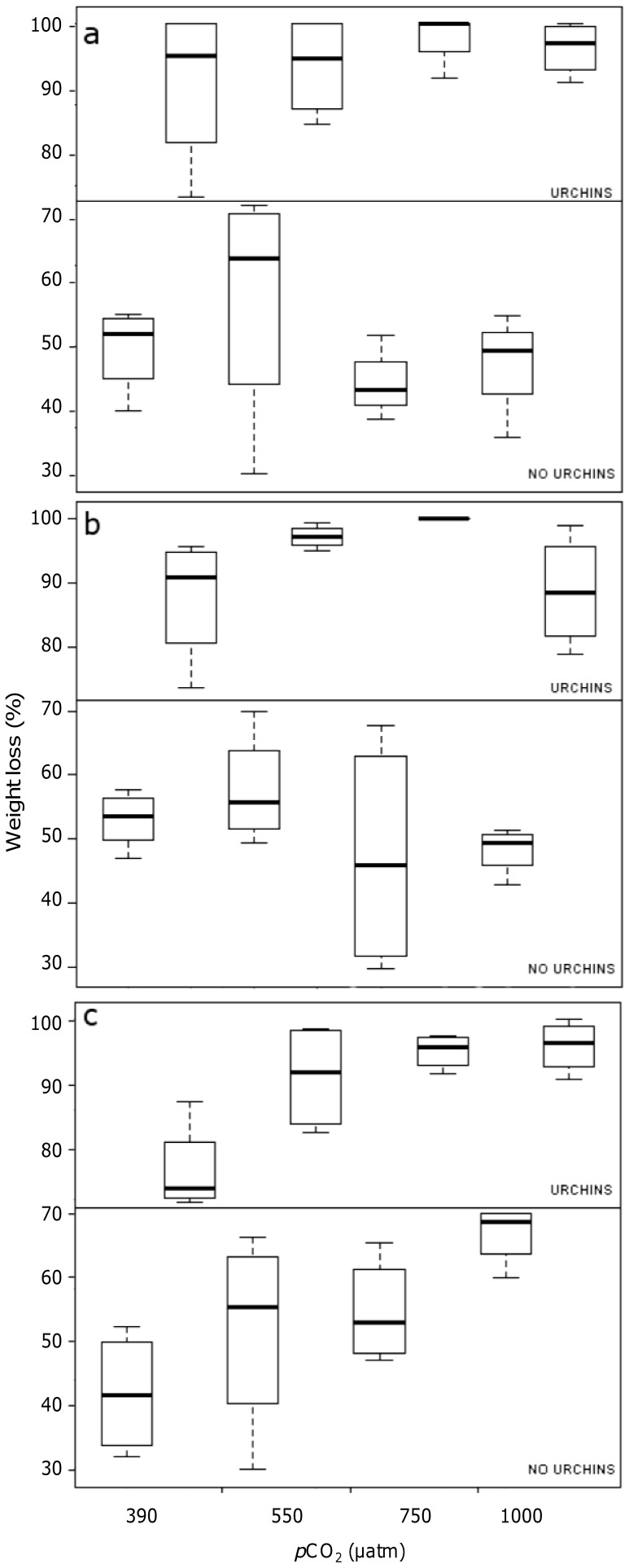
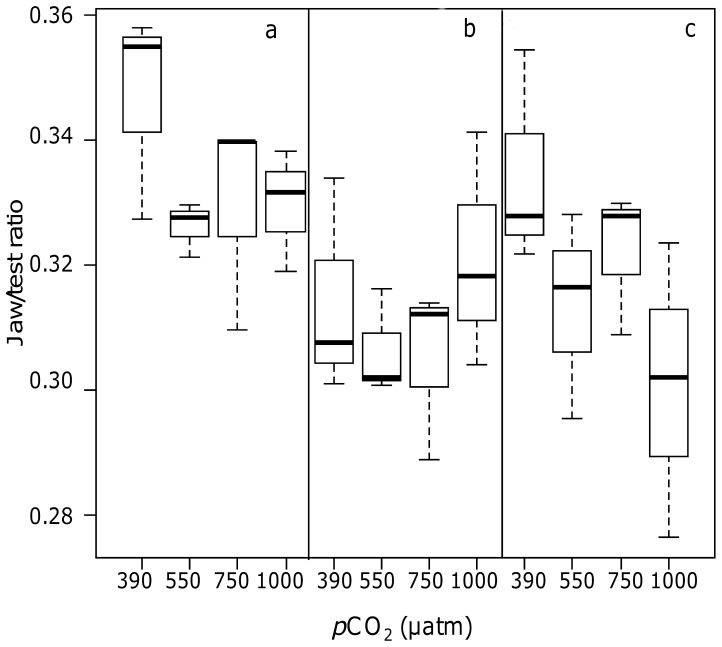
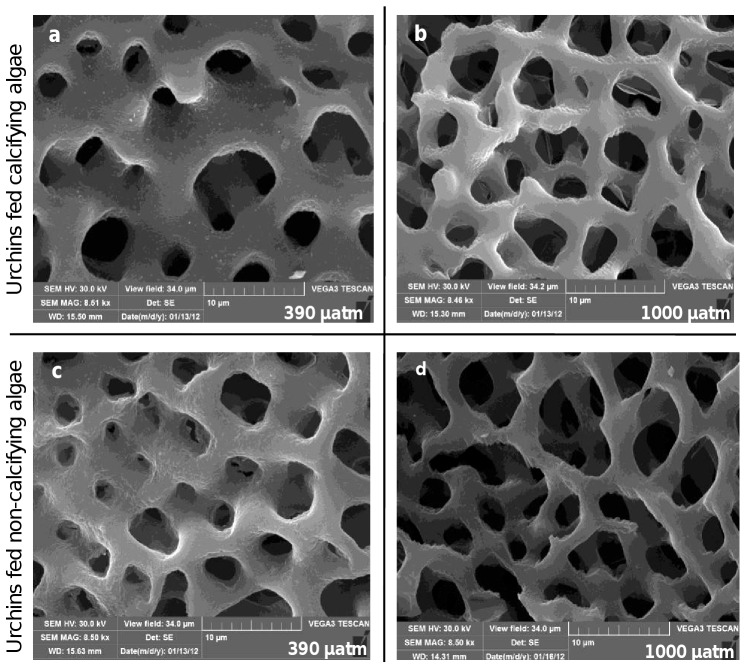
Temperate marine rocky habitats may be alternatively characterized by well vegetated macroalgal assemblages or barren grounds, as a consequence of direct and indirect human impacts (e.g. overfishing) and grazing pressure by herbivorous organisms. In future scenarios of ocean acidification, calcifying organisms are expected to be less competitive: among these two key elements of the rocky subtidal food web, coralline algae and sea urchins. In order to highlight how the effects of increased pCO2 on individual calcifying species will be exacerbated by interactions with other trophic levels, we performed an experiment simultaneously testing ocean acidification effects on primary producers (calcifying and non-calcifying algae) and their grazers (sea urchins). Artificial communities, composed by juveniles of the sea urchin Paracentrotus lividus and calcifying (Corallina elongata) and non-calcifying (Cystoseira amentacea var stricta, Dictyota dichotoma) macroalgae, were subjected to pCO2 levels of 390, 550, 750 and 1000 µatm in the laboratory. Our study highlighted a direct pCO2 effect on coralline algae and on sea urchin defense from predation (test robustness). There was no direct effect on the non-calcifying macroalgae. More interestingly, we highlighted diet-mediated effects on test robustness and on the Aristotle's lantern size. In a future scenario of ocean acidification a decrease of sea urchins' density is expected, due to lower defense from predation, as a direct consequence of pH decrease, and to a reduced availability of calcifying macroalgae, important component of urchins' diet. The effects of ocean acidification may therefore be contrasting on well vegetated macroalgal assemblages and barren grounds: in the absence of other human impacts, a decrease of biodiversity can be predicted in vegetated macroalgal assemblages, whereas a lower density of sea urchin could help the recovery of shallow subtidal rocky areas affected by overfishing from barren grounds to assemblages dominated by fleshy macroalgae.
Conflict of interest statement
Figures

References
-
- Keeling CD, Piper SC, Bollenbacher AF, Walker JS (2009) Atmospheric CO2 records from sites in the SIO air sampling network. Trends: A compendium of data on global change. Carbon Dioxide Information Analysis Center, Oak Ridge National Laboratory, U.S. Department of Energy, Oak Ridge, Tenn., USA.
-
- Gattuso J-P & Hansson L (2011) Ocean acidification: background and history. In: Gattuso J-P, Hansson L, editors. Ocean Acidification. Oxford University Press, Oxford. pp. 1–20.
-
- Orr JC (2011) Recent and future changes in ocean carbonate chemistry. In: Gattuso J-P, Hansson L, editors. Ocean Acidification. Oxford University Press, Oxford. pp. 41–66.
-
- Pörtner HO, Gutowska M, Ishimatsu A, Lucassen M, Melzner F et al.. (2011) Effects of ocean acidification on nektonic organisms. In: Gattuso J-P, Hansson L, editors. Ocean Acidification. Oxford University Press, Oxford.
-
- Gattuso JP, Allemand D, Frankignoulle M (1999) Photosynthesis and calcification at cellular, organismal and community levels in coral reefs: a review on interactions and control by carbonate chemistry. Am Zool 39 (1): 160–183.
Publication types
MeSH terms
LinkOut - more resources
Full Text Sources
Other Literature Sources
Research Materials
Miscellaneous
