Bioactive lipids S1P and C1P are prometastatic factors in human rhabdomyosarcoma, and their tissue levels increase in response to radio/chemotherapy
- PMID: 23615526
- PMCID: PMC3720846
- DOI: 10.1158/1541-7786.MCR-12-0600
Bioactive lipids S1P and C1P are prometastatic factors in human rhabdomyosarcoma, and their tissue levels increase in response to radio/chemotherapy
Abstract
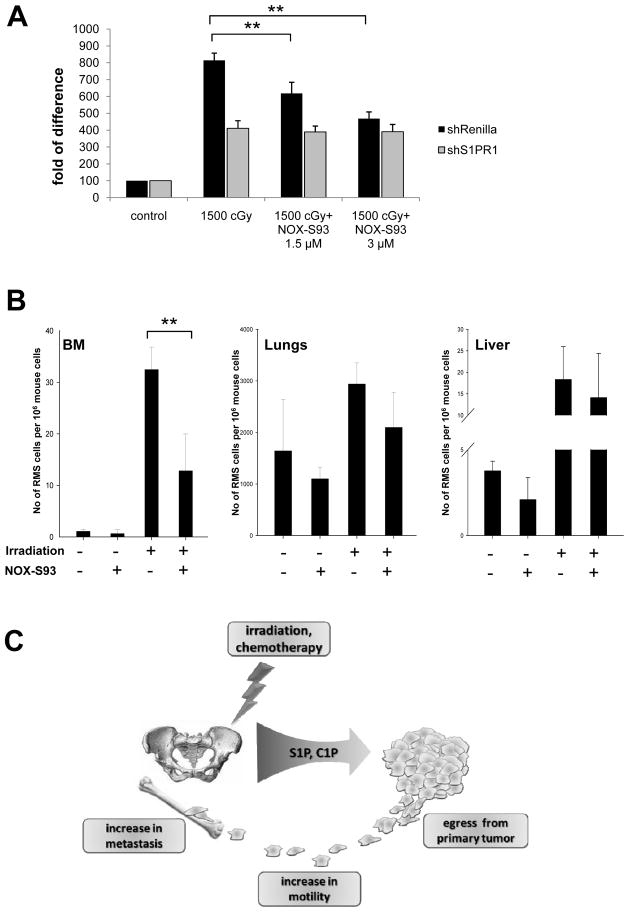
Evidence suggests that bioactive lipids may regulate pathophysiologic functions such as cancer cell metastasis. Therefore, we determined that the bioactive lipid chemoattractants sphingosine-1-phosphate (S1P) and ceramide-1-phosphate (C1P) strongly enhanced the in vitro motility and adhesion of human rhabdomyosarcoma (RMS) cells. Importantly, this effect was observed at physiologic concentrations for both bioactive lipids, which are present in biologic fluids, and were much stronger than the effects observed in response to known RMS prometastatic factors such as stromal derived factors-1 (SDF-1/CXCL12) or hepatocyte growth factor/scatter factor (HGF/SF). We also present novel evidence that the levels of S1P and C1P were increased in several organs after γ-irradiation or chemotherapy, which indicates an unwanted prometastatic environment related to treatment. Critically, we found that the metastasis of RMS cells in response to S1P can be effectively inhibited in vivo with the S1P-specific binder NOX-S93 that is based on a high-affinity Spiegelmer. These data indicate that bioactive lipids play a vital role in dissemination of RMS and contribute to the unwanted side effects of radio/chemotherapy by creating a prometastatic microenvironment.
©2013 AACR
Conflict of interest statement
Conflict of Interest: Gabriela Schneider and Mariusz Ratajczak received minor commercial research funding from NOXXON Pharma AG for studying the effect of NOX-S93 in chemo-radiation induced metastasis of RMS.
Figures


References
-
- Collins MH, Zhao H, Womer RB, Barr FG. Proliferative and apoptotic differences between alveolar rhabdomyosarcoma subtypes: a comparative study of tumors containing PAX3-FKHR or PAX7-FKHR gene fusions. Med Pediatr Oncol. 2001;37(2):83–9. - PubMed
-
- Sandberg AA, Stone JF, Czarnecki L, Cohen JD. Hematologic masquerade of rhabdomyosarcoma. Am J Hematol. 2001;68(1):51–7. - PubMed
-
- Davis RJ, D’Cruz CM, Lovell MA, Biegel JA, Barr FG. Fusion of PAX7 to FKHR by the variant t(1;13)(p36;q14) translocation in alveolar rhabdomyosarcoma. Cancer Res. 1994;54(11):2869–72. - PubMed
-
- Libura J, Drukala J, Majka M, Tomescu O, Navenot JM, Kucia M, et al. CXCR4-SDF-1 signaling is active in rhabdomyosarcoma cells and regulates locomotion, chemotaxis, and adhesion. Blood. 2002;100(7):2597–606. - PubMed
-
- Jankowski K, Kucia M, Wysoczynski M, Reca R, Zhao D, Trzyna E, et al. Both hepatocyte growth factor (HGF) and stromal-derived factor-1 regulate the metastatic behavior of human rhabdomyosarcoma cells, but only HGF enhances their resistance to radiochemotherapy. Cancer Res. 2003;63(22):7926–35. - PubMed
Publication types
MeSH terms
Substances
Grants and funding
LinkOut - more resources
Full Text Sources
Other Literature Sources