


A single early introduction of HIV-1 subtype B into Central America accounts for most current cases
- PMID: 23616665
- PMCID: PMC3700274
- DOI: 10.1128/JVI.01602-12
A single early introduction of HIV-1 subtype B into Central America accounts for most current cases
Abstract
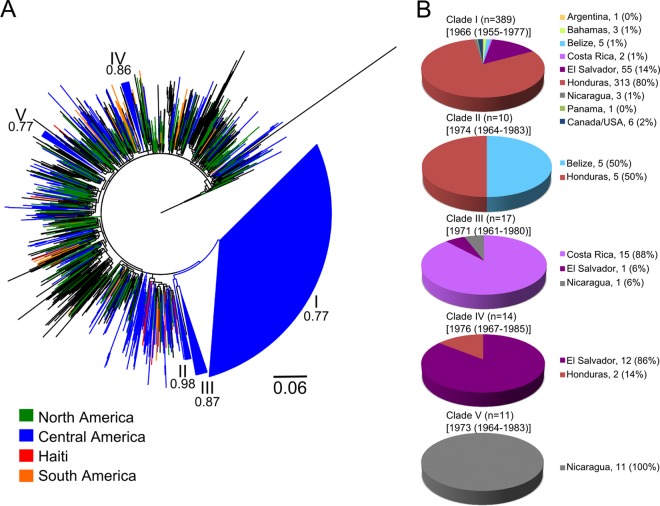
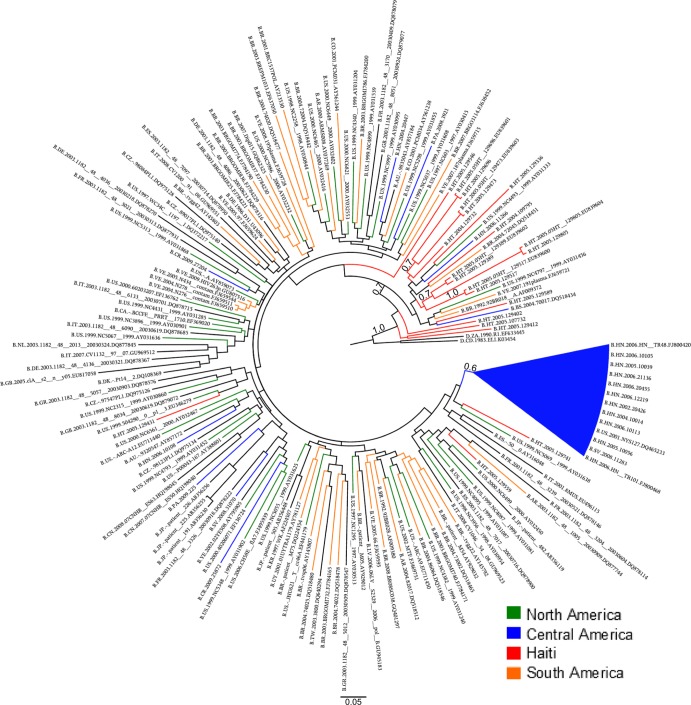
Human immunodeficiency virus type 1 (HIV-1) variants show considerable geographical separation across the world, but there is limited information from Central America. We provide the first detailed investigation of the genetic diversity and molecular epidemiology of HIV-1 in six Central American countries. Phylogenetic analysis was performed on 625 HIV-1 pol gene sequences collected between 2002 and 2010 in Honduras, El Salvador, Nicaragua, Costa Rica, Panama, and Belize. Published sequences from neighboring countries (n = 57) and the rest of the world (n = 740) were included as controls. Maximum likelihood methods were used to explore phylogenetic relationships. Bayesian coalescence-based methods were used to time HIV-1 introductions. Nearly all (98.9%) Central American sequences were of subtype B. Phylogenetic analysis revealed that 437 (70%) sequences clustered within five significantly supported monophyletic clades formed essentially by Central American sequences. One clade contained 386 (62%) sequences from all six countries; the other four clades were smaller and more country specific, suggesting discrete subepidemics. The existence of one large well-supported Central American clade provides evidence that a single introduction of HIV-1 subtype B in Central America accounts for most current cases. An introduction during the early phase of the HIV-1 pandemic may explain its epidemiological success. Moreover, the smaller clades suggest a subsequent regional spread related to specific transmission networks within each country.
Figures
References
-
- USAID February 2011. HIV/AIDS health profiles for the Central America Region. USAID, Washington, DC: www.usaid.gov
-
- USAID April 2011. HIV/AIDS health profiles for the Latin America and the Caribbean Region. USAID, Washington, DC: www.usaid.gov
-
- Ministerio de Salud de El Salvador, Programa Nacional de ITS/VIH/SIDA November 2009. Situación del VIH/SIDA en El Salvador. Ministerio de Salud de El Salvador, San Salvador, El Salvador
-
- Ministerio de Salud de Guatemala, Programa Nacional de ITS/VIH/SIDA June 2009. Reporte epidemiológico del VIH/SIDA en Guatemala. Ministerio de Salud de Guatemala, Guatemala City, Guatemala
-
- Ministerio de Salud de Honduras, Programa Nacional de ITS/VIH/SIDA June 2011. Reporte epidemiológico del VIH/SIDA en Honduras. Ministerio de Salud de Honduras, Tegucigalpa, Honduras
Publication types
MeSH terms
Substances
LinkOut - more resources
Full Text Sources
Other Literature Sources
Medical
