. 2009 Dec 16:2:9-18.
doi: 10.2147/nss.s7624. Print 2010.

Influence of weeks of circadian misalignment on leptin levels

Affiliations

Influence of weeks of circadian misalignment on leptin levels

June Nguyen et al. Nat Sci Sleep. .

Abstract

The neurobiology of circadian, wakefulness-sleep, and feeding systems interact to influence energy homeostasis. Sleep and circadian disruptions are reported to be associated with increased risk of diabetes and obesity, yet the roles of energy balance hormones in these associations are largely unknown. Therefore, in the current study we aimed to assess the influence of several weeks of circadian misalignment (sleep and wakefulness occurring at an inappropriate biological time) on the anorexigenic adipocyte hormone leptin. We utilized data from a previous study designed to assess physiological and cognitive consequences of changes in day length and light exposure as may occur during space fight, including exploration class space missions and exposure to the Martian Sol (day length). We hypothesized that circadian misalignment during an exploration class spaceflight simulation would reduce leptin levels. Following a three-week ~8 hours per night home sleep schedule, 14 healthy participants lived in the laboratory for more than one month. After baseline data collection, participants were scheduled to either 24.0 or 24.6 hours of wakefulness-sleep schedules for 25 days. Changes in the phase of the circadian melatonin rhythm, sleep, and leptin levels were assessed. Half of participants analyzed exhibited circadian misalignment with an average change in phase angle from baseline of ~4 hours and these participants showed reduced leptin levels, sleep latency, stage 2 and total sleep time (7.3 to 6.6 hours) and increased wakefulness after sleep onset (all P < 0.05). The control group remained synchronized and showed significant increases in sleep latency and leptin levels. Our findings indicate that weeks of circadian misalignment, such as that which occurs in circadian sleep disorders, alters leptin levels and therefore may have implications for appetite and energy balance.

Keywords: circadian disruption; circadian entrainment; circadian misalignment; leptin; sleep; sleep loss.


Figures
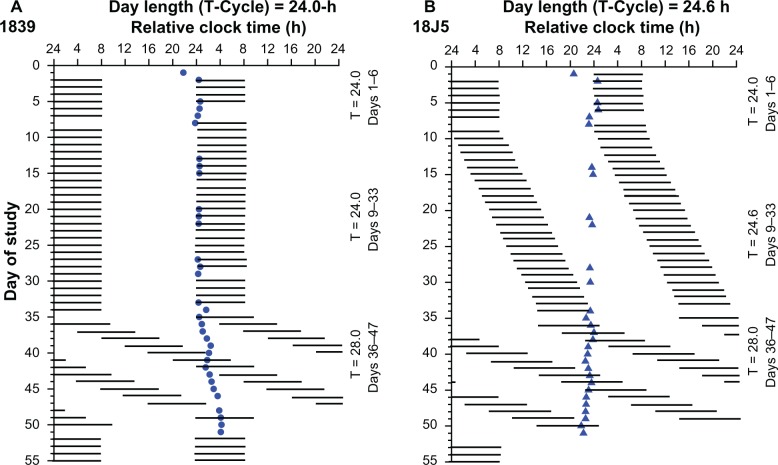
Figure 1
Figure 1
Rasterplot of the study design for two representative individuals. Rasterplot is double plotted such that consecutive days are next to and beneath the other. Data are plotted to a relative clock time with lights-out assigned a value of 24.00 hours on baseline day 1. Scheduled sleep episodes in complete darkness (horizontal black bars). Subject 1839 (closed circle) was scheduled to the 24.0-hour day protocol (A). During the imposed 24.0-hour segment, melatonin onset appears stable and occurs near to lights out. Circadian period delayed during the 28-hour day length forced desynchrony protocol (days 36–47) indicating an intrinsic period longer than 24.0-hours (detailed forced desynchrony data was reported previously)., Subject 18J5 (closed triangle) was scheduled to the 24.6-hours day protocol (B). During the imposed 24.6-hour segment lights out and lights on are delayed by 36 minutes each day. Melatonin onset occurred near to lights out for the subject during baseline days, whereas during the 24.6-hour segment, melatonin onset is progressively phase advanced relative to lights out. Circadian period advanced during the forced desynchrony protocol indicating an intrinsic period shorter than 24.0 hours. Data for the current analyses comes from days 6 to 23 of the protocol. Blood was collected on day 6 to assess 24-hour baseline leptin levels and day 7 to assess circadian melatonin phase. The average day of leptin reassessment was day 22 and the average day of melatonin phase reassessment was day 23 of the protocol.
Figure 2
Figure 2
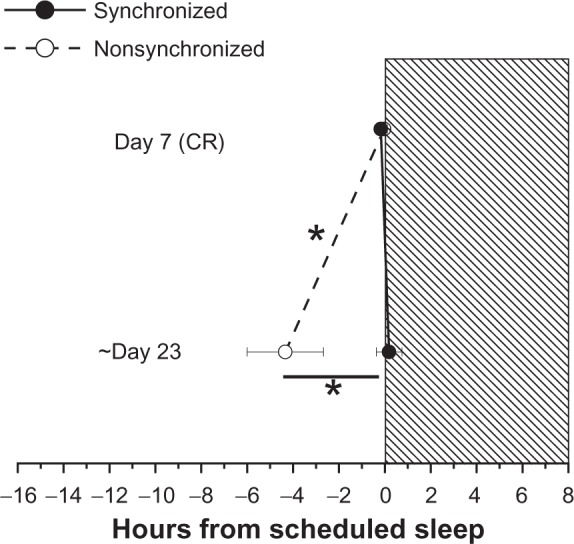
Circadian phase angle as assessed by the timing of the dim light melatonin onset (DLMO25%) in plasma relative to scheduled sleep. Day 7 (baseline) and 23 represent average day of melatonin assessment during the inpatient protocol. On day 23, the DLMO25% occurred earlier in the nonsynchronized group compared to baseline and compared to the synchronized group. The earlier onset of melatonin in the nonsynchronized group resulted in higher melatonin levels during scheduled wakefulness and lower melatonin levels during scheduled sleep. Note that nonsynchronized group was synchronized at baseline. *P< 0.05.
Figure 3
Figure 3
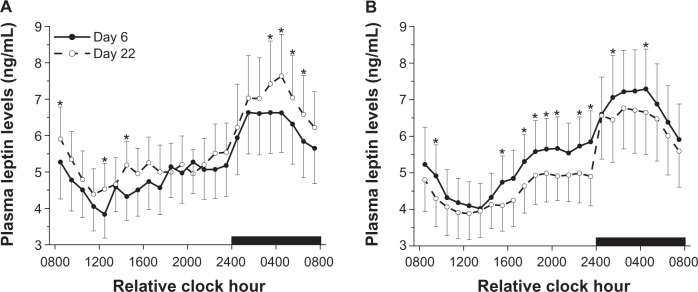
Mean (±SEM) 24-hour profiles of leptin in the synchronized group (A) and nonsynchronized group (B). Black bar represents schedule sleep episode. Note that nonsynchronized group was synchronized at baseline. Notes: *P< 0.05 compared to baseline.
Figure 4
Figure 4
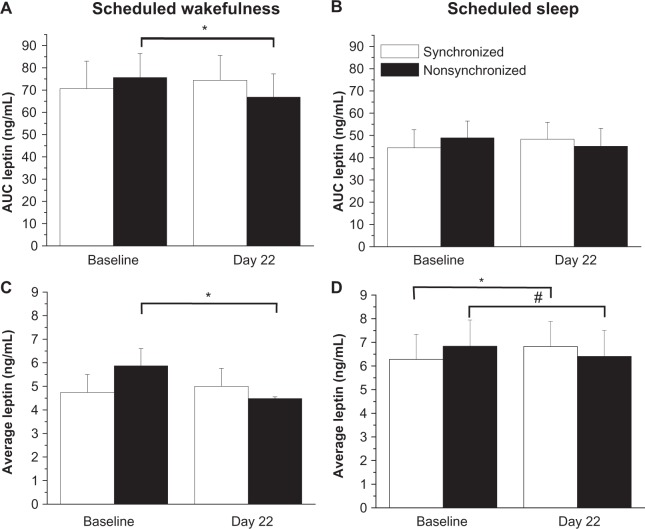
Integrated area under the curve leptin levels during scheduled wakefulness (A) and scheduled sleep (B). Day 22 denotes the average day of study when leptin was reassessed. Average leptin levels during scheduled wakefulness (C) and scheduled sleep (D). Notes: The nonsynchronized group was synchronized at baseline. *P< 0.05 compared to baseline. #P = 0.07 compared to baseline.

References

    1. Arch JR. Central regulation of energy balance: inputs, outputs and leptin resistance. Proc Nutr Soc. 2005;64(1):39–46. - PubMed
    1. Schoeller DA, Cella LK, Sinha MK, Caro JF. Entrainment of the diurnal rhythm of plasma leptin to meal timing. J Clin Invest. 1997;100(7):1882–1887. - PMC - PubMed
    1. Sinha MK, Opentanova I, Ohannesian JP, Kolaczynski JW, Heiman ML, Hale J, et al. Evidence of free and bound leptin in human circulation. Studies in lean and obese subjects and during short-term fasting. J Clin Invest. 1996;98(6):1277–1282. - PMC - PubMed
    1. Saad MF, Riad-Gabriel MG, Khan A, et al. Diurnal and ultradian rhythmicity of plasma leptin: effects of gender and adiposity. J Clin Endocrinol Metab. 1998;83(2):453–459. - PubMed
    1. Simon C, Gronfer C, Schlienger JL, Brandenberger G. Circadian and ultradian variations of leptin in normal man under continuous enteral nutrition: relationship to sleep and body temperature. J Clin Endocrinol Metab. 1998;83(6):1893–1899. - PubMed