


Acute diarrheal syndromic surveillance: effects of weather and holidays
- PMID: 23616829
- PMCID: PMC3632277
- DOI: 10.4338/ACI-2009-12-RA-0024
Acute diarrheal syndromic surveillance: effects of weather and holidays
Abstract
Objective: In an effort to identify and characterize the environmental factors that affect the number of patients with acute diarrheal (AD) syndrome, we developed and tested two regional surveillance models including holiday and weather information in addition to visitor records, at emergency medical facilities in the Seoul metropolitan area of Korea.
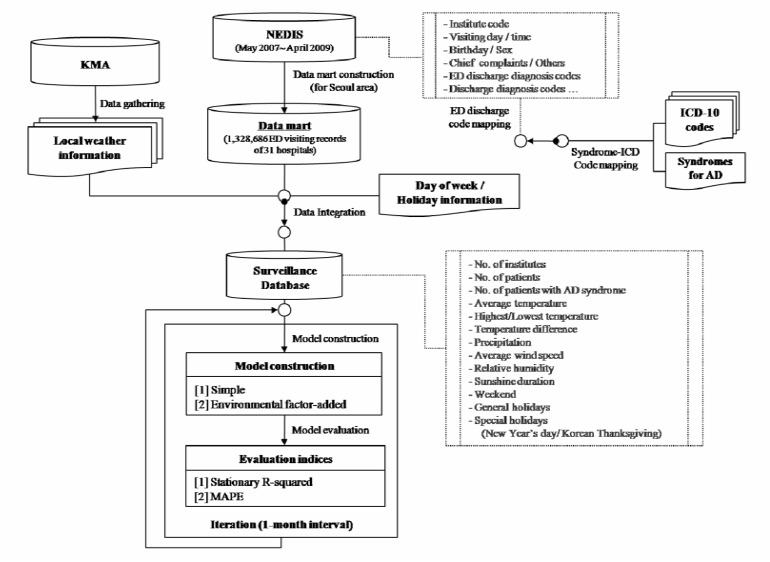
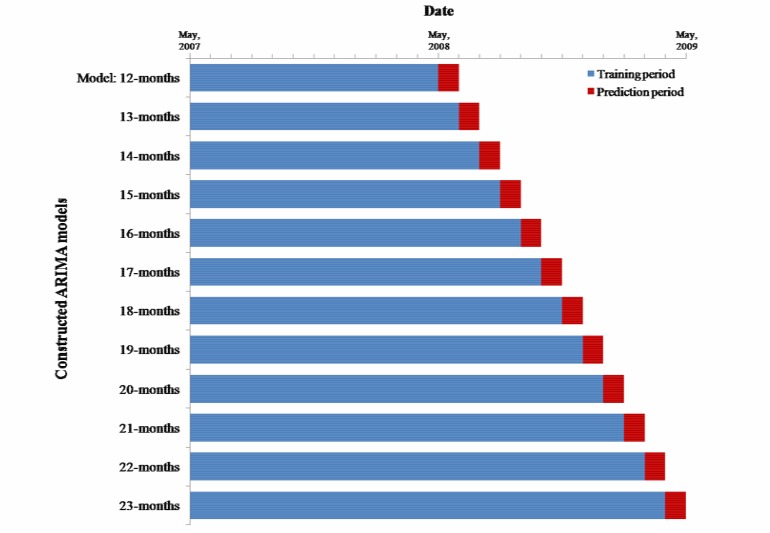
Methods: With 1,328,686 emergency department visitor records from the National Emergency Department Information system (NEDIS) and the holiday and weather information, two seasonal ARIMA models were constructed: (1) The simple model (only with total patient number), (2) the environmental factor-added model. The stationary R-squared was utilized as an in-sample model goodness-of-fit statistic for the constructed models, and the cumulative mean of the Mean Absolute Percentage Error (MAPE) was used to measure post-sample forecast accuracy over the next 1 month.
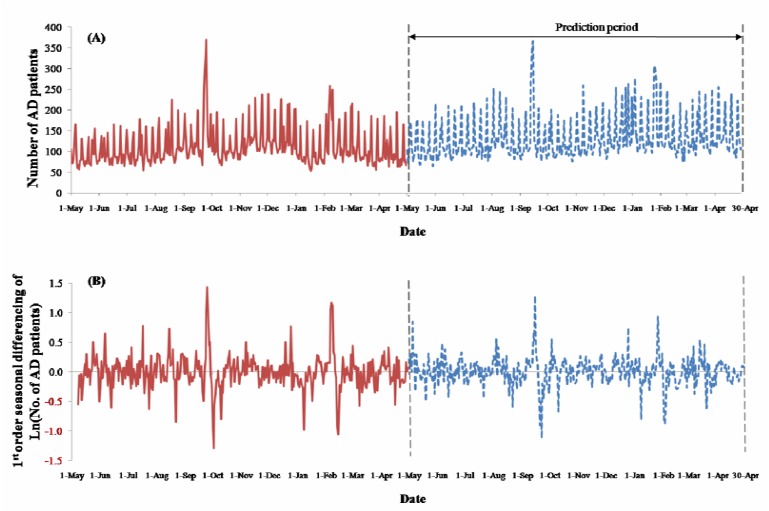
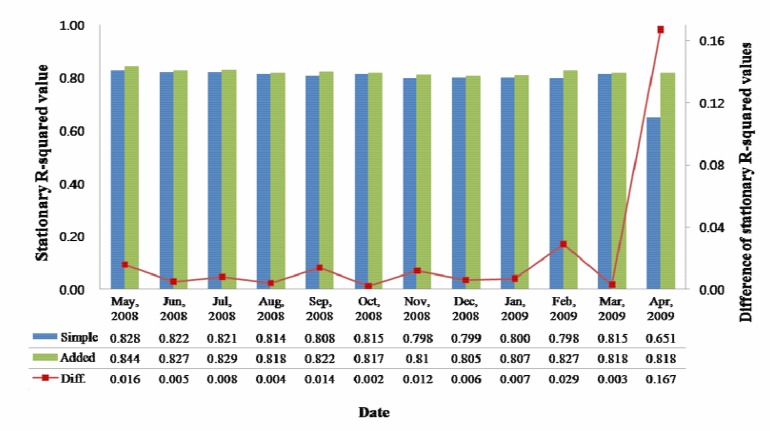
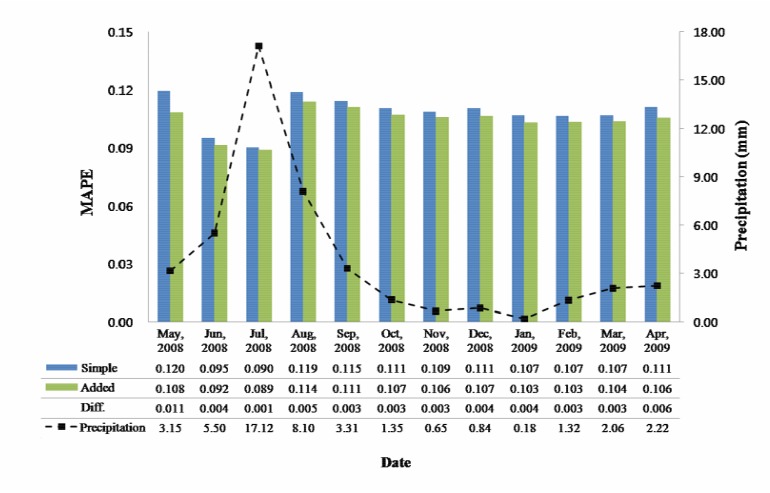
Results: The (1,0,1)(0,1,1)7 ARIMA model resulted in an adequate model fit for the daily number of AD patient visits over 12 months for both cases. Among various features, the total number of patient visits was selected as a commonly influential independent variable. Additionally, for the environmental factor-added model, holidays and daily precipitation were selected as features that statistically significantly affected model fitting. Stationary R-squared values were changed in a range of 0.651-0.828 (simple), and 0.805-0.844 (environmental factor-added) with p<0.05. In terms of prediction, the MAPE values changed within 0.090-0.120 and 0.089-0.114, respectively.
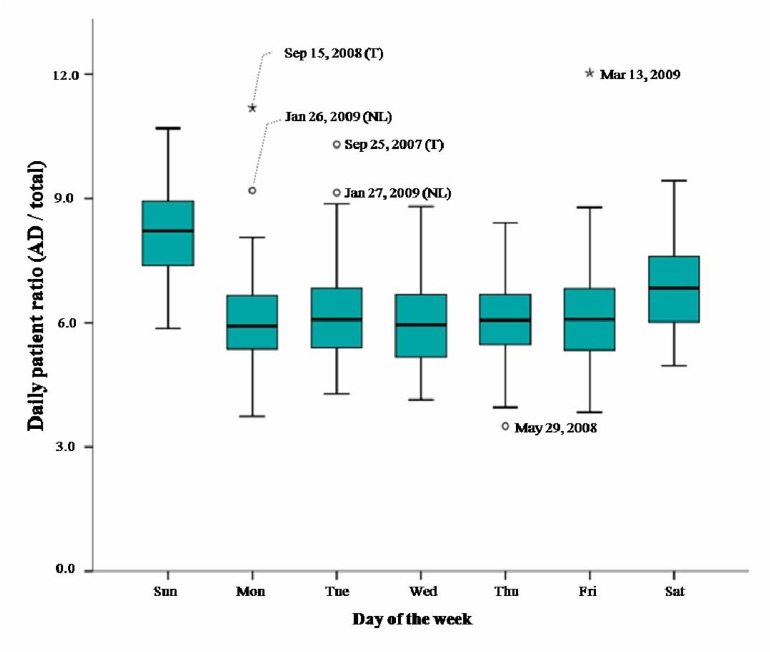
Conclusion: The environmental factor-added model yielded better MAPE values. Holiday and weather information appear to be crucial for the construction of an accurate syndromic surveillance model for AD, in addition to the visitor and assessment records.
Keywords: Surveillance; diarrhea; emergency service hospital; environment; forecasting.
Figures
References
-
- Henning KJ. What is syndromic surveillance? MMWR Morb Mortal Wkly Rep. 2004; 53(Suppl.): 5-11 - PubMed
-
- Green MS, Kaufman Z. Surveillance for early detection and monitoring of infectious disease outbreaks associated with bioterrorism. Isr Med Assoc J. 2002; 4(7): 503-506 - PubMed
-
- Cho JP, Min YG, Choi SC. Syndromic surveillances based on the emergency department. J Prev Med Public Health. 2008; 41(4): 219-224 - PubMed
LinkOut - more resources
Full Text Sources
