


Revisiting the effect of maternal smoking during pregnancy on offspring birthweight: a quasi-experimental sibling analysis in Sweden
- PMID: 23616908
- PMCID: PMC3629140
- DOI: 10.1371/journal.pone.0061734
Revisiting the effect of maternal smoking during pregnancy on offspring birthweight: a quasi-experimental sibling analysis in Sweden
Abstract
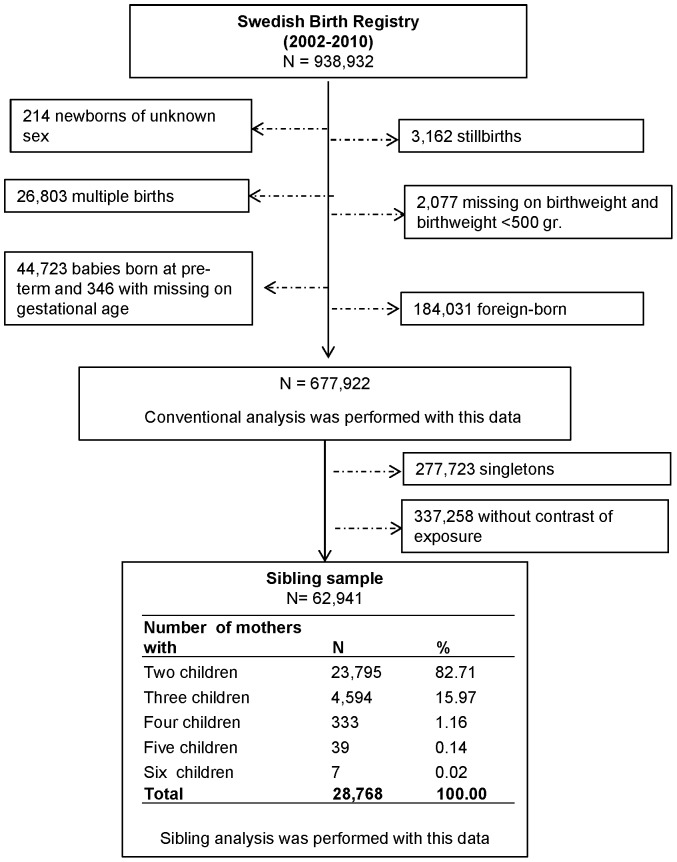
Maternal smoking during pregnancy (SDP) seems associated with reduced birthweight in the offspring. This observation, however, is based on conventional epidemiological analyses, and it might be confounded by unobserved maternal characteristics related to both smoking habits and offspring birth weight. Therefore, we apply a quasi-experimental sibling analysis to revisit previous findings. Using the Swedish Medical Birth Register, we identified 677,922 singletons born between 2002 and 2010 from native Swedish mothers. From this population, we isolated 62,941 siblings from 28,768 mothers with discrepant habits of SDP. We applied conventional and mother-specific multilevel linear regression models to investigate the association between maternal SDP and offspring birthweight. Depending on the mother was light or heavy smoker and the timing of exposition during pregnancy (i.e., first or third trimester), the effect of smoking on birthweight reduction was between 6 and 78 g less marked in the sibling analysis than in the conventional analysis. Sibling analysis showed that continuous smoking reduces birthweight by 162 grams for mothers who were light smokers (1 to 9 cigarettes per day) and 226 g on average for those who were heavy smokers throughout the pregnancy in comparison to non-smoker mothers. Quitting smoking during pregnancy partly counteracted the smoking-related birthweight reduction by 1 to 29 g, and a subsequent smoking relapse during pregnancy reduced birthweight by 77 to 83 g. The sibling analysis provides strong evidence that maternal SDP reduces offspring birthweight, though this reduction was not as great as that observed in the conventional analysis. Our findings support public health interventions aimed to prevent SDP and to persuade those who already smoke to quit and not relapse throughout the pregnancy. Besides, further analyses are needed in order to explain the mechanisms through which smoking reduces birthweight and to identify other maternal characteristics that are common causes of both birthweight reduction and maternal smoking.
Conflict of interest statement
Figures
References
-
- Wilcox AJ, Russell I (1983) Birthweight and Perinatal Mortality: On Weight-Specific Mortality. International Journal of Epidemiology 12: 319–325. - PubMed
-
- Alberman E (1980) Prospects for better perinatal health. Lancet 26: 189–192. - PubMed
-
- Breslau N, Johnson EB, Lucia VC (2001) Academic Achievement of Low Birthweight Children at Age 11: The Role of Cognitive Abilities at School Entry. Journal of Abnormal Child Psychology 29: 273–279. - PubMed
-
- Tong S, Baghurst P, McMichael A (2006) Birthweight and cognitive development during childhood. Journal of Paediatrics and Child Health 42: 98–103. - PubMed
-
- Breslau N, Chilcoat H, Johnson E, Andreski P, Lucia V (2000) Neurologic soft signs and low birthweight: their association and neuropsychiatric implications Society of Biological Psychiatry. 47: 71–79. - PubMed
Publication types
MeSH terms
LinkOut - more resources
Full Text Sources
Other Literature Sources
Medical
