


Analysis of the factor XI variant Arg184Gly suggests a structural basis for factor IX binding to factor XIa
- PMID: 23617568
- PMCID: PMC4158700
- DOI: 10.1111/jth.12275
Analysis of the factor XI variant Arg184Gly suggests a structural basis for factor IX binding to factor XIa
Abstract
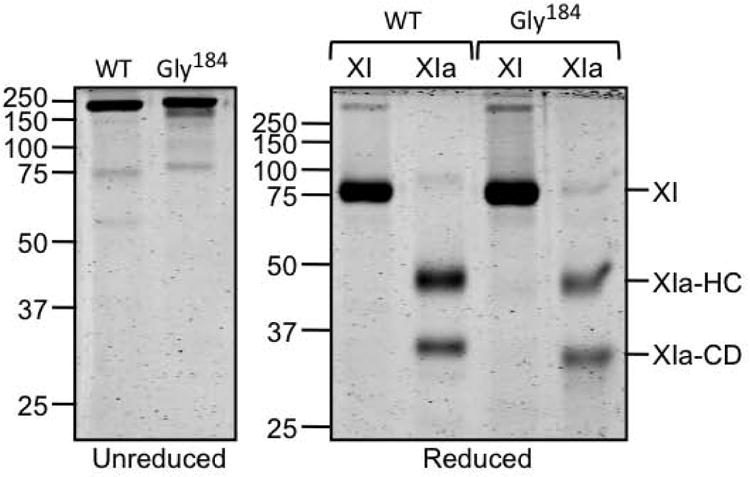
Background: A patient with factor XI (FXI) deficiency was reported with an Arg184Gly substitution in the FXI A3 domain. The A3 domain contains an exosite required for binding of FIX to activated FXI (FXIa).
Objective: To test the effects of the Arg184Gly substitution on FIX activation, and to characterize the FIX-binding site on FXIa.
Methods: Recombinant FXIa and FIX variants were used to identify residues involved in FIX activation by FXIa. Analysis of the FXI structure was used to identify potential FIX-binding sites.
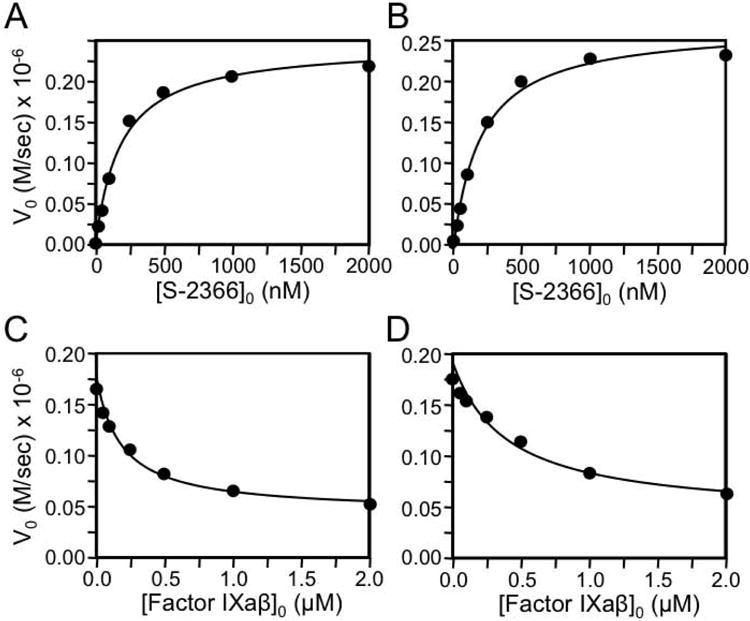
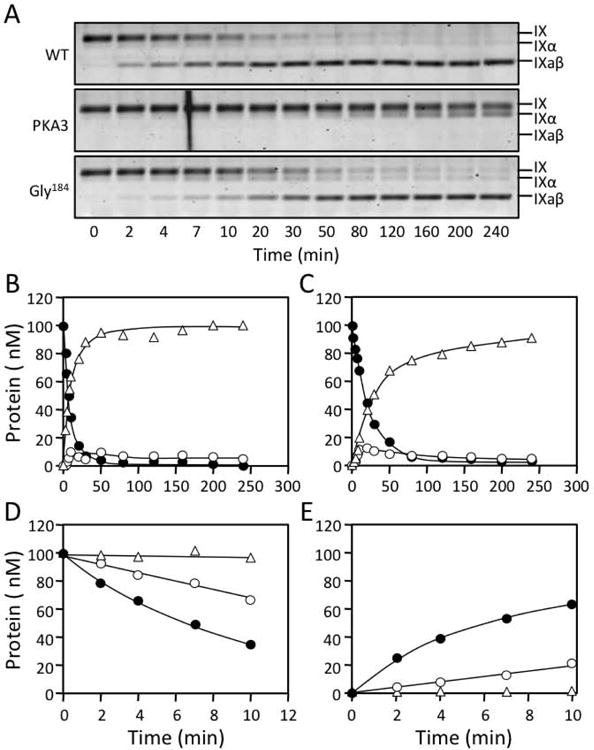
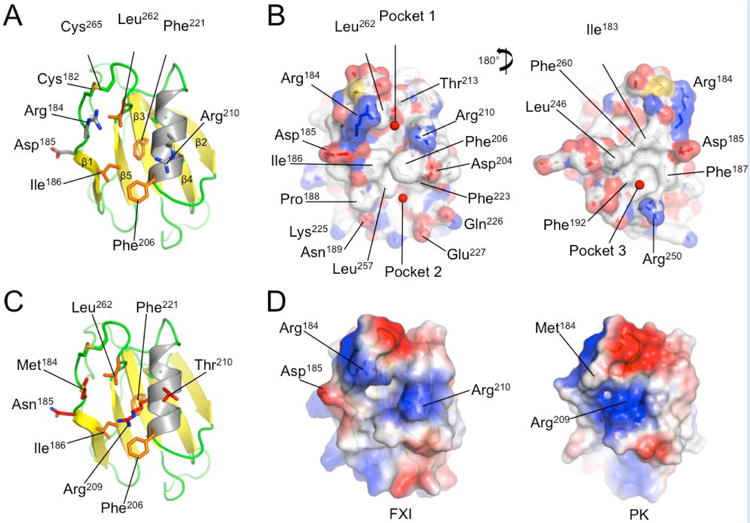
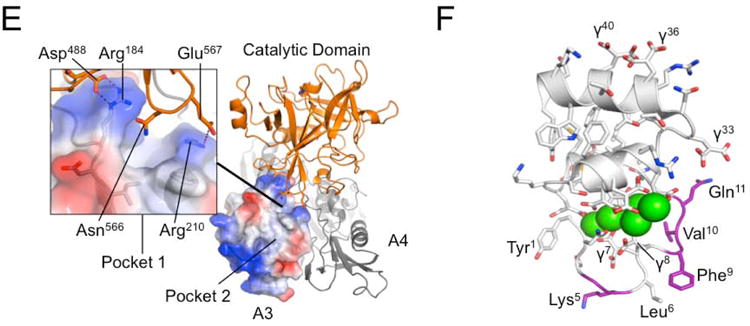
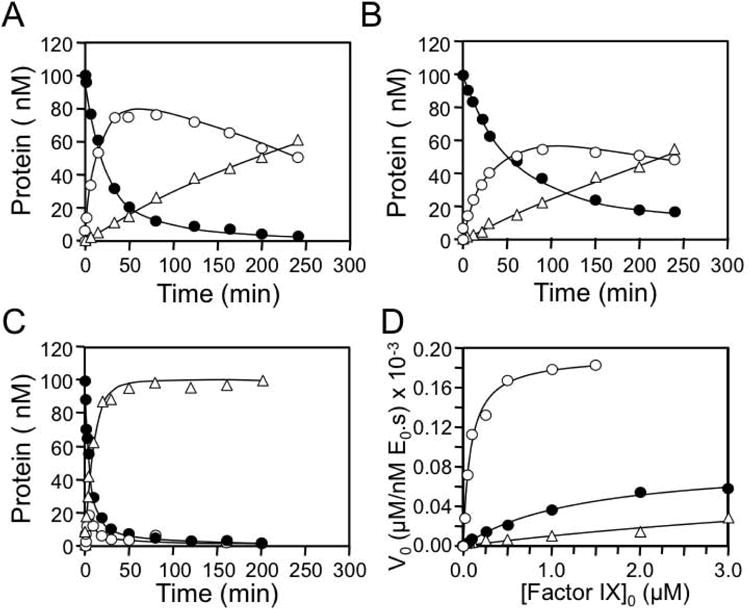
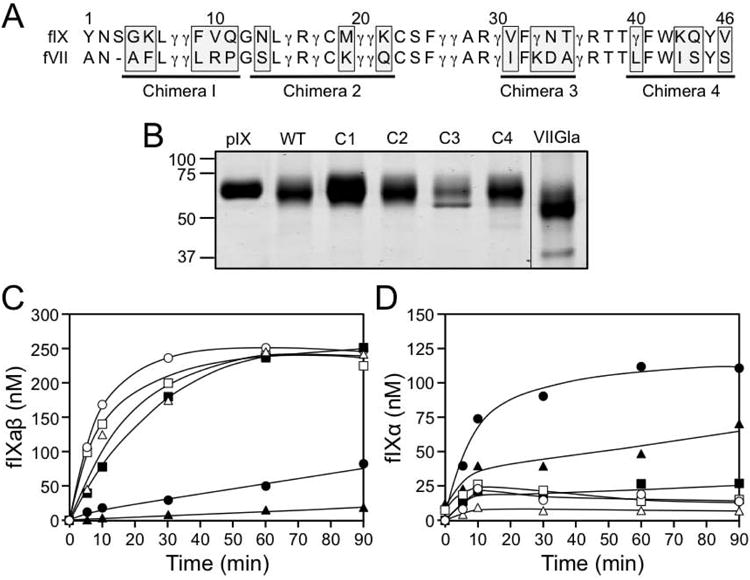
Results: The Km for FIX activation by FXIa-Gly184 was approximately three-fold higher than for FXIa, suggesting that Arg184 is part of the exosite. Arg184 and the adjacent residues, Ile183 and Asp185, contribute to charged and hydrophobic areas that are not present in the FXI homolog prekallikrein (PK). Replacing residues 183-185 with alanine abolished exosite activity, similarly to replacement of the entire A3 domain with the A3 domain from PK (FXIa/PKA3). Reintroducing FXI residues 183-185 into FXIa/PKA3 partially restored the exosite, and replacing residues 183-185 and 260-264 completely restored exosite function. FIX in which the Ω-loop (residues 4-11) was replaced with the FVII Ω-loop was activated poorly by FXIa, suggesting that the FIX Ω-loop binds to FXIa.
Conclusions: The results support a model in which the Ω-loop of FIX binds to an area on FXIa composed of residues from the N-terminus and C-terminus of the A3 domain. These residues are buried in zymogen FXI, and must be exposed upon conversion to FXIa to permit FIX binding.
Keywords: blood coagulation; factor IX; factor XI; factor XIa; proteolysis.
© 2013 International Society on Thrombosis and Haemostasis.
Conflict of interest statement
Figures
References
-
- Brummel-Ziedens K, Mann KG. Hematology: basic principles and practice. 6th. Churchill Livingstone-Elsevier; Philadelphia: 2012. Molecular basis of blood coagulation; pp. 1821–41.
-
- Vadivel K, Schmidt AE, Marder VJ, Krishnaswamy S, Bajaj SP. Hemostasis and Thrombosis: basic principles and clinical practice. 6th. Lippincott, Williams & Wilkins; Philadelphia: 2012. Structure and function of vitamin K-dependent coagulation and anticoagulation proteins; pp. 208–32.
-
- Gailani D, Renné T, Emsley J. Factor XI and the Plasma contact system. In: Scriver CR, Beaudet AL, Sly WS, Valle D, Childs B, Kinzler KW, Vogelstein B, editors. Metabolic and Molecular Bases of Inherited Disease. McGraw-Hill; NY, NY: 2010.
-
- Fujikawa K, Chung D, Hendrickson L, Davie E. Amino acid sequence of human factor XI, a blood coagulation factor with four tandem repeats that are highly homologous with plasma prekallikrein. Biochemistry. 1986;25:2417–24. - PubMed
Publication types
MeSH terms
Substances
Grants and funding
- HL58837/HL/NHLBI NIH HHS/United States
- R01 HL080018/HL/NHLBI NIH HHS/United States
- RG/12/9/29775JE/BHF_/British Heart Foundation/United Kingdom
- R01 HL036365/HL/NHLBI NIH HHS/United States
- R56 HL036365/HL/NHLBI NIH HHS/United States
- HL36365/HL/NHLBI NIH HHS/United States
- R01 HL081326/HL/NHLBI NIH HHS/United States
- RG/07/002/23132/BHF_/British Heart Foundation/United Kingdom
- HL81326/HL/NHLBI NIH HHS/United States
- R01 HL058837/HL/NHLBI NIH HHS/United States
- HL80018/HL/NHLBI NIH HHS/United States
- RG/12/9/29775/BHF_/British Heart Foundation/United Kingdom
LinkOut - more resources
Full Text Sources
Other Literature Sources
