Review
. 2014 Jan;7(1):5-25.
doi: 10.1111/1751-7915.12055. Epub 2013 Apr 25.

Histidine biosynthesis, its regulation and biotechnological application in Corynebacterium glutamicum

Affiliations
Review

Histidine biosynthesis, its regulation and biotechnological application in Corynebacterium glutamicum

Robert K Kulis-Horn et al. Microb Biotechnol. 2014 Jan.

Abstract

l-Histidine biosynthesis is an ancient metabolic pathway present in bacteria, archaea, lower eukaryotes, and plants. For decades l-histidine biosynthesis has been studied mainly in Escherichia coli and Salmonella typhimurium, revealing fundamental regulatory processes in bacteria. Furthermore, in the last 15 years this pathway has been also investigated intensively in the industrial amino acid-producing bacterium Corynebacterium glutamicum, revealing similarities to E. coli and S. typhimurium, as well as differences. This review summarizes the current knowledge of l-histidine biosynthesis in C. glutamicum. The genes involved and corresponding enzymes are described, in particular focusing on the imidazoleglycerol-phosphate synthase (HisFH) and the histidinol-phosphate phosphatase (HisN). The transcriptional organization of his genes in C. glutamicum is also reported, including the four histidine operons and their promoters. Knowledge of transcriptional regulation during stringent response and by histidine itself is summarized and a translational regulation mechanism is discussed, as well as clues about a histidine transport system. Finally, we discuss the potential of using this knowledge to create or improve C. glutamicum strains for the industrial l-histidine production.


Figures

Fig. 1
Fig. 1
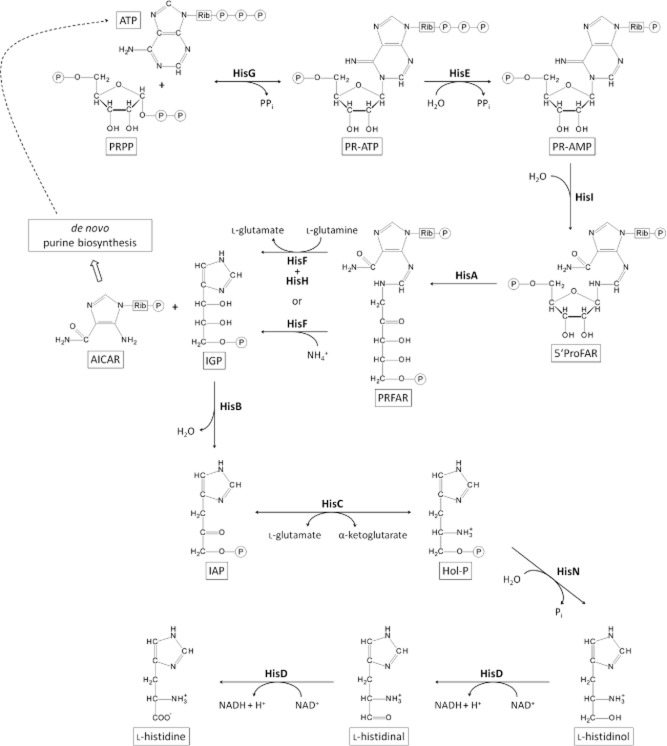
Histidine biosynthetic pathway in C. glutamicum. PRPP, phosphoribosyl pyrophosphate; ATP; adenosine triphosphate; PPi, pyrophosphate; PR-ATP, phosphoribosyl-ATP; PR-AMP, phosphoribosyl-AMP; 5′ProFAR, 1-(5-phosphoribosyl)-5-[(5-phosphoribosylamino)methylideneamino] imidazole-4 carboxamide; PRFAR, 5-[(5-phospho-1-deoxyribulos-1-ylamino)methylideneamino]-1-(5-phosphoribosyl)imidazole-4-carboxamide; IGP, imidazole-glycerol phosphate; AICAR, 1-(5′-phosphoribosyl)-5-amino-4-imidazolecarboxamide; IAP, imidazole-acetol phosphate; Hol-P, l-histidinol phosphate; Pi, phosphate; NAD+, oxidized nicotinamide adenine dinucleotide; NADH, reduced nicotinamide adenine dinucleotide; HisG, ATP phosphoribosyltransferase; HisE, phosphoribosyl-ATP pyrophosphatase; HisI, phosphoribosyl-AMP cyclohydrolase; HisA, 5′ProFAR isomerase; HisF, synthase subunit of IGP synthase; HisH, glutaminase subunit of IGP synthase; HisB, imidazoleglycerol-phosphate dehydratase; HisC, histidinol-phosphate aminotransferase; HisN, histidinol-phosphate phosphatase; HisD, histidinol dehydrogenase.
Fig. 2
Fig. 2
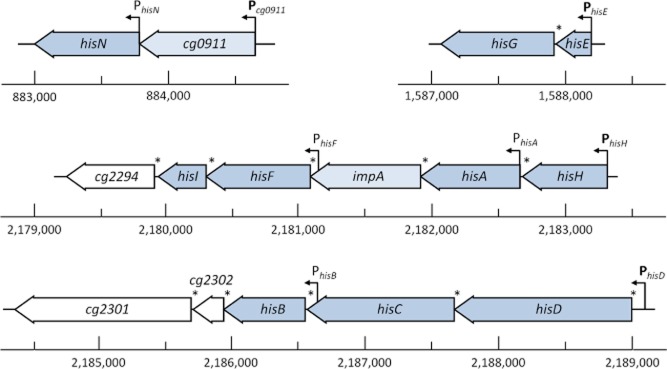
Structure of the four histidine operons in C. glutamicum. Canonical histidine biosynthesis genes are depicted in dark blue. Genes shown in light blue exhibit high sequence similarity to hisN. Genes shown in white have no apparent function in histidine biosynthesis. Arrows indicate the positions of putative primary and internal promoters. Presence of a SD sequence is marked with an asterisk. The ruler indicates the absolute position within the genome (based on the genome version by Kalinowski et al., RefSeq NC_006958.1).
Fig. 3
Fig. 3
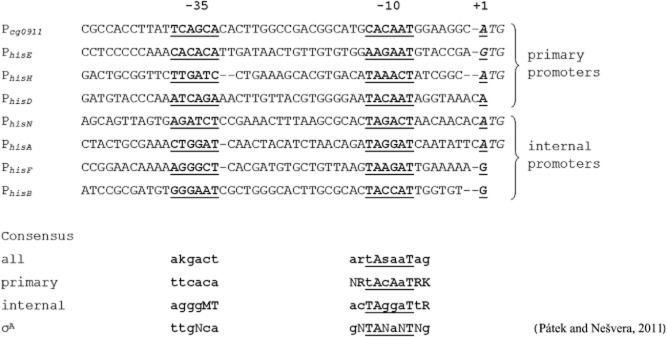
Putative promoter sequences of histidine biosynthesis genes. Transcription start sites (+1) were determined by means of RNA-Seq (K. Pfeifer-Sancar, A. Mentz, C. Rückert, and J. Kalinowski, manuscript in preparation). Putative −10 and −35 boxes are shown in bold and underlined. Dashes indicate gaps of 1–2 nt introduced into the sequence to align the −10 and −35 boxes and the transcription start sites. The start codons are highlighted in italics. The promoter consensus sequences were calculated using either the sequence of all eight promoters, the four primary promoters (Pcg0911, PhisE, PhisH, PhisD), or the four internal promoters (PhisN, PhisA, PhisF, PhisB). The consensus sequence of sigma factor A (σA) dependent promoters from C. glutamicum (Pátek and Nešvera, 2011) is shown in addition. The consensus sequence represents nucleotides occurring in that particular position in more than 80% (uppercase letters) and 35% (lowercase letters) of analysed sequences.
Fig. 4
Fig. 4
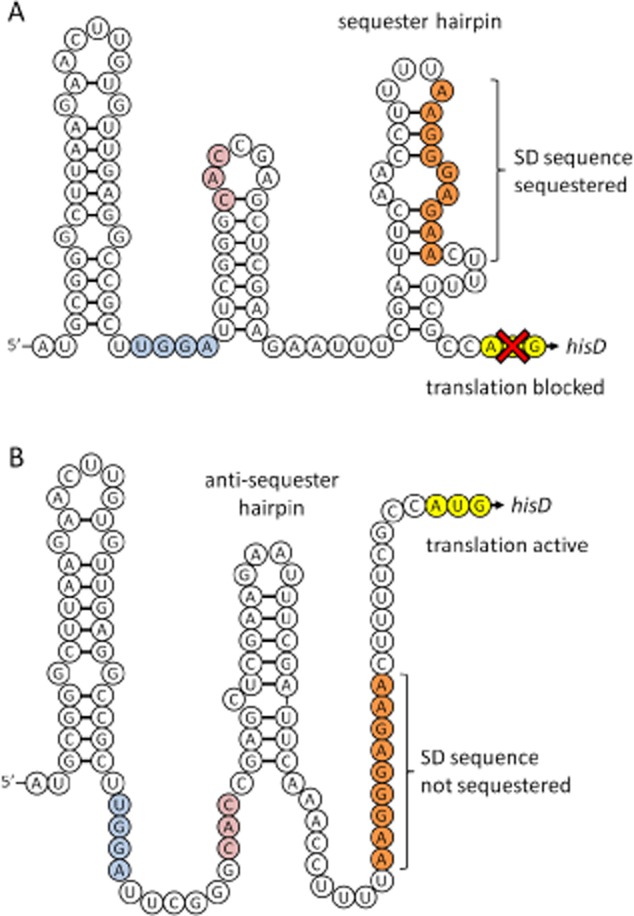
Secondary structure model of the 5′ UTR of the hisDCB-cg2302-cg2301 mRNA from C. glutamicum ATCC 13032. Nucleotides shown in orange and yellow represent the SD sequence and the hisD start codon respectively. The histidine specifier (CAC) is shown in red and the putative CCA binding site for uncharged tRNA 3′ ends (UGGA) is shown in blue. Both sequences might be involved in a histidyl-tRNA dependent riboswitch mechanism.A. SD sequester structure. The SD sequence is sequestered in a hairpin and not available to ribosomes. Translation of the hisD gene is blocked.B. SD anti-sequester structure. The formation of the anti-sequester hairpin prevents the formation of the sequester hairpin. The SD sequence is available to ribosomes and hisD is translated. Uncharged histidyl-tRNA interacting with the histidine specifier and the CCA binding site might be involved in the stabilization of the anti-sequester hairpin, resulting in a switch from the SD sequester to the SD anti-sequester structure.

References

    1. Adams E. The enzymatic synthesis of histidine from histidinol. J Biol Chem. 1954;209:829–846. - PubMed
    1. Alderwick LJ, Dover LG, Seidel M, Gande R, Sahm H, Eggeling L, Besra GS. Arabinan-deficient mutants of Corynebacterium glutamicum and the consequent flux in decaprenylmonophosphoryl-d-arabinose metabolism. Glycobiology. 2006;16:1073–1081. - PubMed
    1. Alifano P, Piscitelli C, Blasi V, Rivellini F, Nappo AG, Bruni CB, Carlomagno MS. Processing of a polycistronic mRNA requires a 5′ cis element and active translation. Mol Microbiol. 1992;6:787–798. - PubMed
    1. Alifano P, Fani R, Lió P, Lazcano A, Bazzicalupo M, Carlomagno MS, Bruni CB. Histidine biosynthetic pathway and genes: structure, regulation, and evolution. Microbiol Rev. 1996;60:44–69. - PMC - PubMed
    1. Amaro RE, Myers RS, Davisson VJ, Luthey-Schulten ZA. Structural elements in IGP synthase exclude water to optimize ammonia transfer. Biophys J. 2005;89:475–487. - PMC - PubMed

Publication types

MeSH terms

LinkOut - more resources