


Plasmacytoid dendritic cells: no longer an enigma and now key to transplant tolerance?
- PMID: 23617754
- PMCID: PMC3977341
- DOI: 10.1111/ajt.12229
Plasmacytoid dendritic cells: no longer an enigma and now key to transplant tolerance?
Abstract
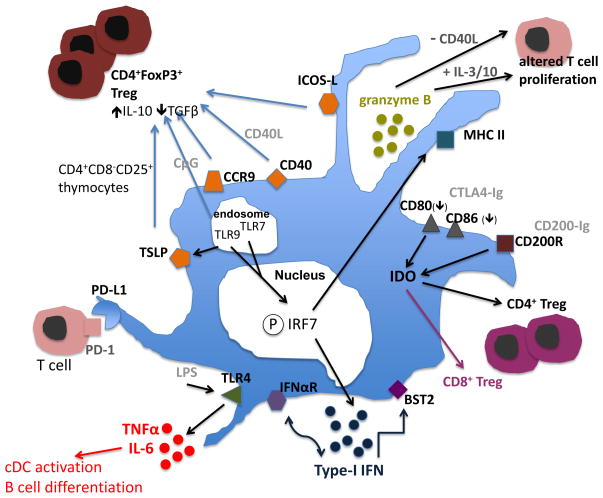
Plasmacytoid (p) dendritic cells (DC) are a specialized subset of DC whose primary role was initially defined by the production of type I interferons in response to viral infection. They are now known to also possess a repertoire of functions capable of determining T cell fate and activation. Under homeostatic conditions, non-lymphoid tissue-resident pDC play a critical role in the regulation of mucosal immunity, as well as the development of central and peripheral tolerance. Although these cells display a number of characteristics that differ from conventional DC, particularly altered costimulatory molecule expression and poor allostimulatory capacity when interacting with T cells, this phenotype favors the generation of alloantigen-specific regulatory CD4(+) or CD8(+) T cells critical to the development of graft tolerance. In this minireview, we discuss pDC ontogeny, functional biology and the emerging data that demonstrate the importance of pDC in the induction of tolerance, as well as recent studies that define mechanisms underlying pDC-mediated tolerance to both solid organ and haematopoietic stem cell transplants. We also highlight their use in clinical settings and the potential of pDC both as targets and cellular therapeutic agents to improve the outcome of organ transplantation.
© 2013 Copyright The American Society of Transplantation and the American Society of Transplant Surgeons.
Figures
References
-
- Trinchieri G, Santoli D. Anti-viral activity induced by culturing lymphocytes with tumor-derived or virus-transformed cells. Enhancement of human natural killer cell activity by interferon and antagonistic inhibition of susceptibility of target cells to lysis. J Exp Med. 1978;147(5):1314–1333. - PMC - PubMed
-
- Shortman K, Naik SH. Steady-state and inflammatory dendritic-cell development. Nat Rev Immunol. 2007;7(1):19–30. - PubMed
-
- Belz GT, Nutt SL. Transcriptional programming of the dendritic cell network. Nat Rev Immunol. 2007;12(2):101–113. - PubMed
-
- Wu L, Liu YJ. Development of dendritic-cell lineages. Immunity. 2007;26(6):741–750. - PubMed
Publication types
MeSH terms
Grants and funding
LinkOut - more resources
Full Text Sources
Other Literature Sources
Research Materials
Miscellaneous
