


Trends in the prevalence of reduced GFR in the United States: a comparison of creatinine- and cystatin C-based estimates
- PMID: 23619125
- PMCID: PMC3723746
- DOI: 10.1053/j.ajkd.2013.03.013
Trends in the prevalence of reduced GFR in the United States: a comparison of creatinine- and cystatin C-based estimates
Abstract
Background: The US prevalence of reduced estimated glomerular filtration rate (eGFR) based on serum creatinine level increased during the decade ending in 2002. National Health and Nutrition Examination Survey (NHANES) cystatin C measurements recently were calibrated to the international standard, allowing for an independent test of the trend in prevalence of reduced eGFR using cystatin C level.
Study design: Cross-sectional surveys performed during 2 periods.
Setting & participants: Nationally representative subsamples of adult participants from NHANES III (1988-1994) and the NHANES 1999-2002 surveys.
Predictor: Survey period.
Outcomes: Prevalence of reduced GFR, defined as eGFR <60 mL/min/1.73 m² based on levels of serum creatinine, cystatin C, or both (eGFRcr, eGFRcys, and eGFRcr-cys), using estimating equations developed by the Chronic Kidney Disease Epidemiology Collaboration (CKD-EPI).
Measurements: Serum cystatin C level, measured from stored samples in 2006, calibrated to the international standard in 2012.
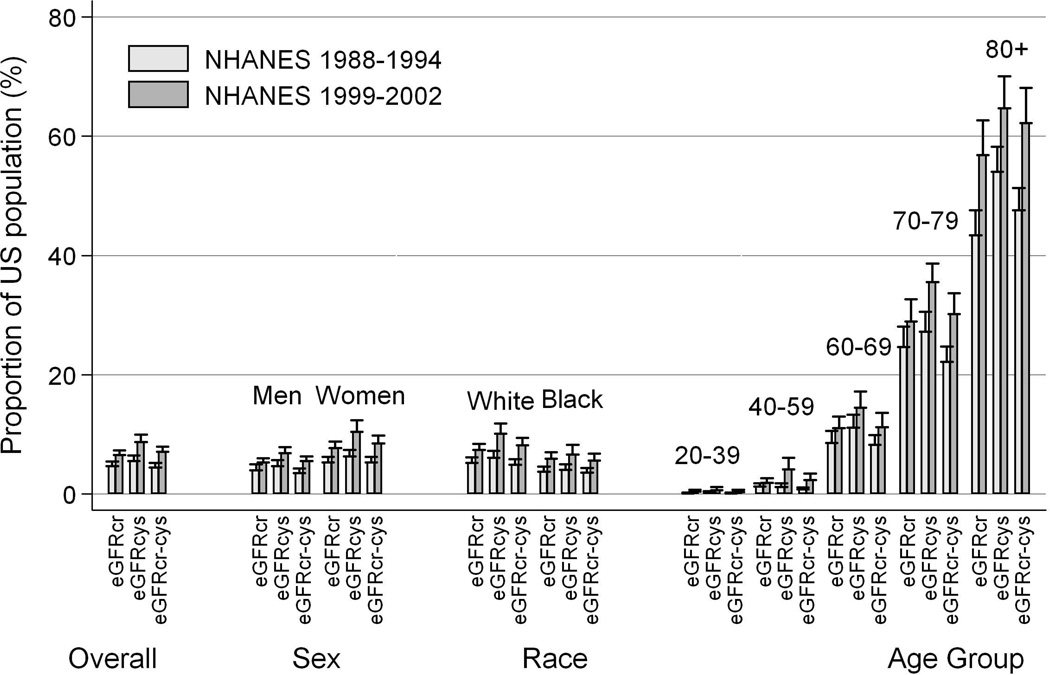
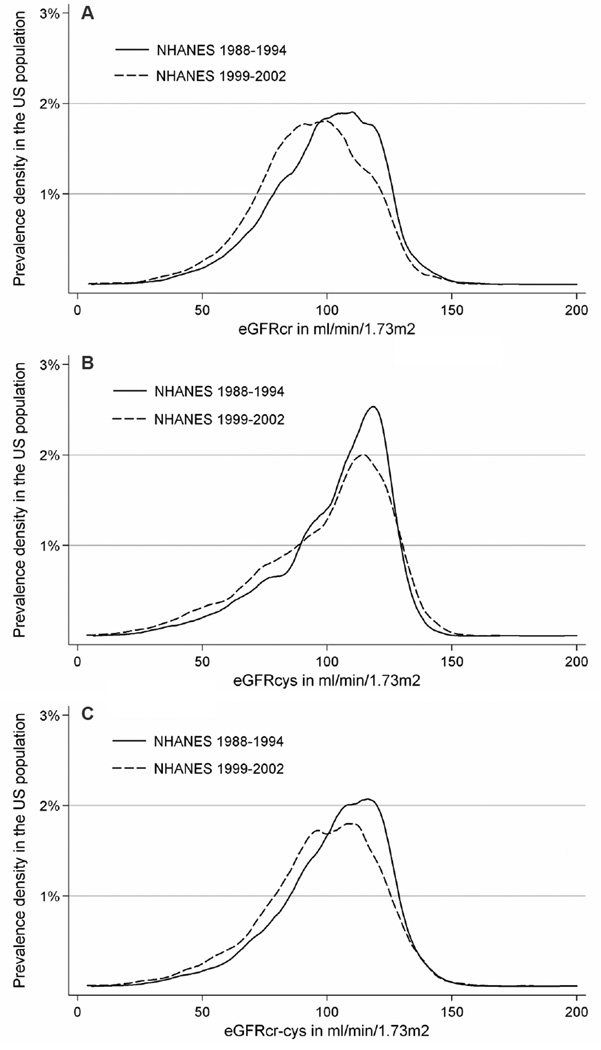
Results: Between 1988-1994 and 1999-2002, the prevalence of reduced eGFRcr, eGFRcys, and eGFRcr-cys increased from 4.7% (95% CI, 4.1%-5.3%) to 6.5% (95% CI, 5.9%-7.1%) (P < 0.001), from 5.5% (95% CI, 4.6%-6.5%) to 8.7% (95% CI, 7.5%-10.0%) (P < 0.001), and from 4.4% (95% CI, 3.7%-5.2%) to 7.1% (95% CI, 6.2%-8.0%) (P < 0.001), respectively. The higher prevalence of reduced GFR in the later period was observed in all subgroups of age, race, sex, and GFR categories. After adjusting for changes in the US population by age, sex, race, diabetes, hypertension, and body mass index, prevalence ratios of reduced GFR in the later versus earlier survey were 1.24 (95% CI, 1.09-1.45), 1.34 (95% CI, 1.15-1.67), and 1.33 (95% CI, 1.17-1.65) using eGFRcr, eGFRcys, and eGFRcr-cys, respectively.
Limitations: Likely underascertainment of persons with GFR <15 mL/min/1.73 m²; GFR was estimated and not measured; comparability of laboratory assays based on a calibration subsample.
Conclusions: The prevalence of reduced eGFRcys in the US civilian noninstitutionalized population increased between 1988-1994 and 1999-2002, confirming the increase observed in the prevalence of reduced eGFRcr.
Keywords: Cystatin C; chronic kidney disease; estimating equations; prevalence.
Copyright © 2013 National Kidney Foundation, Inc. Published by Elsevier Inc. All rights reserved.
Figures
Comment in
-
Temporal trends in prevalence of CKD: the glass is half full and not half empty.Am J Kidney Dis. 2013 Aug;62(2):214-6. doi: 10.1053/j.ajkd.2013.05.003. Am J Kidney Dis. 2013. PMID: 23883656 Free PMC article. No abstract available.
References
-
- U.S. Renal Data System: USRDS 2012 annual data report: Atlas of end-stage renal disease in the United States. Bethesda, MD: National Institutes of Health, National Institute of Diabetes and Digestive and Kidney Diseases; 2012.
-
- Chronic Kidney Disease Prognosis Consortium. Matsushita K, van der Velde M, et al. Association of estimated glomerular filtration rate and albuminuria with all-cause and cardiovascular mortality in general population cohorts: A collaborative metaanalysis. Lancet. 2010;375(9731):2073–2081. - PMC - PubMed
-
- Coresh J, Selvin E, Stevens LA, et al. Prevalence of chronic kidney disease in the united states. JAMA. 2007;298(17):2038–2047. - PubMed
Publication types
MeSH terms
Substances
Grants and funding
LinkOut - more resources
Full Text Sources
Other Literature Sources
Medical
Research Materials
Miscellaneous
