. 2013 Aug;217(2):306-16.
doi: 10.1016/j.jamcollsurg.2013.02.014. Epub 2013 Apr 23.

Optimizing reconstruction of oncologic sternectomy defects based on surgical outcomes

Affiliations

Optimizing reconstruction of oncologic sternectomy defects based on surgical outcomes

James A Butterworth et al. J Am Coll Surg. 2013 Aug.

Abstract

Background: The optimal strategy for oncologic sternectomy reconstruction has not been well characterized. We hypothesized that the major factors driving the reconstructive strategy for oncologic sternectomy include the need for skin replacement, extent of the bony sternectomy defect, and status of the internal mammary vessels.

Study design: We reviewed consecutive oncologic sternectomy reconstructions performed at The University of Texas MD Anderson Cancer Center during a 10-year period. Regression models analyzed associations between patient, defect, and treatment factors and outcomes to identify patient and treatment selection criteria. We developed a generalized management algorithm based on these data.

Results: Forty-nine consecutive patients underwent oncologic sternectomy reconstruction (mean follow-up 18 ± 23 months). More sternectomies were partial (74%) rather than total/subtotal (26%). Most defects (n = 40 [82%]) required skeletal reconstruction. Pectoralis muscle flaps were most commonly used for sternectomies with intact overlying skin (64%) and infrequently used when a presternal skin defect was present (36%; p = 0.06). Free flaps were more often used for total/subtotal vs partial sternectomy defects (75% vs 25%, respectively; p = 0.02). Complication rates for total/subtotal sternectomy and partial sternectomy were equivalent (46% vs 44%, respectively; p = 0.92).

Conclusions: Despite more extensive sternal resections, total/subtotal sternectomies resulted in equivalent postoperative complications when combined with the appropriate soft-tissue reconstruction. Good surgical and oncologic outcomes can be achieved with defect-characteristic-matched reconstructive strategies for these complex oncologic sternectomy resections.

Keywords: ADM; IM; PMM; PP; RRFS; acellular dermal matrix; internal mammary; l-lactide-co-glycolide copolymer rapidly resorbable fixation system; polymethylmethacrylate; polypropylene.


Figures

Figure 1
Figure 1
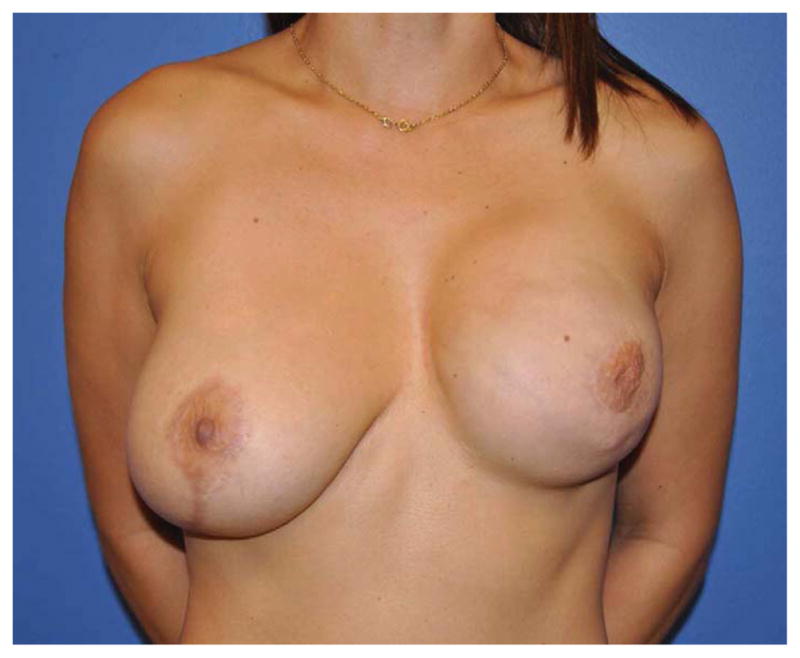
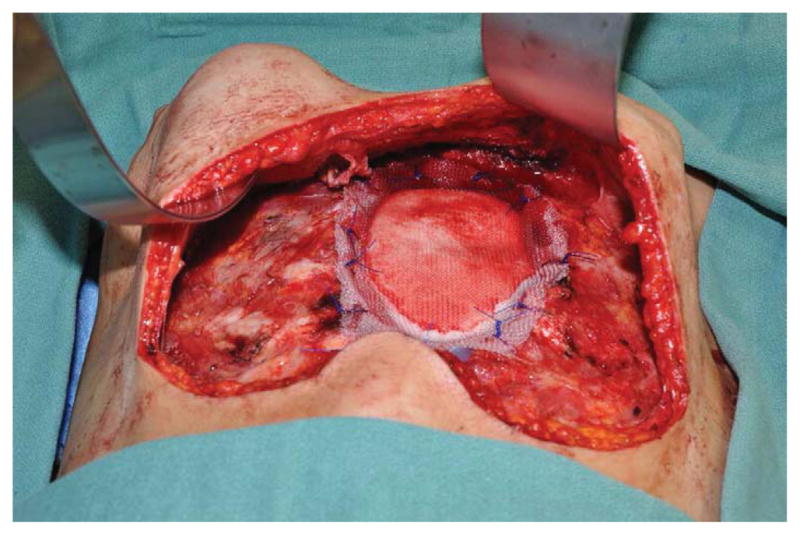
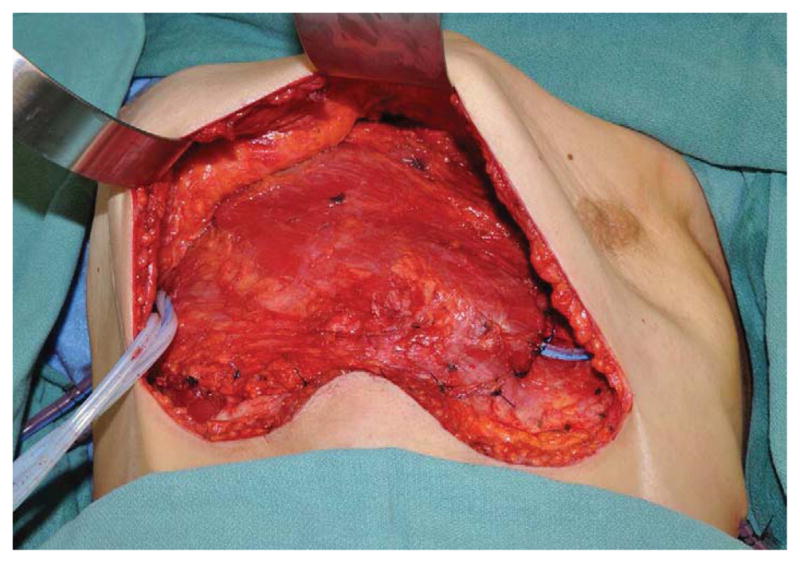
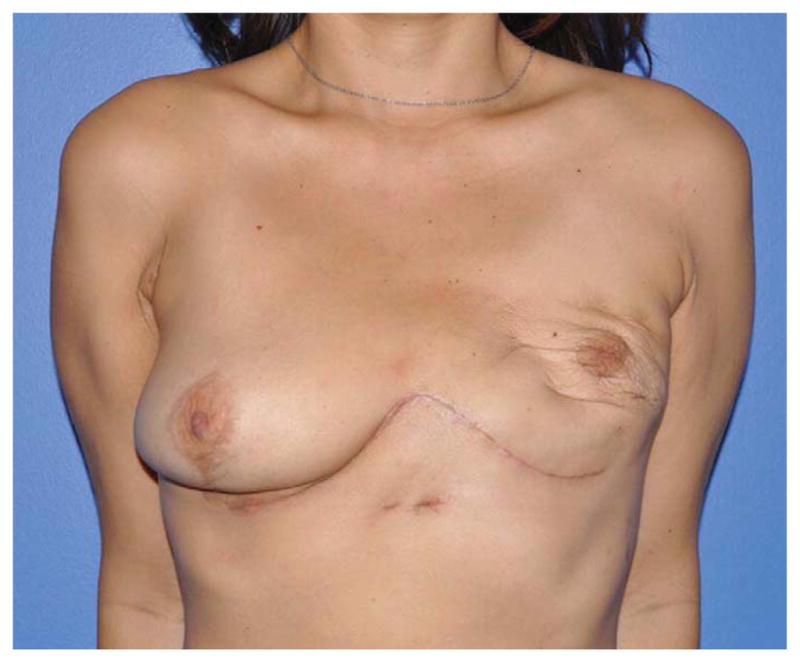
(A) Example of a subtotal sternectomy reconstruction patient. A 40-year-old female presented with metastatic breast cancer to her left sternal body five years after having undergone a left mastectomy and immediate left breast implant reconstruction at an outside facility. (B) Intraoperative appearance after a manubrium-sparing subtotal sternectomy and PMM/PP prosthesis reconstruction. (C) Intraoperative appearance after defect coverage with a right pectoralis major muscle flap pedicled on the thoracoacromial artery. (D) Six-week postoperative appearance. (E) One-year postoperative appearance after 2-stage, tissue expander/implant breast reconstruction and contralateral augmentation.
Figure 1
Figure 1
(A) Example of a subtotal sternectomy reconstruction patient. A 40-year-old female presented with metastatic breast cancer to her left sternal body five years after having undergone a left mastectomy and immediate left breast implant reconstruction at an outside facility. (B) Intraoperative appearance after a manubrium-sparing subtotal sternectomy and PMM/PP prosthesis reconstruction. (C) Intraoperative appearance after defect coverage with a right pectoralis major muscle flap pedicled on the thoracoacromial artery. (D) Six-week postoperative appearance. (E) One-year postoperative appearance after 2-stage, tissue expander/implant breast reconstruction and contralateral augmentation.
Figure 1
Figure 1
(A) Example of a subtotal sternectomy reconstruction patient. A 40-year-old female presented with metastatic breast cancer to her left sternal body five years after having undergone a left mastectomy and immediate left breast implant reconstruction at an outside facility. (B) Intraoperative appearance after a manubrium-sparing subtotal sternectomy and PMM/PP prosthesis reconstruction. (C) Intraoperative appearance after defect coverage with a right pectoralis major muscle flap pedicled on the thoracoacromial artery. (D) Six-week postoperative appearance. (E) One-year postoperative appearance after 2-stage, tissue expander/implant breast reconstruction and contralateral augmentation.
Figure 1
Figure 1
(A) Example of a subtotal sternectomy reconstruction patient. A 40-year-old female presented with metastatic breast cancer to her left sternal body five years after having undergone a left mastectomy and immediate left breast implant reconstruction at an outside facility. (B) Intraoperative appearance after a manubrium-sparing subtotal sternectomy and PMM/PP prosthesis reconstruction. (C) Intraoperative appearance after defect coverage with a right pectoralis major muscle flap pedicled on the thoracoacromial artery. (D) Six-week postoperative appearance. (E) One-year postoperative appearance after 2-stage, tissue expander/implant breast reconstruction and contralateral augmentation.
Figure 1
Figure 1
(A) Example of a subtotal sternectomy reconstruction patient. A 40-year-old female presented with metastatic breast cancer to her left sternal body five years after having undergone a left mastectomy and immediate left breast implant reconstruction at an outside facility. (B) Intraoperative appearance after a manubrium-sparing subtotal sternectomy and PMM/PP prosthesis reconstruction. (C) Intraoperative appearance after defect coverage with a right pectoralis major muscle flap pedicled on the thoracoacromial artery. (D) Six-week postoperative appearance. (E) One-year postoperative appearance after 2-stage, tissue expander/implant breast reconstruction and contralateral augmentation.
Figure 2
Figure 2
Authors’ classification for types of oncologic sternectomies. The top row depicts a partial (Type I) sternectomy. The middle row demonstrates (from left to right) a Type IIA subtotal sternectomy sparing the manubrium, a Type IIB subtotal sternectomy sparing the xiphisternum, and a Type IIC vertical hemi-sternectomy. The bottom row provides an example of a total (Type III) sternectomy. (Reprinted from The University of Texas MD Anderson Cancer Center, with permission.)
Figure 3
Figure 3
Oncologic sternectomy reconstruction algorithm. U/L, unilateral; B/L, bilateral; Pec, pectoralis muscle; TA, thoracoacromial artery; IM, internal mammary artery; VRAM, vertical rectus abdominis musculocutaneous flap.

References

    1. Noguchi S, Miyauchi K, Nishizawa Y, et al. Results of surgical treatment for sternal metastasis of breast cancer. Cancer. 1988;62:1397–401. - PubMed
    1. Carbognani P, Vagliasindi A, Costa P, et al. Surgical treatment of primary and metastatic sternal tumours. J Cardiovasc Surg (Torino) 2001;42:411–414. - PubMed
    1. Pairolero PC, Arnold PG, Harris JB. Long-term results of pectoralis major muscle transposition for infected sternotomy wounds. Ann Surg. 1991;213:583–589. - PMC - PubMed
    1. Pairolero PC, Arnold PG. Management of recalcitrant median sternotomy wounds. J Thorac Cardiovasc Surg. 1984;88:357–364. - PubMed
    1. Jurkiewicz MJ, Bostwick J, 3rd, Hester TR, et al. Infected median sternotomy wound. Successful treatment by muscle flaps. Ann Surg. 1980;191:738–744. - PMC - PubMed

Publication types