. 2013 Jul;41(12):6175-89.
doi: 10.1093/nar/gkt302. Epub 2013 Apr 25.

Differential regulation by ppGpp versus pppGpp in Escherichia coli

Affiliations

Differential regulation by ppGpp versus pppGpp in Escherichia coli

Undine Mechold et al. Nucleic Acids Res. 2013 Jul.

Abstract

Both ppGpp and pppGpp are thought to function collectively as second messengers for many complex cellular responses to nutritional stress throughout biology. There are few indications that their regulatory effects might be different; however, this question has been largely unexplored for lack of an ability to experimentally manipulate the relative abundance of ppGpp and pppGpp. Here, we achieve preferential accumulation of either ppGpp or pppGpp with Escherichia coli strains through induction of different Streptococcal (p)ppGpp synthetase fragments. In addition, expression of E. coli GppA, a pppGpp 5'-gamma phosphate hydrolase that converts pppGpp to ppGpp, is manipulated to fine tune differential accumulation of ppGpp and pppGpp. In vivo and in vitro experiments show that pppGpp is less potent than ppGpp with respect to regulation of growth rate, RNA/DNA ratios, ribosomal RNA P1 promoter transcription inhibition, threonine operon promoter activation and RpoS induction. To provide further insights into regulation by (p)ppGpp, we have also determined crystal structures of E. coli RNA polymerase-σ(70) holoenzyme with ppGpp and pppGpp. We find that both nucleotides bind to a site at the interface between β' and ω subunits.


Figures
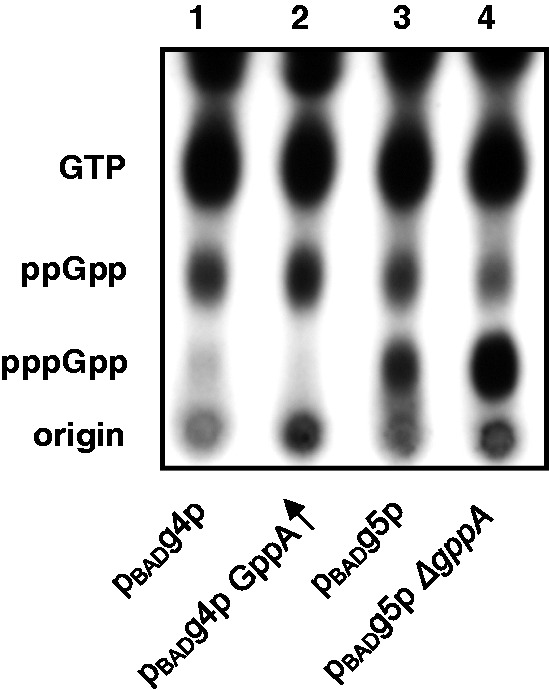
Figure 1.
Figure 1.
Arabinose induction of cellular ppGpp or pppGpp. An autogradiogram is shown of cell extracts of 32P-labeled GTP, ppGpp and pppGpp resolved by TLC after 0.05% arabinose induction (see ‘Materials and Methods’ section). Lane abbreviations: Lane 1. pBADg4p = (ppGpp synthetase): pBADRelSeq79-385 (pUM9); Lane 2. GppA↑ = (ppGpp synthetase + overexpressed gppA): pBADg4p + PgppA (pUM76); Lane 3. pBADg5p = (pppGpp synthetase): pBADRelSeq1-385 (pUM66); Lane 4. pBADg5p ΔgppA = (pppGpp synthetase + ΔgppA).
Figure 2.
Figure 2.
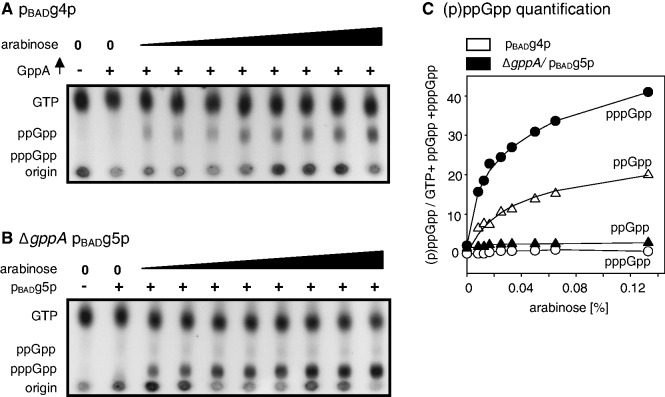
ppGpp versus pppGpp: effects of incremental arabinose concentrations. (A) An autoradiogram showing ppGpp accumulation in cells with: lane 1. an uninduced pBAD vector; lane 2. an uninduced pBADg4p + PgppA; lanes 3–10. pBADg4p + PgppA-induced experimental samples containing increasing arabinose concentrations 0.008, 0.012, 0.01, 0.025, 0.033, 0.05, 0.065 and 0.133%. (B) An autoradiogram showing pppGpp accumulation in cells with: lane 1. an uninduced pBAD vector ΔgppA control; lane 2. an uninduced pBADg5p ΔgppA control; lanes 3–10. induced experimental samples with arabinose concentrations as in Panel A. (C) The relation between inducing arabinose concentrations and the fractional content of ppGpp and pppGpp (percentage total of ppGpp/GTP + ppGpp + pppGpp). Data from Panel (A) were used to calculate preferential accumulation of ppGpp (open triangles) and of minority pppGpp (filled circles). Analogous values are taken from data in panel (B) for preferential accumulation of pppGpp (filled circles) and minority ppGpp (filled triangles). The ordinate numerical values for the fractional content of ppGpp or pppGpp are given in percentage.
Figure 3.
Figure 3.
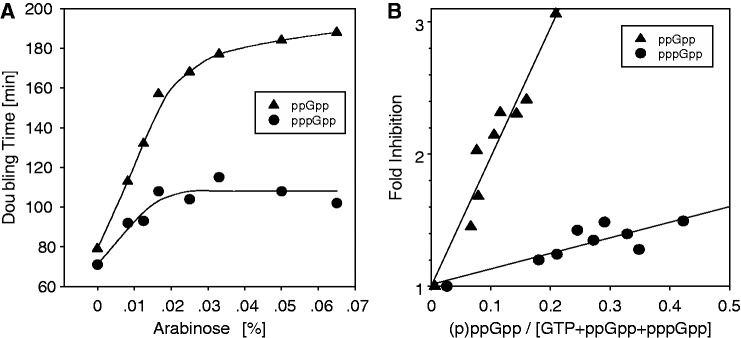
ppGpp versus pppGpp: effects of induction on growth rates and specific activities for growth inhibition. (A) The relation between the observed growth rate (doubling times expressed in minutes) of cells subjected to increasing concentrations of arabinose is shown when ppGpp (filled circles) preferentially accumulates as in Figure 2A as well as when pppGpp (filled triangles) preferentially accumulates as in Figure 2B. (B) The inhibitory activities of increasing the fractional content of ppGpp or pppGpp. The fractional growth rates are calculated from the growth rates expressed as μ (doublings/hr from Figure 3A), which are normalized to μ values for uninduced cultures and expressed as fold-inhibition on the ordinate. These values are plotted against the ppGpp or pppGpp fractional content (from Figure 2C). The slopes of these relations are taken as a measure of the relative specific activity for growth inhibition for ppGpp or pppGpp. Filled circles = pppGpp. These values are corrected for contribution to growth inhibition of the 5% content of ppGpp present in each sample seen in Panel (B) of Figure 2. Filled triangles = ppGpp [not corrected for ∼0.5% content of pppGpp in Panel (A) of Figure 2].
Figure 4.
Figure 4.
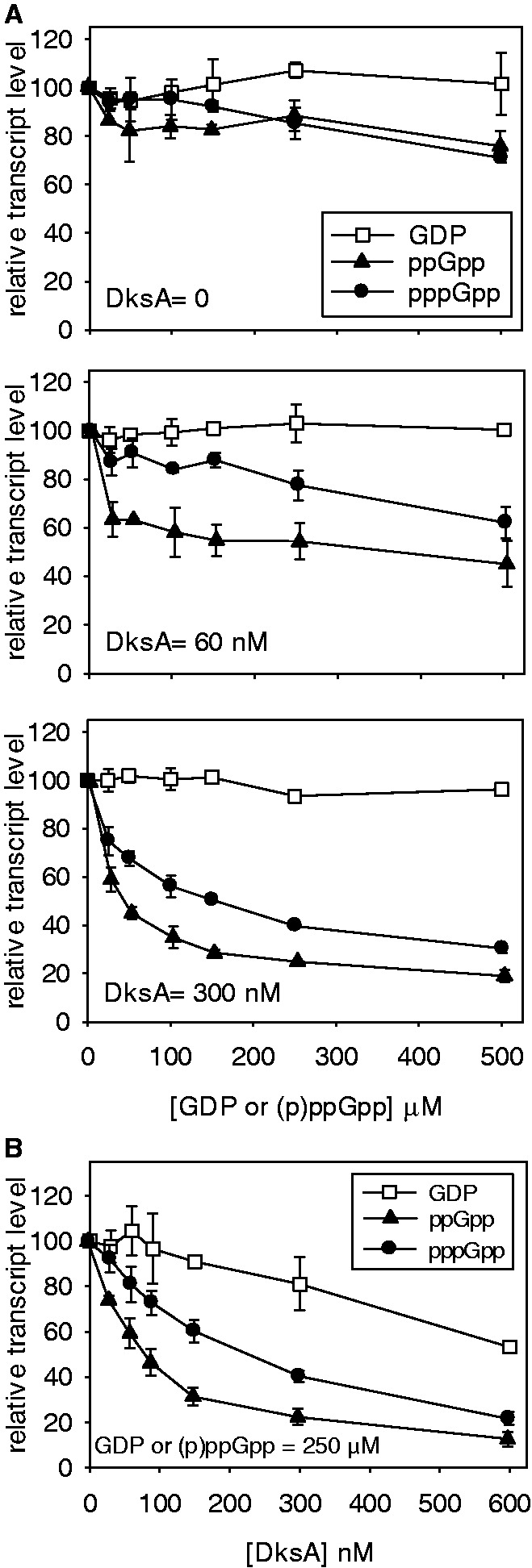
ppGpp versus pppGpp: inhibition of rrnB P1 promoter in vitro. Multi-round in vitro transcription was carried out with (A) increasing (0–500 µM) GDP, ppGpp or pppGpp, and constant DksA concentrations indicated (0, 60 and 300 nM); and (B) increasing DksA (0–600 nM) and constant (250 µM) GDP, ppGpp or pppGpp. Open squares = GDP, filled triangles = ppGpp, filled circles = pppGpp.
Figure 5.
Figure 5.
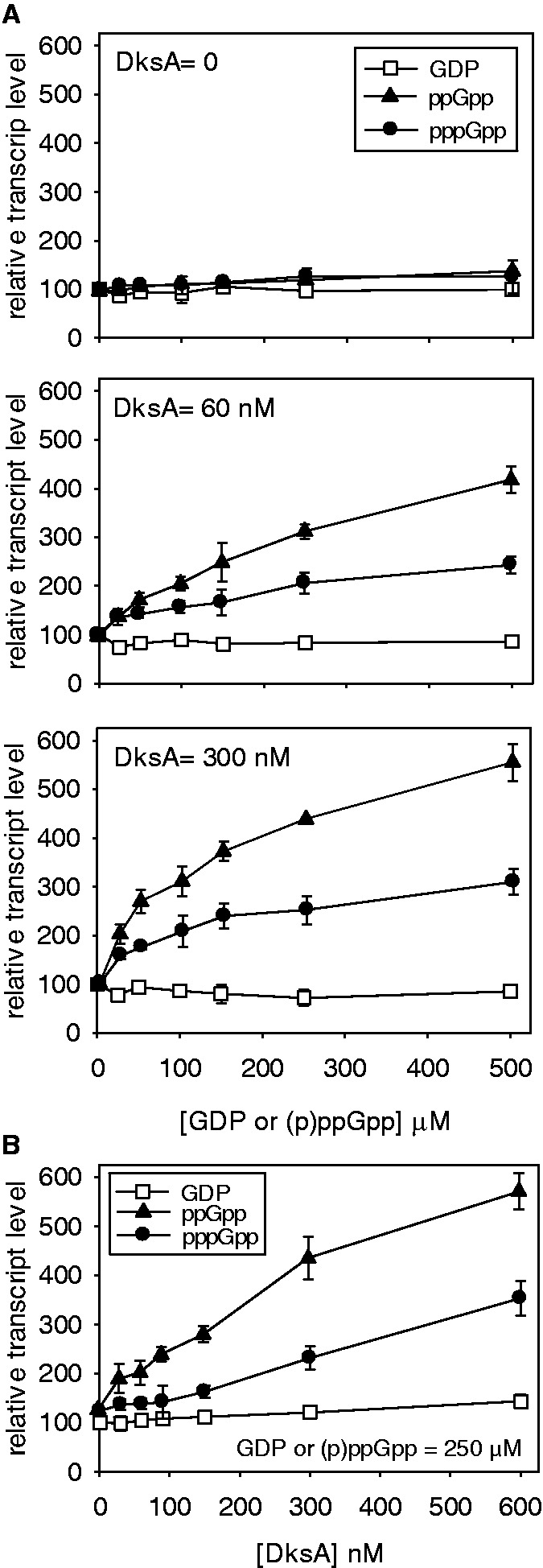
ppGpp versus pppGpp: activation of pthr promoter in vitro. Multi-round in vitro transcription was carried out with (A) increasing (0–500 µM) GDP, ppGpp or pppGpp, and constant DksA concentrations indicated (0, 60 and 300 nM); and (B) increasing DksA (0–600 nM) and constant (250 µM) GDP, ppGpp or pppGpp. Open squares = GDP, filled triangles = ppGpp, filled circles = pppGpp.
Figure 6.
Figure 6.
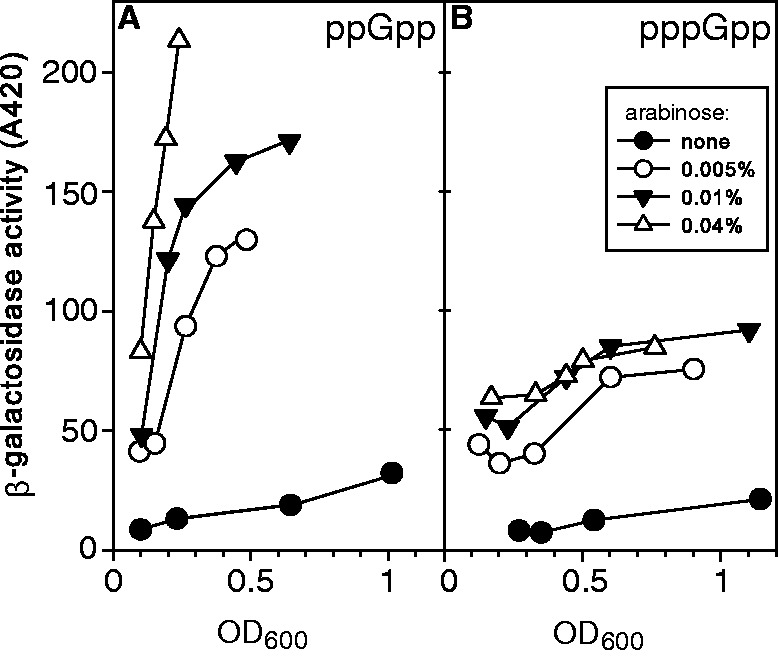
ppGpp versus pppGpp: Stimulation of RpoS-lac protein fusion β-galactosidase activity. Cells containing a single chromosomal copy of a ppGpp-activated RpoS-lac protein fusion were transformed with plasmids to preferentially induce ppGpp (strain CF16838) or pppGpp (CF16839) as in Figure 1. Each culture at indicated cell densities was assayed for β-galactosidase activity as described in ‘Materials and Methods’ section. (A) After adding arabinose (0, 0.005, 0.01 or 0.04%) to preferentially induce ppGpp, cultures were grown with doubling times of 63, 97, 157 and 190 min, respectively. (B) Analogous but preferential induction of pppGpp using the same arabinose concentrations, which resulted in doubling times of 65, 84, 99 and 139 min, respectively.
Figure 7.
Figure 7.
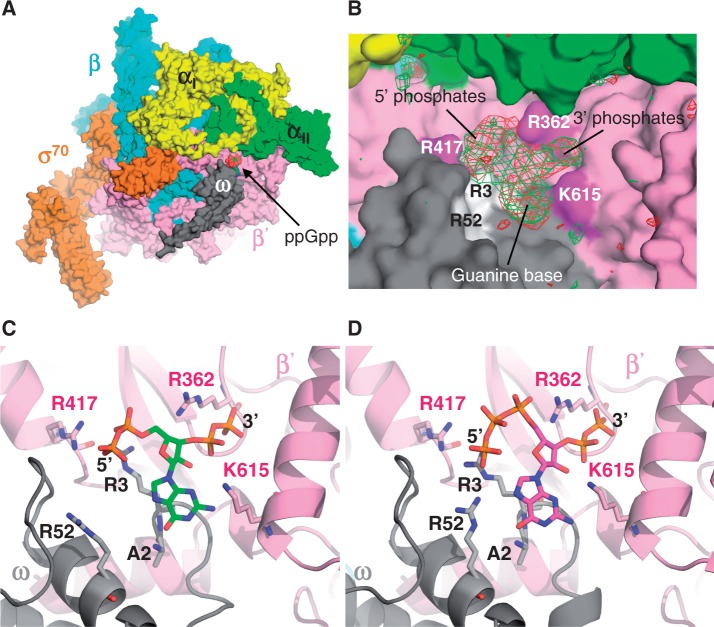
RNA polymerase – (p)ppGpp complex structures. (A) Overall structure of the E. coli RNA polymerase–ppGpp complex. RNA polymerase is depicted as a molecular surface model (αI: yellow, αII: green, β: cyan, β’: pink, ω: gray, σ70: orange). The ppGpp is depicted as a sphere model and its binding site is indicated. (B) Electron density maps showing ppGpp (green) and pppGpp (red) found in the complexes with RNA polymerase. Basic residues of β′ and ω subunits are indicated and regions of density maps corresponding to the 5′ and 3′ phosphates and the guanosine base are indicated. (C) Binding sites of the ppGpp and (D) pppGpp. Amino acid residues of β′ (pink stick) and ω subunits (gray stick) involved in (p)ppGpp binding are depicted on the cartoon models of β′ (pink) and ω subunits (gray). (p)ppGpp are shown as stick models.

Comment in

References

    1. Potrykus K, Cashel M. (p)ppGpp: still magical? Annu. Rev. Microbiol. 2008;62:35–51. - PubMed
    1. Cashel M, Genrty DR, Hernandez VJ, Vinella D. In: Escherichia coli and Salmonella: Cellular and Molecular Biology. 2nd edn. Neidhardt FC, et al., editors. Washington, DC: ASM Press; 1996. pp. 1458–1496.
    1. Cashel M. The control of ribonucleic acid synthesis in Escherichia coli. IV. Relevance of unusual phosphorylated compounds from amino acid-starved stringent strains. J. Biol. Chem. 1969;244:3133–3141. - PubMed
    1. Laffler T, Gallant JA. Stringent control of protein synthesis in E. coli. Cell. 1974;3:47–49. - PubMed
    1. Lazzarini RA, Cashel M, Gallant J. On the regulation of guanosine tetraphosphate levels in stringent and relaxed strains of Escherichia coli. J. Biol. Chem. 1971;246:4381–4385. - PubMed

Publication types

MeSH terms