


ATM kinase inhibition preferentially sensitizes p53-mutant glioma to ionizing radiation
- PMID: 23620409
- PMCID: PMC3687028
- DOI: 10.1158/1078-0432.CCR-12-3408
ATM kinase inhibition preferentially sensitizes p53-mutant glioma to ionizing radiation
Abstract
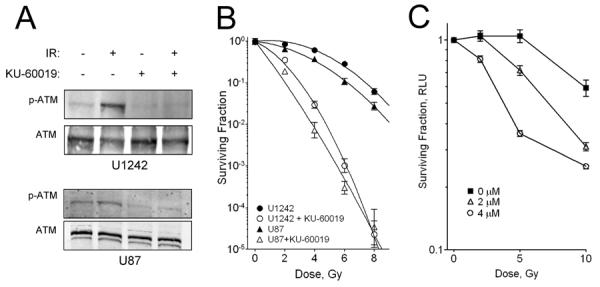
Purpose: Glioblastoma multiforme (GBM) is the most lethal form of brain cancer with a median survival of only 12 to 15 months. Current standard treatment consists of surgery followed by chemoradiation. The poor survival of patients with GBM is due to aggressive tumor invasiveness, an inability to remove all tumor tissue, and an innate tumor chemo- and radioresistance. Ataxia-telangiectasia mutated (ATM) is an excellent target for radiosensitizing GBM because of its critical role in regulating the DNA damage response and p53, among other cellular processes. As a first step toward this goal, we recently showed that the novel ATM kinase inhibitor KU-60019 reduced migration, invasion, and growth, and potently radiosensitized human glioma cells in vitro.
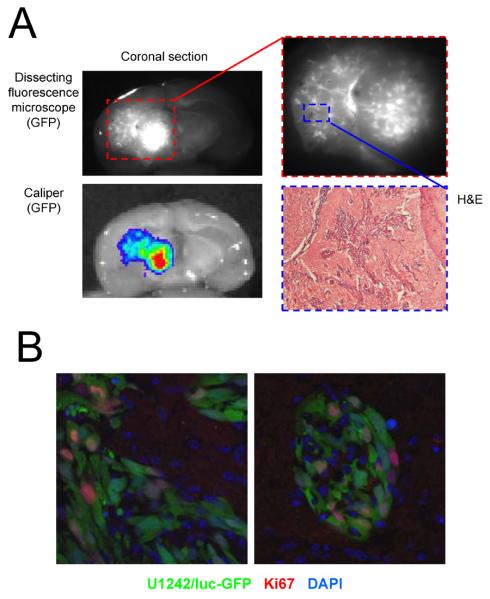
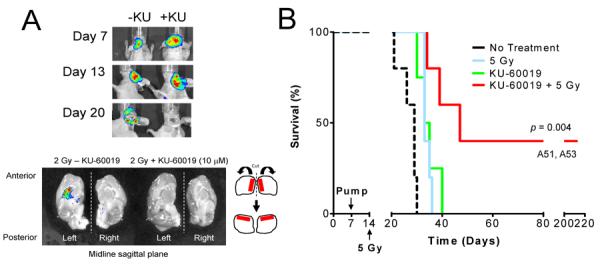
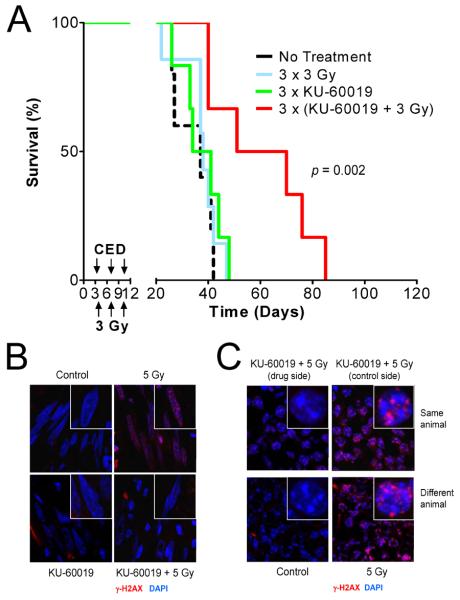
Experimental design: Using orthotopic xenograft models of GBM, we now show that KU-60019 is also an effective radiosensitizer in vivo. Human glioma cells expressing reporter genes for monitoring tumor growth and dispersal were grown intracranially, and KU-60019 was administered intratumorally by convection-enhanced delivery or osmotic pump.
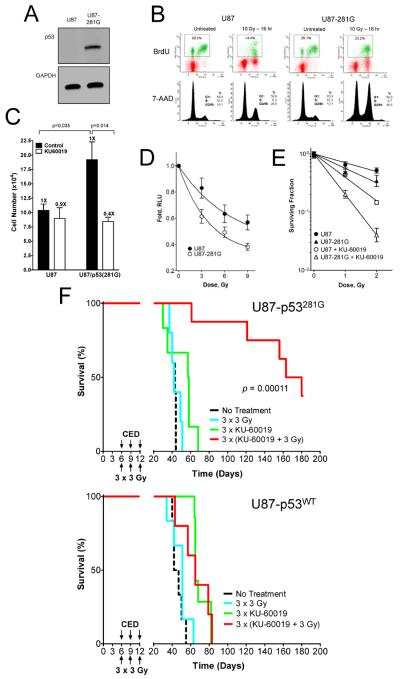
Results: Our results show that the combined effect of KU-60019 and radiation significantly increased survival of mice 2- to 3-fold over controls. Importantly, we show that glioma with mutant p53 is much more sensitive to KU-60019 radiosensitization than genetically matched wild-type glioma.
Conclusions: Taken together, our results suggest that an ATM kinase inhibitor may be an effective radiosensitizer and adjuvant therapy for patients with mutant p53 brain cancers.
Figures
References
-
- Kleihues P, Burger PC, Scheithauer BW. The new WHO classification of brain tumours. Brain Pathol. 1993;3:255–68. - PubMed
-
- Furnari FB, Fenton T, Bachoo RM, Mukasa A, Stommel JM, Stegh A, et al. Malignant astrocytic glioma: genetics, biology, and paths to treatment. Genes Dev. 2007;21:2683–710. - PubMed
-
- Huse JT, Holland EC. Targeting brain cancer: advances in the molecular pathology of malignant glioma and medulloblastoma. Nature reviews Cancer. 2010;10:319–31. - PubMed
-
- Charles NA, Holland EC, Gilbertson R, Glass R, Kettenmann H. The brain tumor microenvironment. Glia. 2011;59:1169–80. - PubMed
Publication types
MeSH terms
Substances
Grants and funding
- P30NS047463/NS/NINDS NIH HHS/United States
- R01NS064593/NS/NINDS NIH HHS/United States
- T32 CA113277/CA/NCI NIH HHS/United States
- P30 NS047463/NS/NINDS NIH HHS/United States
- P30CA016059/CA/NCI NIH HHS/United States
- P30 CA016059/CA/NCI NIH HHS/United States
- T32CA113277/CA/NCI NIH HHS/United States
- R01 NS064593/NS/NINDS NIH HHS/United States
- T32CA085159/CA/NCI NIH HHS/United States
- T32 CA085159/CA/NCI NIH HHS/United States
- F30 CA171893/CA/NCI NIH HHS/United States
- R21 CA156995/CA/NCI NIH HHS/United States
- F30CA171893/CA/NCI NIH HHS/United States
- R21CA156995/CA/NCI NIH HHS/United States
- S10 RR022443/RR/NCRR NIH HHS/United States
LinkOut - more resources
Full Text Sources
Other Literature Sources
Medical
Research Materials
Miscellaneous
