


Relative and attributable diabetes risk associated with hyperuricemia in US veterans with gout
- PMID: 23620537
- PMCID: PMC3713590
- DOI: 10.1093/qjmed/hct093
Relative and attributable diabetes risk associated with hyperuricemia in US veterans with gout
Abstract
Background: Hyperuricemia is known to be a risk factor for incident type 2 diabetes mellitus, but the absolute magnitude of the association is not known. We aimed to evaluate the strength of association between hyperuricemia and the risk of developing diabetes among the US veterans with gout.
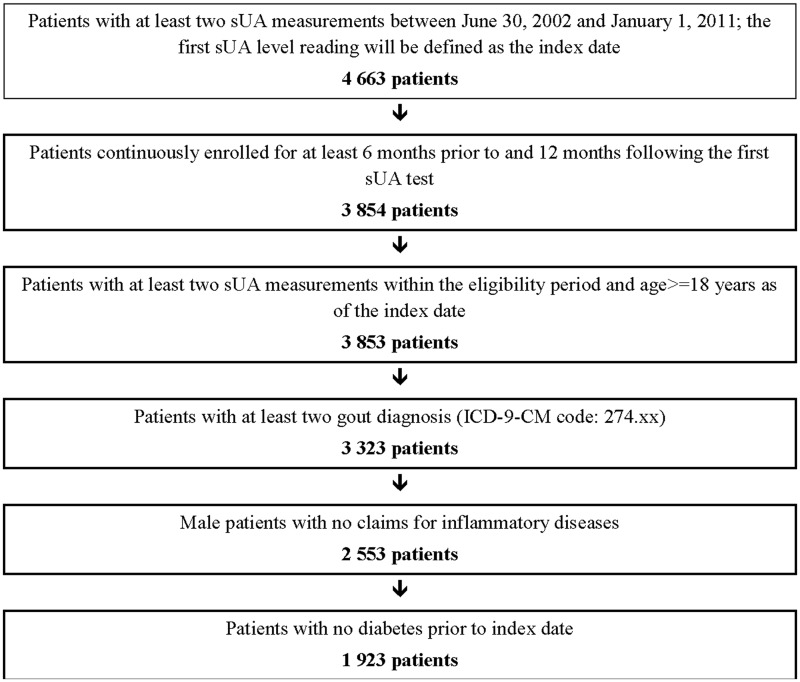
Methods: Patients (age ≥ 18 years) with ≥2 clinical encounters with gout diagnoses, no history of inflammatory diseases or diabetes and two serum urate (sUA) measurements between 1 January 2002 and 1 January 2011 were selected. Diabetes was identified using International Classification of Disease-9-Clinical Modification codes, use of anti-diabetic medications or HbA1c ≥6.5%. sUA levels were assessed at 6-month cycles (hyperuricemia: sUA >7 mg/dl). Accumulated hazard curves for time to first diabetes diagnosis were derived from Kaplan-Meier (KM) analysis. Risk of diabetes associated with hyperuricemia was estimated using a Cox proportional hazards model. Population attributable fraction (AF) of new-onset diabetes within 1 year was estimated using logistic regression.
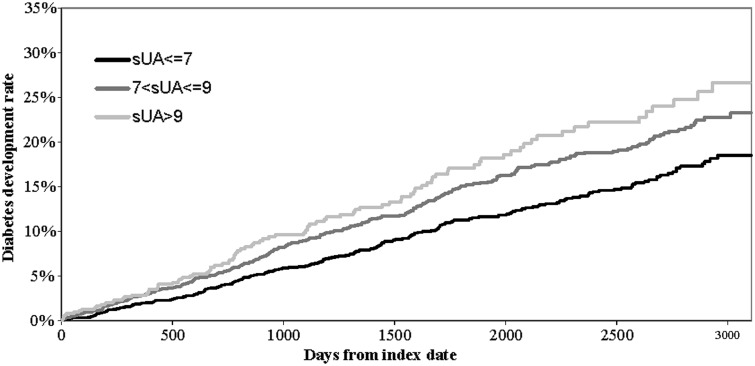
Results: Among 1923 patients, average age was 62.9 years, body mass index was 30.6 kg/m(2), and follow-up time was 80 months. Diabetes rates from KM were 19% for sUA ≤ 7 mg/dl, 23% for 7 mg/dl < sUA ≤ 9 mg/dl and 27% for sUA > 9 mg/dl at the end of follow-up period (P < 0.001). Hyperuricemia was associated with a significantly higher risk of developing diabetes, after adjusting for confounding factors (hazard ratio: 1.19, 95% confidence interval: [1.01-1.41]). Approximately, 8.7% of all new cases of diabetes were statistically attributed to hyperuricemia.
Conclusions: Among veterans, hyperuricemia was associated with excess risk for developing diabetes. Approximately, 1 in 11 new cases of diabetes were statistically attributed to hyperuricemia.
Figures
References
-
- Doherty M. New insights into the epidemiology of gout. Rheumatology (Oxford) 2009;48(Suppl. 2):ii2–8. - PubMed
-
- Zhu Y, Pandya BJ, Choi HK. Prevalence of gout and hyperuricemia in the US general population: the National Health and Nutrition Examination Survey 2007-2008. Arthritis Rheum. 2011;63:3136–41. - PubMed
-
- Pillinger MH, Goldfarb DS, Keenan RT. Gout and its comorbidities. Bull NYU Hosp Jt Dis. 2010;68:199–203. - PubMed
-
- Choi HK, De Vera MA, Krishnan E. Gout and the risk of type 2 diabetes among men with a high cardiovascular risk profile. Rheumatology. 2008;47:1567–70. - PubMed
Publication types
MeSH terms
Substances
LinkOut - more resources
Full Text Sources
Other Literature Sources
Medical
