


Early responses predict better outcomes in patients with newly diagnosed chronic myeloid leukemia: results with four tyrosine kinase inhibitor modalities
- PMID: 23620574
- PMCID: PMC3743466
- DOI: 10.1182/blood-2013-03-490128
Early responses predict better outcomes in patients with newly diagnosed chronic myeloid leukemia: results with four tyrosine kinase inhibitor modalities
Abstract
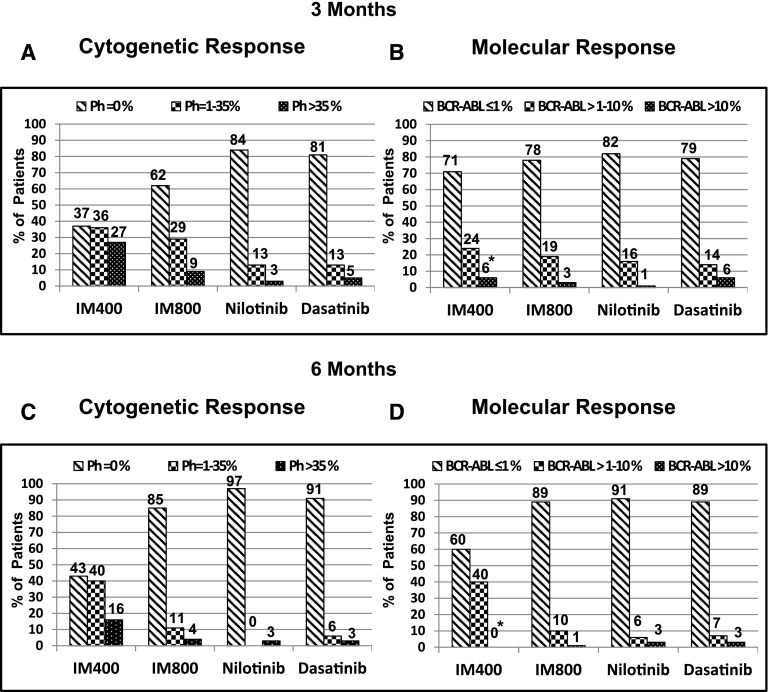
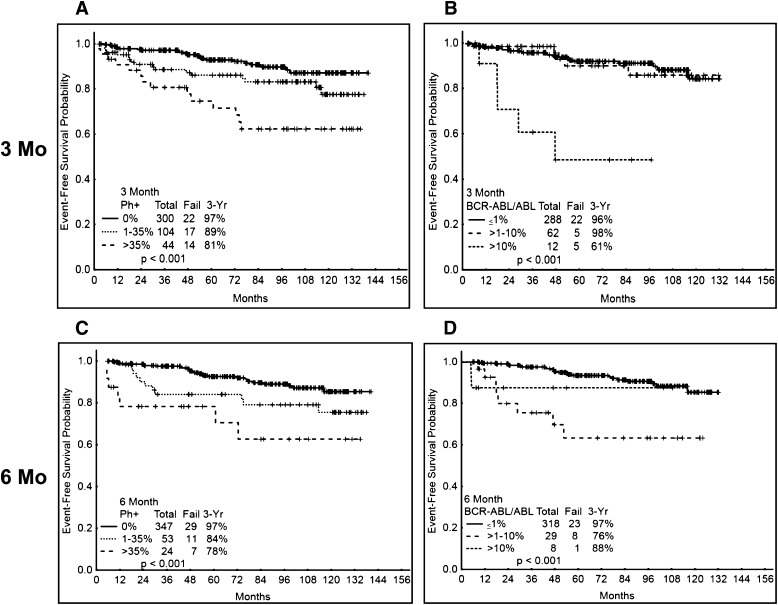
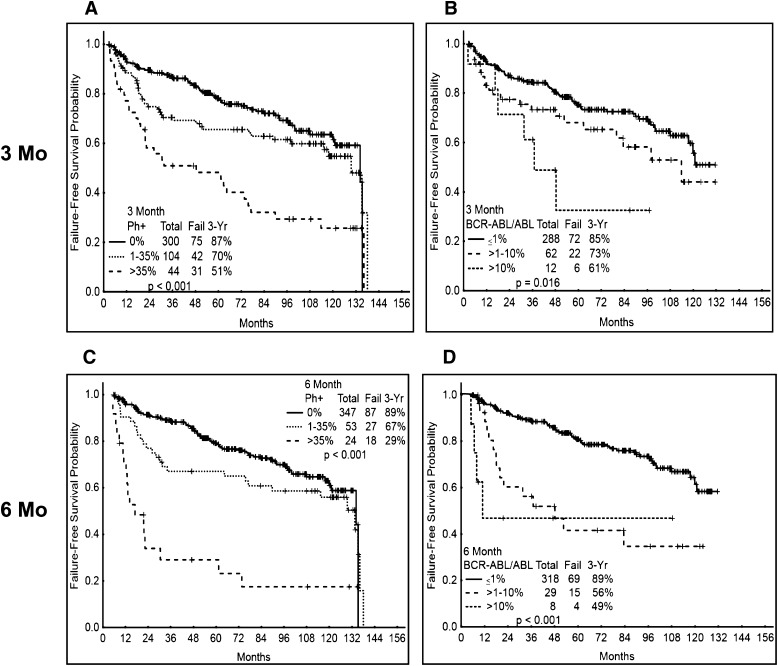
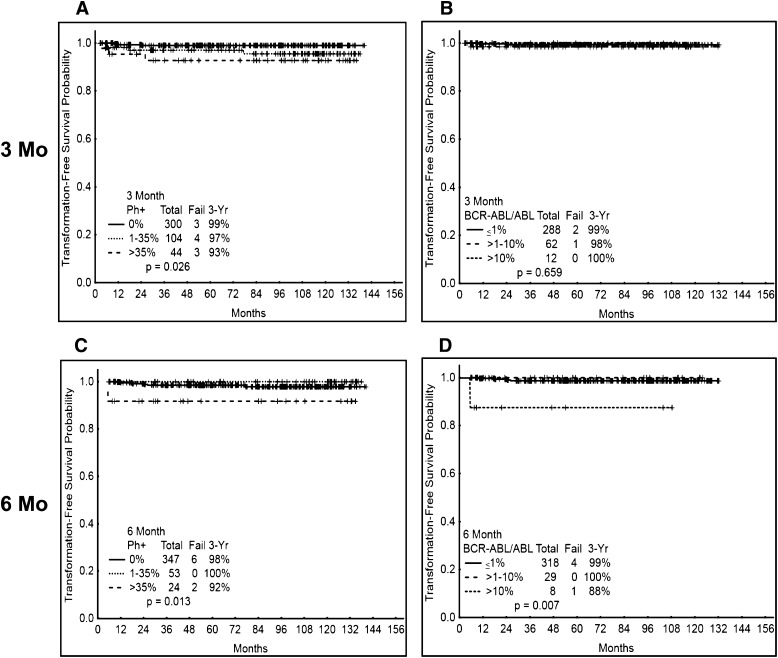
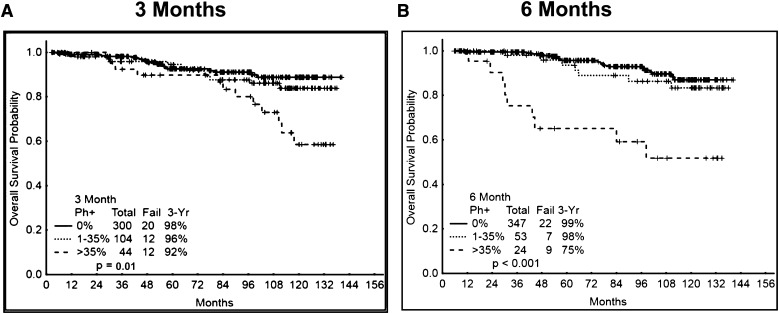
Early responses to tyrosine kinase inhibitors (TKIs) in chronic myeloid leukemia (CML)-chronic phase (CP) are associated with improved outcome. We analyzed the impact of such a response on outcomes among patients treated with 4 TKI modalities as frontline therapy in CML-CP. A total of 483 patients who received 400 or 800 mg imatinib, nilotinib, or dasatinib were analyzed. The median follow-up was 72 mo. Landmark analysis at 3 mo by molecular response showed that the cumulative proportions of 3-y event-free survival (EFS) for 3-mo BCR-ABL levels was 95% for those with ≤1%, 98% for >1% to 10%, and 61% for those with >10% (P = .001). The corresponding values by cytogenetic responses were 97% if Ph+ = 0%, 89% if Ph+ = 1% to 35%, and 81% if Ph+ >35% (P = .001). Cytogenetic response at 3 mo significantly discriminated for 3-y overall survival (OS): 98%, 96%, and 92%, respectively (P = .01). In multivariate analysis, young patients, high Sokal index, and treatment with imatinib 400 significantly predicted for poor (>35%) cytogenetic response at 3 mo. Early responses are predictive for EFS and failure-free survival and to a lesser extent OS, regardless of the treatment modality, although therapies other than standard-dose imatinib result in higher rates of deep early responses.
Trial registration: ClinicalTrials.gov NCT00038649 NCT00048672 NCT00050531 NCT00129740 NCT00254423 NCT00333840.
Figures
References
-
- Deininger M, O'Brien SG, Guilhot F, et al. International Randomized Study of Interferon vs STI571 (IRIS) 8-year follow up: sustained survival and low risk for progression or events in patients with newly diagnosed chronic myeloid leukemia in chronic phase (CML-CP) treated with imatinib. [Abstract]. Blood. 2009;114(22):Abstract−1126.
-
- Apperley JF. Part I: mechanisms of resistance to imatinib in chronic myeloid leukaemia. Lancet Oncol. 2007;8(11):1018–1029. - PubMed
-
- von Bubnoff N, Schneller F, Peschel C, Duyster J. BCR-ABL gene mutations in relation to clinical resistance of Philadelphia-chromosome-positive leukaemia to STI571: a prospective study. Lancet. 2002;359(9305):487–491. - PubMed
-
- Saglio G, Kim DW, Issaragrisil S, et al. ENESTnd Investigators. Nilotinib versus imatinib for newly diagnosed chronic myeloid leukemia. N Engl J Med. 2010;362(24):2251–2259. - PubMed
-
- Larson RA, Hochhaus A, Hughes TP, et al. Nilotinib vs imatinib in patients with newly diagnosed Philadelphia chromosome-positive chronic myeloid leukemia in chronic phase: ENESTnd 3-year follow-up. Leukemia. 2012;26(10):2197–2203. - PubMed
Publication types
MeSH terms
Substances
Associated data
Grants and funding
LinkOut - more resources
Full Text Sources
Other Literature Sources
Medical
Miscellaneous
