


The evidence for association of ATP2B2 polymorphisms with autism in Chinese Han population
- PMID: 23620727
- PMCID: PMC3631200
- DOI: 10.1371/journal.pone.0061021
The evidence for association of ATP2B2 polymorphisms with autism in Chinese Han population
Abstract
Background: Autism is a neurodevelopmental disorder with a high estimated heritability. ATP2B2, located on human chromosome 3p25.3, encodes the plasma membrane calcium-transporting ATPase 2 which extrudes Ca(2+) from cytosol into extracellular space. Recent studies reported association between ATP2B2 and autism in samples from Autism Genetic Resource Exchange (AGRE) and Italy. In this study, we investigated whether ATP2B2 polymorphisms were associated with autism in Chinese Han population.
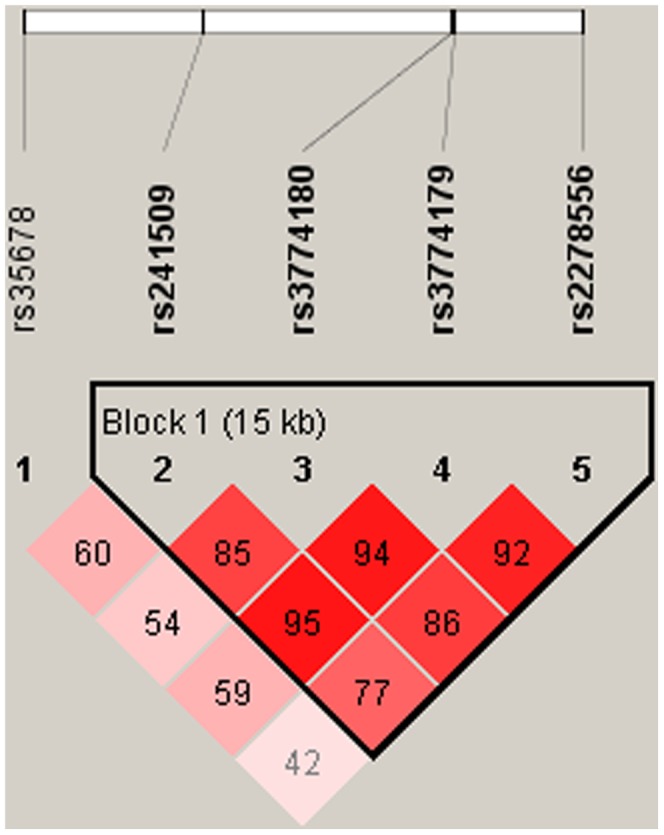
Methods: We performed a family based association study between five SNPs (rs35678 in exon, rs241509, rs3774180, rs3774179, and rs2278556 in introns) in ATP2B2 and autism in 427 autism trios of Han Chinese descent. All SNPs were genotyped using the Sequenom genotyping platform. The family-based association test (FBAT) program was used to perform association test for SNPs and haplotype analyses.
Results: This study demonstrated a preferential transmission of T allele of rs3774179 to affected offsprings under an additive model (T>C, Z = 2.482, p = 0.013). While C allele of rs3774179 showed an undertransmission from parents to affected children under an additive and a dominant model, respectively (Z = -2.482, p = 0.013; Z = -2.591, p = 0.0096). Haplotype analyses revealed that three haplotypes were significantly associated with autism. The haplotype C-C (rs3774180-rs3774179) showed a significant undertransmission from parents to affected offsprings both in specific and global haplotype FBAT (Z = -2.037, p = 0.042; Global p = 0.03). As for the haplotype constructed by rs3774179 and rs2278556, C-A might be a protective haplotype (Z = -2.206, p = 0.027; Global p = 0.04), while T-A demonstrated an excess transmission from parents to affected offsprings (Z = 2.143, p = 0.032). These results were still significant after using the permutation method to obtain empirical p values.
Conclusions: Our research suggested that ATP2B2 might play a role in the etiology of autism in Chinese Han population.
Conflict of interest statement
Figures
References
-
- American Psychiatric Association, Washington DC (1994) Diagnostic and statistical manual of mental disorders, Fourth Edition.
-
- Fombonne E (2005) Epidemiology of autistic disorder and other pervasive developmental disorders. J Clin Psychiatry 66 Suppl 103–8. - PubMed
-
- Folstein S, Rutter M (1977) Infantile autism: a genetic study of 21 twin pairs. J Child Psychol Psychiatry 18: 297–321. - PubMed
-
- Steffenburg S, Gillberg C, Hellgren L, Andersson L, Gillberg IC, et al. (1989) A twin study of autism in Denmark, Finland, Iceland, Norway and Sweden. J Child Psychol Psychiatry 30: 405–416. - PubMed
-
- Bailey A, Le Couteur A, Gottesman I, Bolton P, Simonoff E, et al. (1995) Autism as a strongly genetic disorder: evidence from a British twin study. Psychol Med 25: 63–77. - PubMed
Publication types
MeSH terms
Substances
LinkOut - more resources
Full Text Sources
Other Literature Sources
Research Materials
Miscellaneous
