


Reproducibility of non-invasive assessment of skin endothelial function using laser Doppler flowmetry and laser speckle contrast imaging
- PMID: 23620742
- PMCID: PMC3631172
- DOI: 10.1371/journal.pone.0061320
Reproducibility of non-invasive assessment of skin endothelial function using laser Doppler flowmetry and laser speckle contrast imaging
Abstract
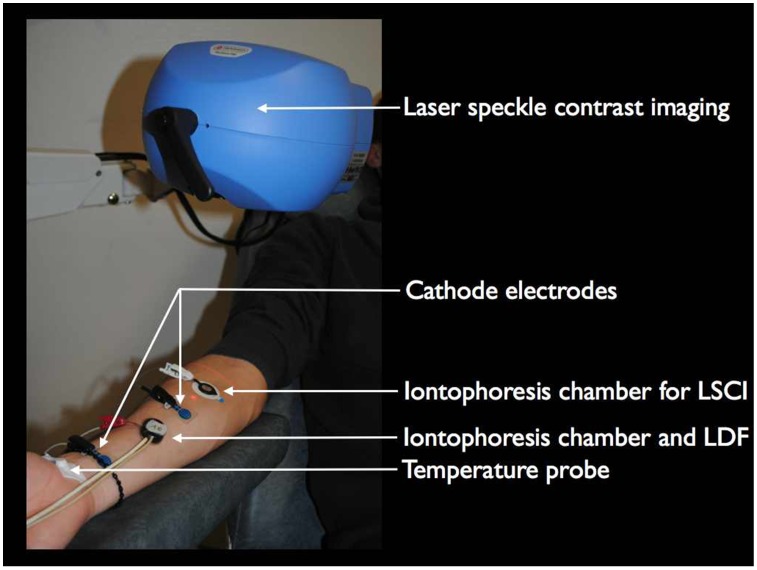
Background: Endothelial dysfunction precedes atherosclerosis. Vasodilation induced by acetylcholine (ACh) is a specific test of endothelial function. Reproducibility of laser techniques such as laser-Doppler-flowmetry (LDF) and Laser-speckle-contrast-imaging (LSCI) to detect ACh vasodilation is debated and results expressions lack standardization. We aimed to study at a 7-day interval (i) the inter-subject reproducibility, (ii) the intra-subjects reproducibility, and (iii) the effect of the results expressions over variability.
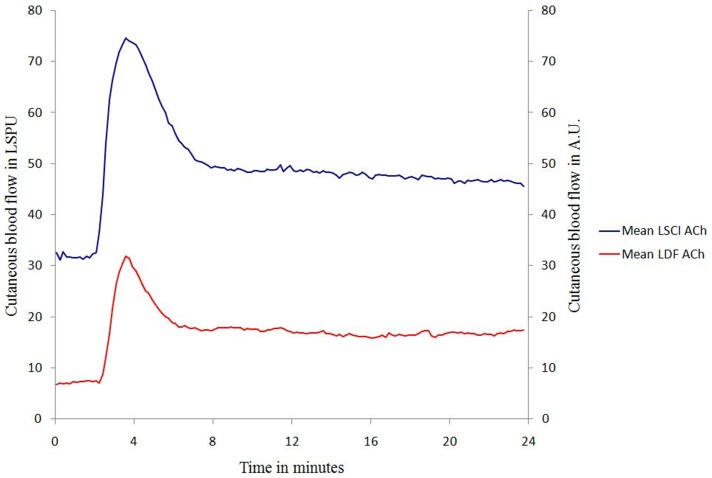
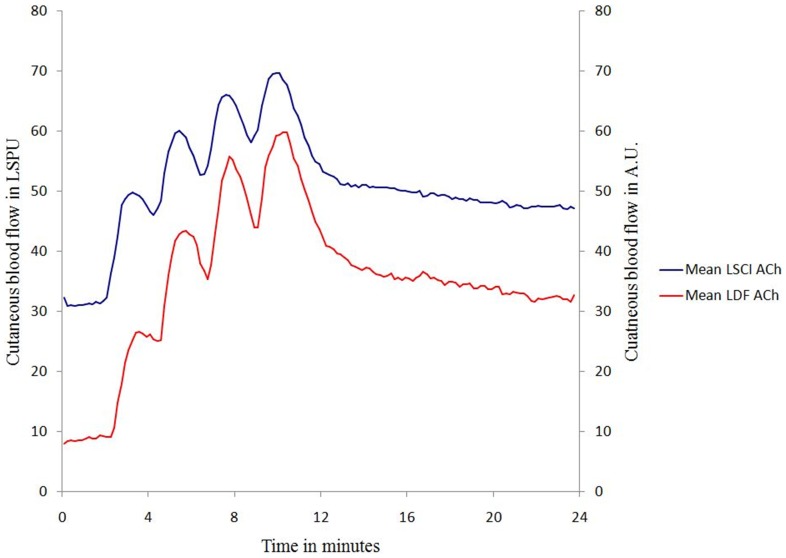
Methods and results: Using LDF and LSCI simultaneously, we performed two different ACh-iontophoresis protocols. The maximal ACh vasodilation (peak-ACh) was expressed as absolute or normalized flow or conductance values. Inter-subject reproducibility was expressed as coefficient of variation (inter-CV,%). Intra-subject reproducibility was expressed as within subject coefficients of variation (intra-CV,%), and intra-class correlation coefficients (ICC). Fifteen healthy subjects were included. The inter-subject reproducibility of peak-ACh depended upon the expression of the results and ranged from 55% to 162% for LDF and from 17% to 83% for LSCI. The intra-subject reproducibility (intra-CV/ICC) of peak-ACh was reduced when assessed with LSCI compared to LDF no matter how the results were expressed and whatever the protocol used. The highest intra-subject reproducibility was found using LSCI. It was 18.7%/0.87 for a single current stimulation (expressed as cutaneous vascular conductance) and 11.4%/0.61 for multiple current stimulations (expressed as absolute value).
Conclusion: ACh-iontophoresis coupled with LSCI is a promising test to assess endothelial function because it is reproducible, safe, and non-invasive. N°: NCT01664572.
Conflict of interest statement
Figures
References
-
- WHO (2007) Recommendations for Prevention of Cardiovascular disease: Guidelines for assessment and management for cardiovascular risk. Geneva, Switzerland World health organization.
-
- Ross R (1993) The pathogenesis of atherosclerosis: a perspective for the 1990s. Nature 362: 801–809. - PubMed
-
- Bonetti PO, Lerman LO, Lerman A (2003) Endothelial dysfunction: a marker of atherosclerotic risk. Arterioscler Thromb Vasc Biol 23: 168–175. - PubMed
-
- Celermajer DS, Sorensen KE, Gooch VM, Spiegelhalter DJ, Miller OI, et al. (1992) Non-invasive detection of endothelial dysfunction in children and adults at risk of atherosclerosis. Lancet 340: 1111–1115. - PubMed
Publication types
MeSH terms
Substances
Associated data
LinkOut - more resources
Full Text Sources
Other Literature Sources
Medical
