Predictors of radiation pneumonitis and pulmonary function changes after concurrent chemoradiotherapy of non-small cell lung cancer
- PMID: 23620867
- PMCID: PMC3633229
- DOI: 10.3857/roj.2013.31.1.34
Predictors of radiation pneumonitis and pulmonary function changes after concurrent chemoradiotherapy of non-small cell lung cancer
Abstract
Purpose: To evaluate the predictive factors of radiation pneumonitis (RP) and associated changes in pulmonary function after definitive concurrent chemoradiotherapy (CCRT) in patients with non-small cell lung cancer (NSCLC).
Materials and methods: Medical records of 60 patients with NSCLC who received definitive CCRT were retrospectively reviewed. Dose volumetric (DV) parameters, clinical factors, and pulmonary function test (PFT) data were analyzed. RP was graded according to the CTCAE ver. 4.0. Percentage of lung volume that received a dose of threshold (Vdose) and mean lung dose (MLD) were analyzed for potential DV predictors. PFT changes were calculated as the difference between pre-RT and post-RT values at 3, 6, and 12 months after RT.
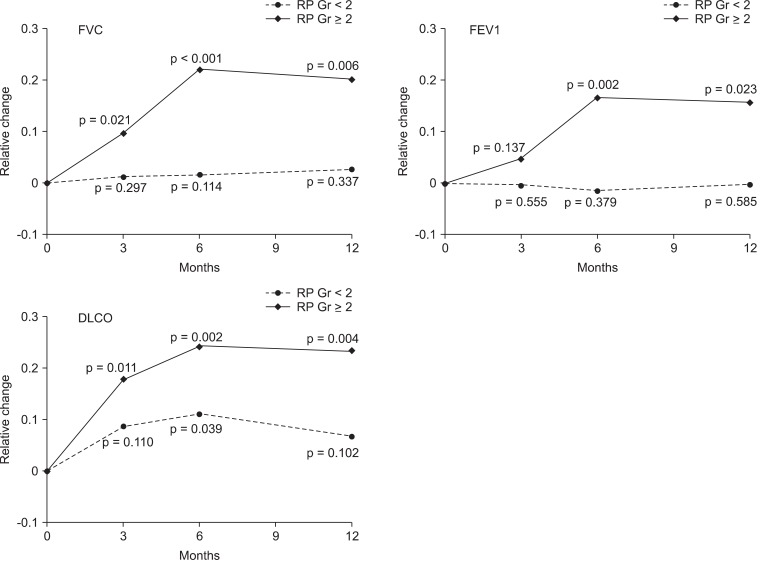
Results: Twenty-two patients (37%) developed grade ≥2 RP. Among clinical factors, tumor location in lower lobe was associated with RP. Among the DV parameters, only MLD >15 Gy was associated with grade ≥2 RP. There were statistically significant decreases in PFT at all points compared with pre-RT values in grade ≥2 RP group. MLD was associated with forced vital capacity (FVC) and forced expiratory volume in 1 second (FEV1) changes at 6 and 12 months. V10 was associated with FVC changes at 12 months. V20 and V30 were associated with FEV1 changes at 6 months and FVC changes at 12 months.
Conclusion: After definitive CCRT in patients with NSCLC, MLD >15 Gy and lower lobe tumor location were predictors of grade ≥2 RP. Pulmonary functions were decreased after CCRT and the magnitude of changes was associated with DV parameters.
Keywords: Dose volumetric parameter; Non-small-cell lung carcinoma; Radiation pneumonitis; Respiratory function test.
Conflict of interest statement
No potential conflict of interest relevant to this article was reported.
Figures
References
-
- Furuse K, Fukuoka M, Kawahara M, et al. Phase III study of concurrent versus sequential thoracic radiotherapy in combination with mitomycin, vindesine, and cisplatin in unresectable stage III non-small-cell lung cancer. J Clin Oncol. 1999;17:2692–2699. - PubMed
-
- Perez CA, Stanley K, Grundy G, et al. Impact of irradiation technique and tumor extent in tumor control and survival of patients with unresectable non-oat cell carcinoma of the lung: report by the Radiation Therapy Oncology Group. Cancer. 1982;50:1091–1099. - PubMed
-
- Yorke ED, Jackson A, Rosenzweig KE, et al. Dose-volume factors contributing to the incidence of radiation pneumonitis in non-small-cell lung cancer patients treated with three-dimensional conformal radiation therapy. Int J Radiat Oncol Biol Phys. 2002;54:329–339. - PubMed
-
- Kwa SL, Theuws JC, Wagenaar A, et al. Evaluation of two dose-volume histogram reduction models for the prediction of radiation pneumonitis. Radiother Oncol. 1998;48:61–69. - PubMed
LinkOut - more resources
Full Text Sources
Other Literature Sources