


Obesity and outcomes in patients treated with chemoradiotherapy for esophageal carcinoma
- PMID: 23621168
- PMCID: PMC3740061
- DOI: 10.1111/dote.12074
Obesity and outcomes in patients treated with chemoradiotherapy for esophageal carcinoma
Abstract
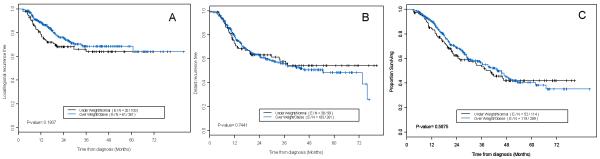
Body mass index (BMI) is a risk factor for comorbid illnesses and cancer development. It was hypothesized that obesity status affects disease outcomes and treatment-related toxicities in esophageal cancer patients treated with chemoradiotherapy (CRT). From March 2002 to April 2010, 405 patients with non-metastatic esophageal carcinoma at MD Anderson Cancer Center treated with either definitive or neoadjuvant CRT were retrospectively analyzed. Patients were categorized as either obese (BMI ≥ 25 kg/m(2) ) or nonobese (BMI < 25 kg/m(2) ). Progression-free survival and overall survival times were examined using the Kaplan-Meier method and Cox proportional hazards regression analysis. One hundred fifteen (28.4%) patients were classified as nonobese and 290 (71.6%) as obese. Obese patients were more likely than others to have several comorbid diseases (P < 0.001), adenocarcinoma located distally (P < 0.001), and have undergone surgery (P = 0.004). Obesity was not associated with either worse operative morbidity/mortality (P > 0.05) or worse positron emission tomography tumor response (P = 0.46) on univariate analysis, nor with worse pathologic complete response (P = 0.98) on multivariate analysis. There was also no difference in overall survival, locoregional control, or metastasis-free survival between obese and nonobese patients (P = 0.86). However, higher BMI was associated with reduced risk of chemoradiation-induced high-grade esophagitis (P = 0.021), esophageal stricture (P < 0.001), and high-grade hematologic toxicity (P < 0.001). In esophageal cancer patients treated with CRT, obesity is not predictive of poorer disease outcomes or operative morbidities; instead, data suggest it may be associated with decreased risk of acute chemotherapy- and radiotherapy-related treatment toxicities.
Keywords: esophageal cancer; obesity; outcome.
© 2013 Wiley Periodicals, Inc. and the International Society for Diseases of the Esophagus.
Figures
References
-
- Blanck HM, Dietz WH, Galuska DA, et al. State-specific prevalence of obesity among adults-United States, 2005. Centers for Diseases Control and Prevention, Morbidity and Mortality Weekly Report. 2006;55:4. - PubMed
-
- Hedley AA, Ogden CL, Johnson CL, Carroll MD, Curtin LR, Flegal KM. Prevalence of overweight and obesity among US children, adolescents, and adults, 1999-2002. JAMA. 2004 Jun 16;291(23):2847–50. - PubMed
-
- Peto J. Cancer epidemiology in the last century and the next decade. Nature. 2001 May 17;411(6835):390–5. - PubMed
-
- Lew EA, Garfinkel L. Variations in mortality by weight among 750,000 men and women. J Chronic Dis. 1979;32(8):563–76. - PubMed
-
- Bastarrachea J, Hortobagyi GN, Smith TL, Kau SW, Buzdar AU. Obesity as an adverse prognostic factor for patients receiving adjuvant chemotherapy for breast cancer. Ann Intern Med. 1994 Jan 1;120(1):18–25. - PubMed
Publication types
MeSH terms
Grants and funding
LinkOut - more resources
Full Text Sources
Other Literature Sources
Medical
Research Materials
Miscellaneous
