


Emotional modulation of pain and spinal nociception in fibromyalgia
- PMID: 23622762
- PMCID: PMC3679206
- DOI: 10.1016/j.pain.2013.03.025
Emotional modulation of pain and spinal nociception in fibromyalgia
Abstract
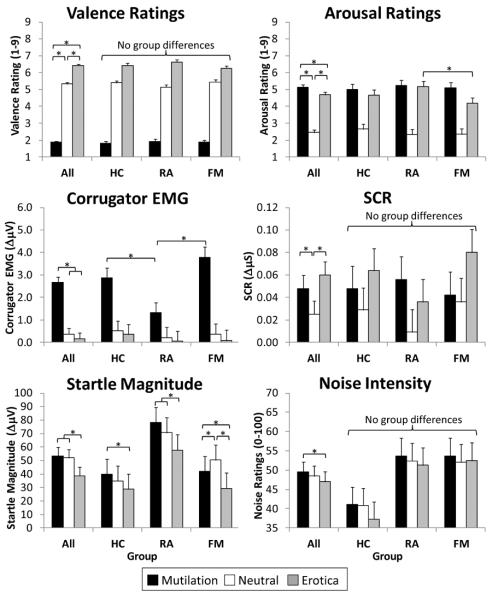
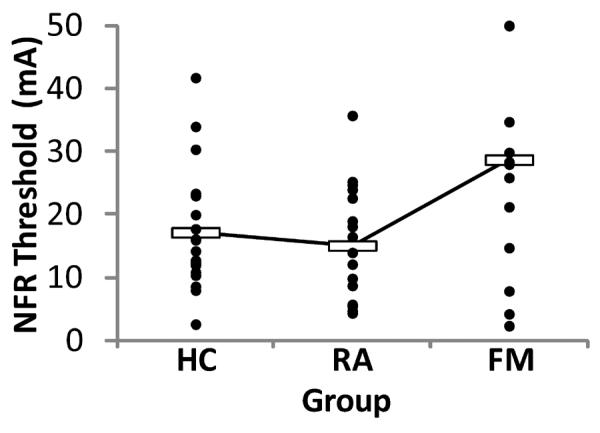
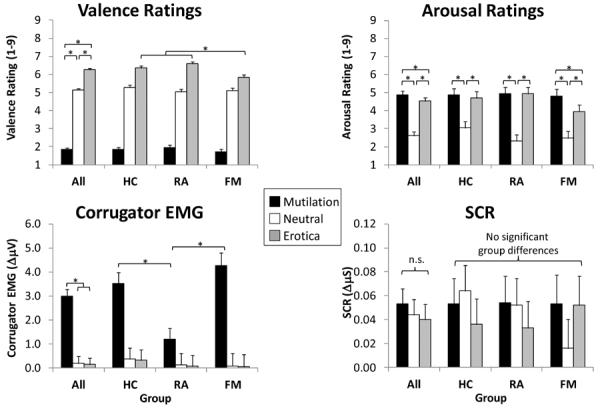
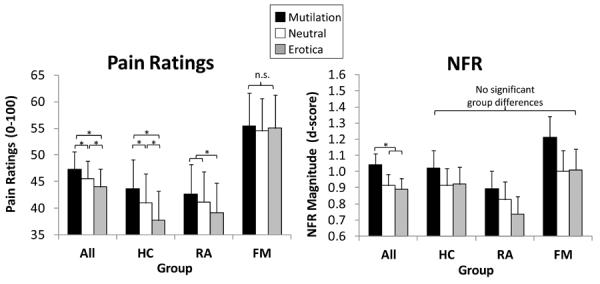
Fibromyalgia (FM) is characterized by widespread pain, as well as affective disturbance (eg, depression). Given that emotional processes are known to modulate pain, a disruption of emotion and emotional modulation of pain and nociception may contribute to FM. The present study used a well-validated affective picture-viewing paradigm to study emotional processing and emotional modulation of pain and spinal nociception. Participants were 18 individuals with FM, 18 individuals with rheumatoid arthritis (RA), and 19 healthy pain-free controls (HC). Mutilation, neutral, and erotic pictures were presented in 4 blocks; 2 blocks assessed only physiological-emotional reactions (ie, pleasure/arousal ratings, corrugator electromyography, startle modulation, skin conductance) in the absence of pain, and 2 blocks assessed emotional reactivity and emotional modulation of pain and the nociceptive flexion reflex (NFR, a physiological measure of spinal nociception) evoked by suprathreshold electric stimulations over the sural nerve. In general, mutilation pictures elicited displeasure, corrugator activity, subjective arousal, and sympathetic activation, whereas erotic pictures elicited pleasure, subjective arousal, and sympathetic activation. However, FM was associated with deficits in appetitive activation (eg, reduced pleasure/arousal to erotica). Moreover, emotional modulation of pain was observed in HC and RA, but not FM, even though all 3 groups evidenced modulation of NFR. Additionally, NFR thresholds were not lower in the FM group, indicating a lack of spinal sensitization. Together, these results suggest that FM is associated with a disruption of supraspinal processes associated with positive affect and emotional modulation of pain, but not brain-to-spinal cord circuitry that modulates spinal nociceptive processes.
Copyright © 2013 International Association for the Study of Pain. Published by Elsevier B.V. All rights reserved.
Figures

References
-
- Ang DC, Chakr R, Mazzuca S, France CR, Steiner J, Stump T. Cognitive-behavioral therapy attenuates nociceptive responding in patients with fibromyalgia: a pilot study. Arthritis Care Res. 2010;62:618–623. - PubMed
-
- Apkarian AV, Bushnell MC, Treede R-D, Zubieta J-K. Human brain mechanisms of pain perception and regulation in health and disease. European Journal of Pain. 2005;9:463–484. - PubMed
-
- Ardic F, Toraman F. Psychological Dimensions of Pain in Patients with Rheumatoid Arthritis, Fibromyalgia Syndrome, and Chronic Low Back Pain. Journal of Musculoskeletal Pain. 2002;10:19.
-
- Banic B, Petersen-Felix S, Andersen OK, Radanov BP, Villiger PM, Arendt-Nielsen L, Curatolo M. Evidence for spinal cord hypersensitivity in chronic pain after whiplash injury and in fibromyalgia. Pain. 2004;107:7–15. - PubMed
-
- Bartley EJ, Rhudy JL, Williams AE. Experimental assessment of affective processing in fibromyalgia. J Pain. 2009;10:1151–1160. - PubMed
Publication types
MeSH terms
Grants and funding
LinkOut - more resources
Full Text Sources
Other Literature Sources
Medical
