


Evaluation of an in silico cardiac safety assay: using ion channel screening data to predict QT interval changes in the rabbit ventricular wedge
- PMID: 23624022
- PMCID: PMC4142193
- DOI: 10.1016/j.vascn.2013.04.004
Evaluation of an in silico cardiac safety assay: using ion channel screening data to predict QT interval changes in the rabbit ventricular wedge
Abstract
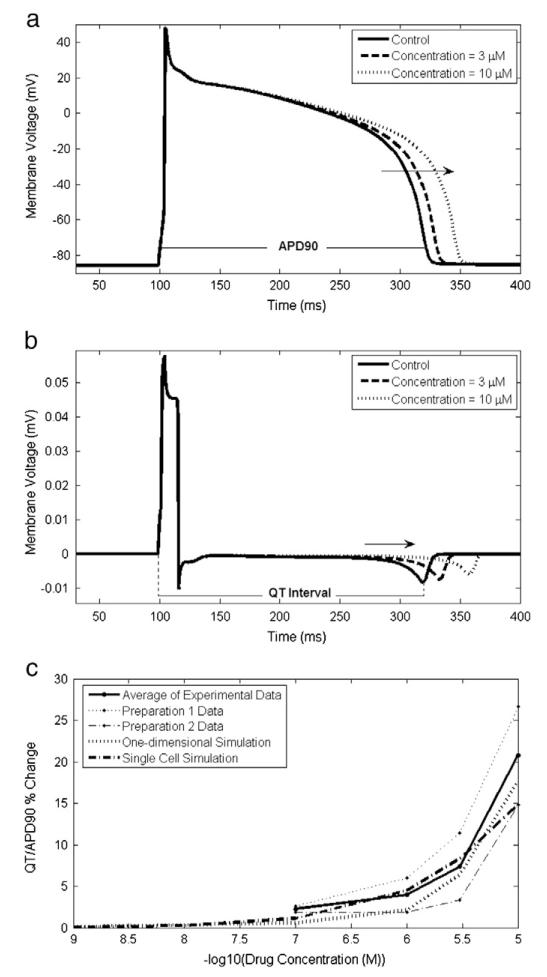
Introduction: Drugs that prolong the QT interval on the electrocardiogram present a major safety concern for pharmaceutical companies and regulatory agencies. Despite a range of assays performed to assess compound effects on the QT interval, QT prolongation remains a major cause of attrition during compound development. In silico assays could alleviate such problems. In this study we evaluated an in silico method of predicting the results of a rabbit left-ventricular wedge assay.
Methods: Concentration-effect data were acquired from either: the high-throughput IonWorks/FLIPR; the medium-throughput PatchXpress ion channel assays; or QSAR, a statistical IC50 value prediction model, for hERG, fast sodium, L-type calcium and KCNQ1/minK channels. Drug block of channels was incorporated into a mathematical differential equation model of rabbit ventricular myocyte electrophysiology through modification of the maximal conductance of each channel by a factor dependent on the IC50 value, Hill coefficient and concentration of each compound tested. Simulations were performed and agreement with experimental results, based upon input data from the different assays, was evaluated.
Results: The assay was found to be 78% accurate, 72% sensitive and 81% specific when predicting QT prolongation (>10%) using PatchXpress assay data (77 compounds). Similar levels of predictivity were demonstrated using IonWorks/FLIPR data (121 compounds) with 78% accuracy, 73% sensitivity and 80% specificity. QT shortening (<-10%) was predicted with 77% accuracy, 33% sensitivity and 90% specificity using PatchXpress data and 71% accuracy, 42% sensitivity and 81% specificity using IonWorks/FLIPR data. Strong quantitative agreement between simulation and experimental results was also evident.
Discussion: The in silico action potential assay demonstrates good predictive ability, and is suitable for very high-throughput use in early drug development. Adoption of such an assay into cardiovascular safety assessment, integrating ion channel data from routine screens to infer results of animal-based tests, could provide a cost- and time-effective cardiac safety screen.
Keywords: AP (D); Action Potential (Duration); Action potential; Cardiac safety; Compound screening; Concentration for 50% Inhibition; ECG; ECVAM; European Centre for the Validation of Alternative Methods; FLIPR; FLuorescence Imaging Plate Reader; GSK; GlaxoSmithKline; I(Kr); I(Ks); IC(50); ICH; International Conference for Harmonization; Ion channels; Mathematical model; Methods; QSAR; QT interval; Quantitative Structure Activity Relationship; Rabbit ventricular wedge; TdP; Torsades de Pointes; electrocardiogram; hERG; human-Ether-a-go-go Related Gene; minus log(10) of IC(50); pIC(50); rapid delayed rectifier potassium current; slow delayed rectifier potassium current.
Copyright © 2013 The Authors. Published by Elsevier Inc. All rights reserved.
Figures

References
-
- Anon The clinical evaluation of QT/QTc interval prolongation and proarrhythmic potential for non-antiarrhythmic drugs: E14. 2005a http://www.ich.org/LOB/media/MEDIA1476.pdf. - PubMed
-
- Anon The non-clinical evaluation of the potential for delayed ventricular repolarization (QT interval prolongation) by human pharmaceuticals: S7B. 2005b http://www.ich.org/LOB/media/MEDIA2192.pdf. - PubMed
-
- Balay S, Brown J, Buschelman K, Eijkhout V, Gropp W, Kaushik D, et al. PETSc users manual revision 3.3. 2012.
-
- Bishop M, Plank G, Burton R, Schneider J, Gavaghan D, Grau V, et al. Development of an anatomically detailed MRI-derived rabbit ventricular model and assessment of its impact on simulations of electrophysiological function. American Journal of Physiology. Heart and Circulatory Physiology. 2010;298:H699–H718. - PMC - PubMed
-
- Bottino D, Penland R, Stamps A, Traebert M, Dumotier B, Georgiva A, et al. Preclinical cardiac safety assessment of pharmaceutical compounds using an integrated systems-based computer model of the heart. Progress in Biophysics and Molecular Biology. 2006;90:414–443. - PubMed
Publication types
MeSH terms
Substances
Grants and funding
LinkOut - more resources
Full Text Sources
Other Literature Sources
