


Enumeration of Salmonella and Campylobacter spp. in environmental farm samples and processing plant carcass rinses from commercial broiler chicken flocks
- PMID: 23624481
- PMCID: PMC3697552
- DOI: 10.1128/AEM.00836-13
Enumeration of Salmonella and Campylobacter spp. in environmental farm samples and processing plant carcass rinses from commercial broiler chicken flocks
Abstract
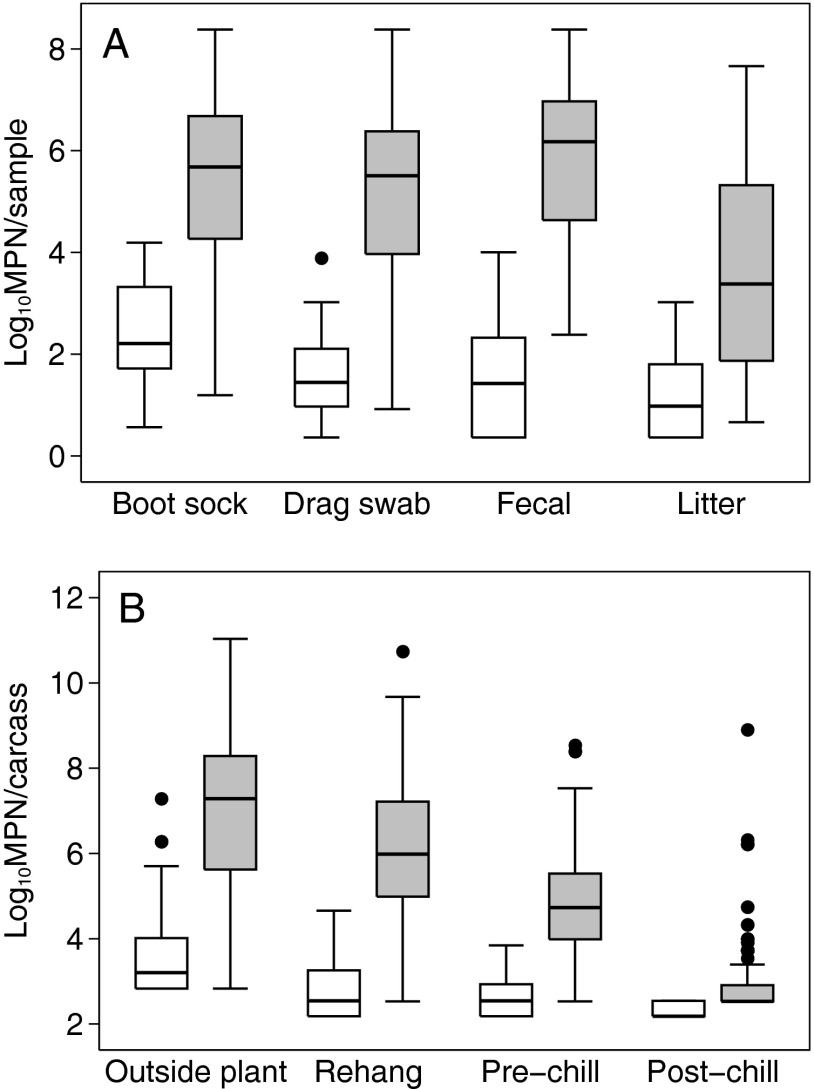
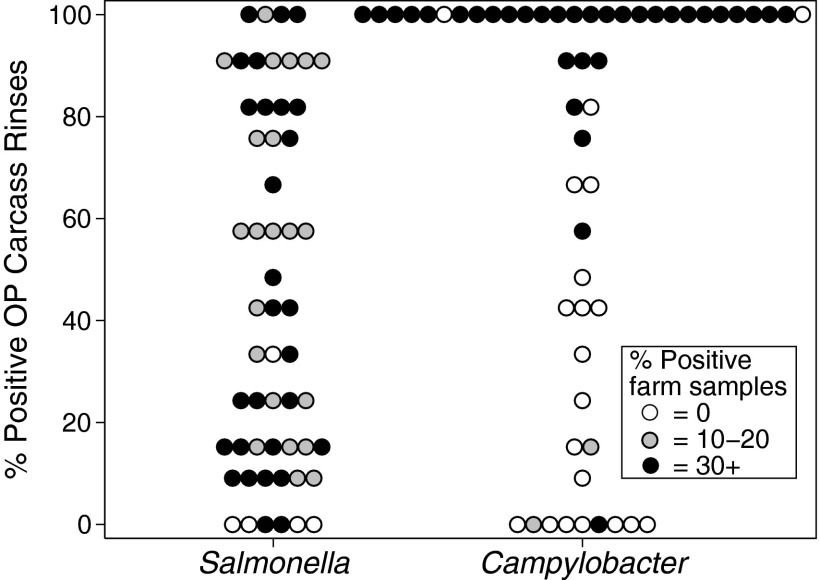
A prospective cohort study was performed to evaluate the prevalences and loads of Salmonella and Campylobacter spp. in farm and processing plant samples collected from 55 commercial broiler chicken flocks. Environmental samples were collected from broiler houses within 48 h before slaughter, and carcass rinses were performed on birds from the same flocks at 4 different stages of processing. Salmonella was detected in farm samples of 50 (90.9%) flocks and in processing samples of 52 (94.5%) flocks. Campylobacter was detected in farm samples of 35 (63.6%) flocks and in processing samples of 48 (87.3%) flocks. There was a significant positive relationship between environmental farm samples and processing plant carcass rinses with respect to both Salmonella and Campylobacter prevalences and loads. Campylobacter loads were significantly higher than Salmonella loads, and the correlations between samples collected from the same flocks were higher for Campylobacter than they were for Salmonella. Boot socks were the most sensitive sample type for detection of Salmonella on the farm, whereas litter samples had the strongest association with Salmonella loads in pre- and postchill carcass rinses. Boot socks, drag swabs, and fecal samples all had similar sensitivities for detecting Campylobacter on the farm, and all were more strongly associated with Campylobacter loads in carcass rinses than were litter samples. Farm samples explained a greater proportion of the variability in carcass rinse prevalences and loads for Campylobacter than they did for Salmonella. Salmonella and Campylobacter prevalences and loads both decreased significantly as birds progressed through the processing plant.
Figures

References
-
- Domingues AR, Pires SM, Halasa T, Hald T. 2012. Source attribution of human campylobacteriosis using a meta-analysis of case-control studies of sporadic infections. Epidemiol. Infect. 140:970–981 - PubMed
-
- Greig JD, Ravel A. 2009. Analysis of foodborne outbreak data reported internationally for source attribution. Int. J. Food Microbiol. 130:77–87 - PubMed
-
- Guo C, Hoekstra RM, Schroeder CM, Pires SM, Ong KL, Hartnett E, Naugle A, Harman J, Bennett P, Cieslak P, Scallan E, Rose B, Holt KG, Kissler B, Mbandi E, Roodsari R, Angulo FJ, Cole D. 2011. Application of Bayesian techniques to model the burden of human salmonellosis attributable to U.S. food commodities at the point of processing: adaptation of a Danish model. Foodborne Pathog. Dis. 8:509–516 - PMC - PubMed
-
- Batz MB, Hoffmann S, Morris JG., Jr 2012. Ranking the disease burden of 14 pathogens in food sources in the United States using attribution data from outbreak investigations and expert elicitation. J. Food Prot. 75:1278–1291 - PubMed
Publication types
MeSH terms
LinkOut - more resources
Full Text Sources
Other Literature Sources
Medical
Molecular Biology Databases
Miscellaneous
