. 2013 Apr 26:2013:bat031.
doi: 10.1093/database/bat031. Print 2013.

The Protein Model Portal--a comprehensive resource for protein structure and model information

Affiliations

The Protein Model Portal--a comprehensive resource for protein structure and model information

Juergen Haas et al. Database (Oxford). .

Abstract

The Protein Model Portal (PMP) has been developed to foster effective use of 3D molecular models in biomedical research by providing convenient and comprehensive access to structural information for proteins. Both experimental structures and theoretical models for a given protein can be searched simultaneously and analyzed for structural variability. By providing a comprehensive view on structural information, PMP offers the opportunity to apply consistent assessment and validation criteria to the complete set of structural models available for proteins. PMP is an open project so that new methods developed by the community can contribute to PMP, for example, new modeling servers for creating homology models and model quality estimation servers for model validation. The accuracy of participating modeling servers is continuously evaluated by the Continuous Automated Model EvaluatiOn (CAMEO) project. The PMP offers a unique interface to visualize structural coverage of a protein combining both theoretical models and experimental structures, allowing straightforward assessment of the model quality and hence their utility. The portal is updated regularly and actively developed to include latest methods in the field of computational structural biology. Database URL: http://www.proteinmodelportal.org.


Figures
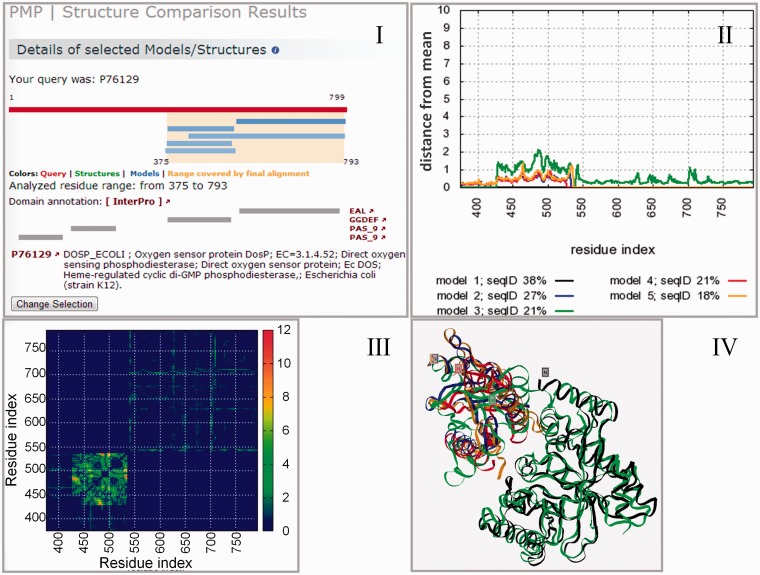
Figure 1.
Figure 1.
Structural variability analysis of the models for the oxygen sensor protein DosP across a region spanning a GGDEF domain and an EAL domain. Panel I indicates the five models (light blue bars) computed for the N-terminal part of the DosP protein (depicted as a red bar). The models selected for the structural variability analysis are shown with a light-brown background color. Pfam domain information is displayed by gray bars, followed by a short description of the target protein and a link to the corresponding entry in the UniProt database for protein functional information. For each of the five analyzed models, Panel II illustrates regions of the models that deviate more from the ensemble in a local (per residue) deviation plot. Most of the variability in this example is observed around residues 430–550. Panel III shows the underlying variability matrix S. Panel IV displays a structural superposition to visualize structural variability among the five selected models. This picture shows the two structural and functional domains GGDEF (with the superposed models #2, #4 and #5 and partially model #3—in blue, red, orange and green colors, respectively) and EAL [with the superposed models #1 (black) and #3 (green)].
Figure 2.
Figure 2.
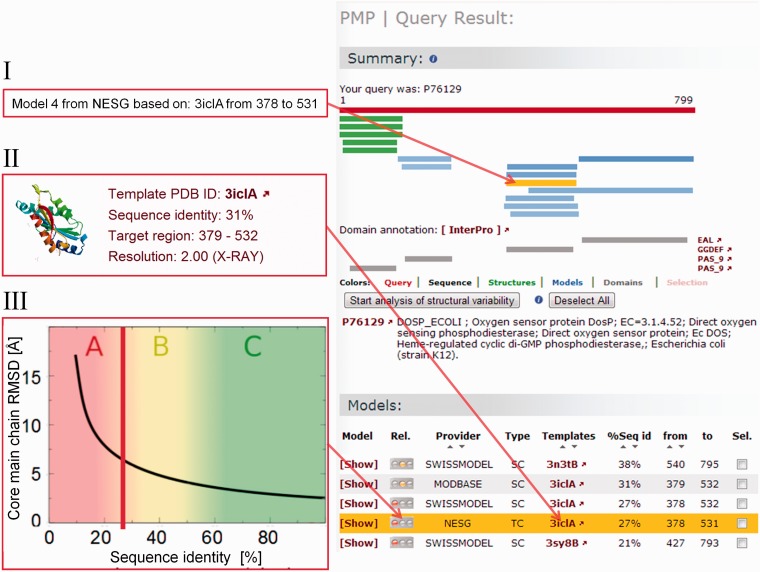
PMP results summary page for the oxygen sensor protein (UniProt Accession Code P76129). Experimentally determined structures for the protein (i.e. PDB entries with sequence identity >90%) are shown in green, models in shades of blue, the darker the higher the sequence identity of the template to the target protein. Pfam domain annotations are depicted in gray, to the right of each domain is a direct link to InterPro providing more information about the different domains. Apart from the graphical representation of structural coverage, detailed lists of experimental structures (not shown) and models are presented. As example, a model from NESG, which was built on the template 3ICL chain A, is highlighted in orange (mouseover text of corresponding model bar is shown in panel I). More details of the template used is given in panel II, where also the template deposition date, a preview image of the structure and the experimental method are given. Expected quality of the model based on the sequence identity between aligned target and template sequences is illustrated in panel III, where a vertical red bar marks the sequence identity of 27% to the template and the expected model accuracy based on the work of Chothia and Lesk (37).

References

    1. Stevens RC, Yokoyama S, Wilson IA. Global efforts in structural genomics. Science. 2001;294:89–92. - PubMed
    1. Terwilliger TC, Stuart D, Yokoyama S. Lessons from structural genomics. Annu. Rev. Biophys. 2009;38:371–383. - PMC - PubMed
    1. Gabanyi MJ, Adams PD, Arnold K, et al. The structural biology knowledgebase: a portal to protein structures, sequences, functions, and methods. J. Struct. Funct. Genomics. 2011;12:45–54. - PMC - PubMed
    1. Baker D, Sali A. Protein structure prediction and structural genomics. Science. 2001;294:93–96. - PubMed
    1. Schwede T, Sali A, Eswar N, et al. 2008. Protein structure modeling. In: T.S.–M.P. (eds). Computational Structural Biology. World Scientific Publishing, Singapore, pp. 3–34.

Publication types