Which strategies reduce breast cancer mortality most? Collaborative modeling of optimal screening, treatment, and obesity prevention
- PMID: 23625540
- PMCID: PMC3700651
- DOI: 10.1002/cncr.28087
Which strategies reduce breast cancer mortality most? Collaborative modeling of optimal screening, treatment, and obesity prevention
Abstract
Background: US breast cancer mortality is declining, but thousands of women still die each year.
Methods: Two established simulation models examine 6 strategies that include increased screening and/or treatment or elimination of obesity versus continuation of current patterns. The models use common national data on incidence and obesity prevalence, competing causes of death, mammography characteristics, treatment effects, and survival/cure. Parameters are modified based on obesity (defined as BMI ≥ 30 kg/m(2) ). Outcomes are presented for the year 2025 among women aged 25+ and include numbers of cases, deaths, mammograms and false-positives; age-adjusted incidence and mortality; breast cancer mortality reduction and deaths averted; and probability of dying of breast cancer.
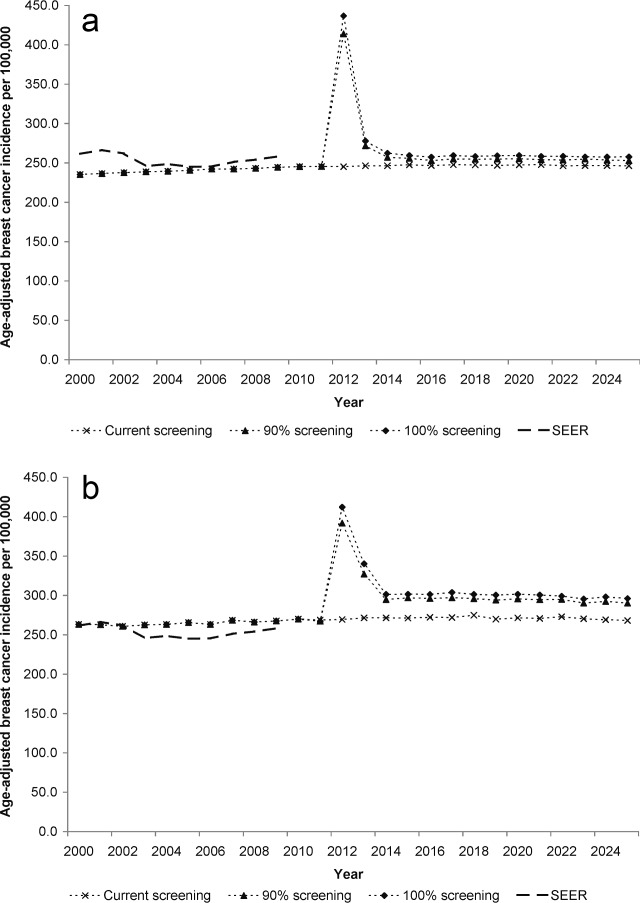
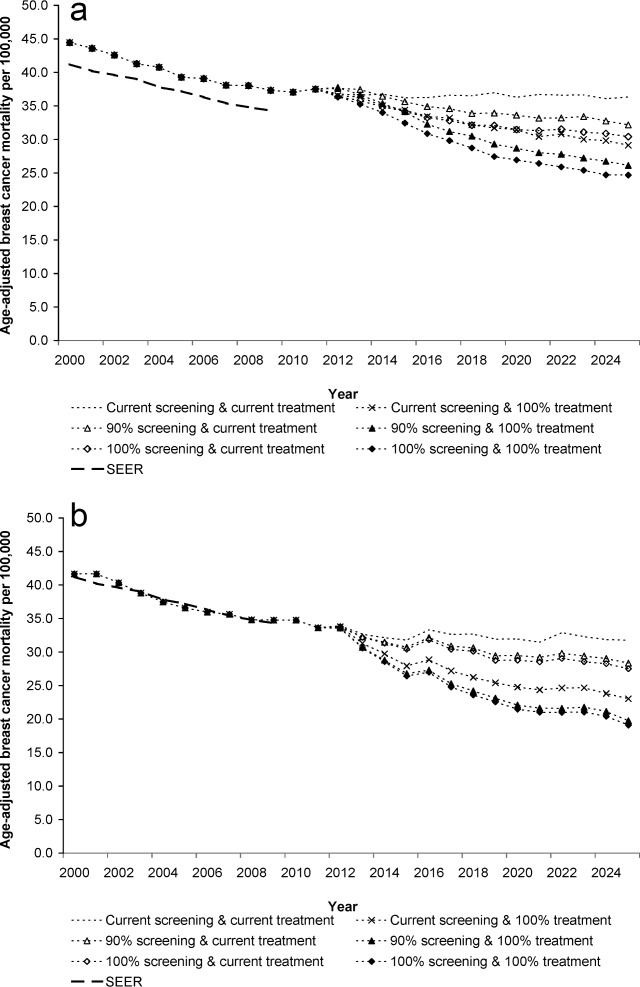
Results: If current patterns continue, the models project that there would be about 50,100-57,400 (range across models) annual breast cancer deaths in 2025. If 90% of women were screened annually from ages 40 to 54 and biennially from ages 55 to 99 (or death), then 5100-6100 fewer deaths would occur versus current patterns, but incidence, mammograms, and false-positives would increase. If all women received the indicated systemic treatment (with no screening change), then 11,400-14,500 more deaths would be averted versus current patterns, but increased toxicity could occur. If 100% received screening plus indicated therapy, there would be 18,100-20,400 fewer deaths. Eliminating obesity yields 3300-5700 fewer breast cancer deaths versus continuation of current obesity levels.
Conclusions: Maximal reductions in breast cancer deaths could be achieved through optimizing treatment use, followed by increasing screening use and obesity prevention.
Keywords: breast cancer; mammography; modeling; obesity; simulation; treatment.
© 2013 American Cancer Society.
Figures
References
-
- Berry DA, Cronin KA, Plevritis SK, et al. Effect of screening and adjuvant therapy on mortality from breast cancer. New Engl J Med. 2005;353:1784–1792. - PubMed
-
- Siegel R, Naishadham D, Jemal A. Cancer statistics, 2012. CA Cancer J Clin. 2012;62:10–29. - PubMed
-
- Rosner GL, Hargis JB, Hollis DR, et al. Relationship between toxicity and obesity in women receiving adjuvant chemotherapy for breast cancer: results from cancer and leukemia group B study 8541. J Clin Oncol. 1996;14:3000–3008. - PubMed
-
- Gorin SS, Heck JE, Cheng B, Smith SJ. Delays in breast cancer diagnosis and treatment by racial/ethnic group. Arch Intern Med. 2006;166:2244–2252. - PubMed
-
- Griggs JJ, Sorbero ME, Lyman GH. Undertreatment of obese women receiving breast cancer chemotherapy. Arch Intern Med. 2005;165:1267–1273. - PubMed
Publication types
MeSH terms
Grants and funding
- U01 CA152958/CA/NCI NIH HHS/United States
- U01CA69976/CA/NCI NIH HHS/United States
- U01CA088283/CA/NCI NIH HHS/United States
- U01CA70013/CA/NCI NIH HHS/United States
- P01 CA154292/CA/NCI NIH HHS/United States
- KO5CA96940/CA/NCI NIH HHS/United States
- U01CA63736/CA/NCI NIH HHS/United States
- U01CA86082/CA/NCI NIH HHS/United States
- U01CA86076/CA/NCI NIH HHS/United States
- K05 CA096940/CA/NCI NIH HHS/United States
- U01CA152958/CA/NCI NIH HHS/United States
- U01CA63731/CA/NCI NIH HHS/United States
- U01 CA088283/CA/NCI NIH HHS/United States
- U01CA70040/CA/NCI NIH HHS/United States
- U01CA63740/CA/NCI NIH HHS/United States
- P01CA154292/CA/NCI NIH HHS/United States
- 261201100031C/PHS HHS/United States
LinkOut - more resources
Full Text Sources
Other Literature Sources
Medical