


The role of VEGF in melanoma progression
- PMID: 23626629
- PMCID: PMC3634290
The role of VEGF in melanoma progression
Abstract
Background: Melanoma is the most serious skin cancer. There is an established correlation between thickness and aggressiveness of the tumor. Nevertheless, the potential value of vascular endothelial growth factor (VEGF) in correlation with tumor progression remains unresolved.
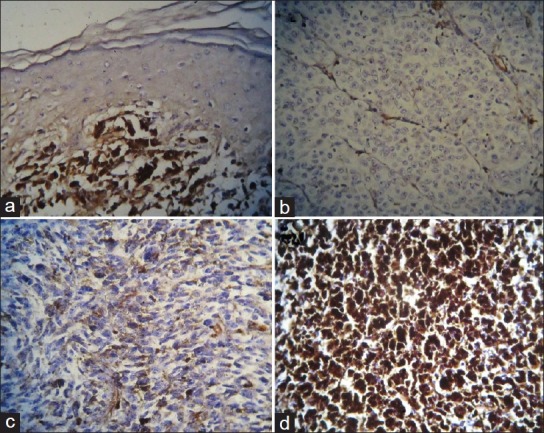
Materials and methods: Thirty seven paraffin blocks of cutaneous melanoma were obtained from Pathology department of Al-zahra hospital between 2005 and 2010. The sections were stained with monoclonal mouse antibodies (mAbs) against vascular endothelial growth factor A and evaluated by distribution of expression of VEGF in tumor cells as 0, 0%; 1, 1%--25%; 2, 25%--50%; 3, >50% and the staining intensity from 0 (negative) to 3 (strong). The sum of intensity score and distribution score was then calculated as the VEGF index. The relationship between VEGF expression (distribution, intensity, and index) and tumor progression (vertical and radial growth, Clark's level, and Breslow's depth) was studied. SPSS software was used to analyze the data by ANOVA, and chi-square tests.
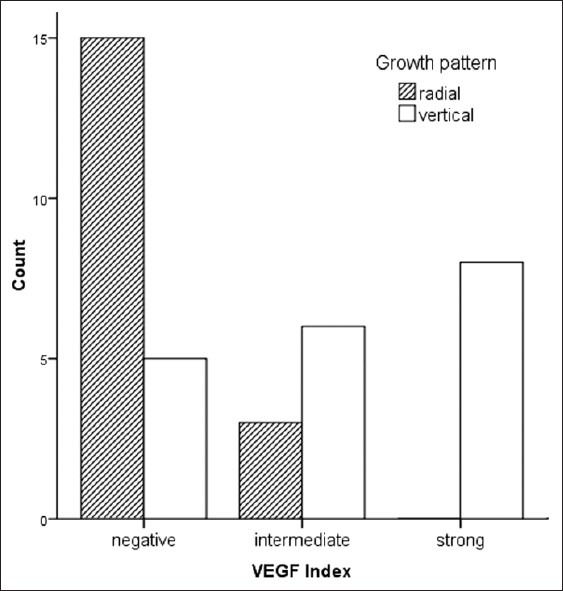
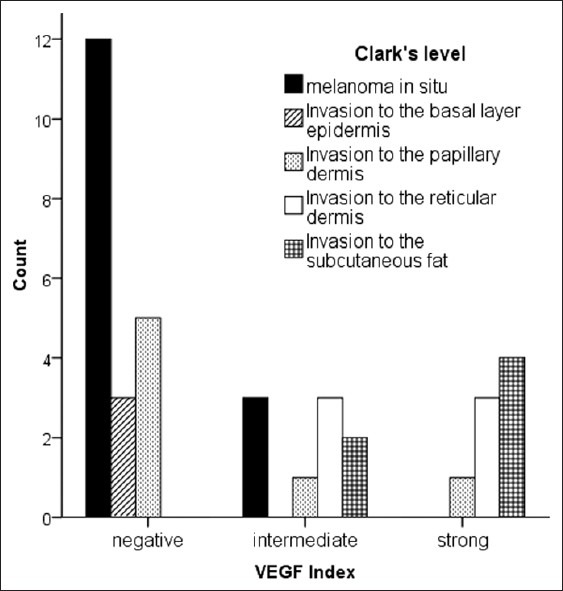
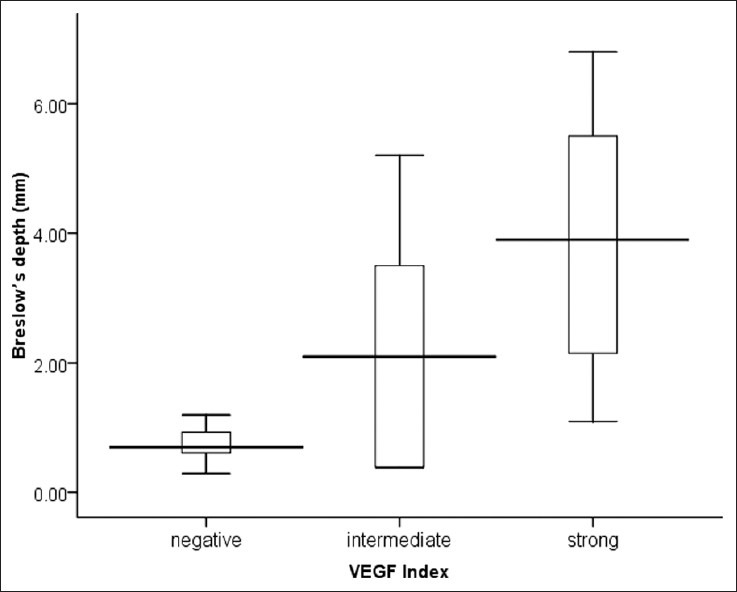
Results: 51.4% of the patients showed vertical growth pattern. Mean Breslow's depth was 1.84 ± 1.79 mm. There was a significant association between growth pattern and VEGF distribution, intensity and index (P = 0.006, P = 0.005, and P = 0.001 respectively). VEGF distribution, intensity, and index all had correlation with Breslow's depth as well (ANOVA test: P = 0.003, P < 0.001, and P < 0.001 respectively) VEGF index had also correlation with Clark's level, but this was not seen for VEGF distribution and intensity.
Conclusion: VEGF expression (both VEGF distribution and intensity) is associated with progression of malignant melanoma. VEGF index can explain this association better.
Keywords: Breslow's depth; Melanoma; vascular endothelial growth factor.
Conflict of interest statement
Figures
References
-
- Rigel DS, Friedman RJ, Kopf AW. The incidence of malignant melanoma in the United States: Issues as we approach the 21st century. J Am Acad Dermatol. 1996;34:839–47. - PubMed
-
- Berwick M, Wiggins C. The current epidemiology of cutaneous malignant melanoma. Front Biosci. 2006;11:1244–54. - PubMed
-
- Liu V, Mihm MC. Pathology of malignant melanoma. Surg Clin North Am. 2003;83:31–60. v. - PubMed
-
- Homsi J, Kashani-Sabet M, Messina JL, Daud A. Cutaneous melanoma: Prognostic factors. Cancer Control. 2005;12:223–9. - PubMed
-
- Buzaid AC, Ross MI, Balch CM, Soong S, McCarthy WH, Tinoco L, et al. Critical analysis of the current American Joint Committee on Cancer staging system for cutaneous melanoma and proposal of a new staging system. J Clin Oncol. 1997;15:1039–51. - PubMed
LinkOut - more resources
Full Text Sources
Other Literature Sources