


Validation of the Edmonton Symptom Assessment System in Korean patients with cancer
- PMID: 23628516
- PMCID: PMC3851583
- DOI: 10.1016/j.jpainsymman.2013.01.012
Validation of the Edmonton Symptom Assessment System in Korean patients with cancer
Abstract
Context: The Edmonton Symptom Assessment System (ESAS) is a brief, widely adopted, multidimensional questionnaire to evaluate patient-reported symptoms.
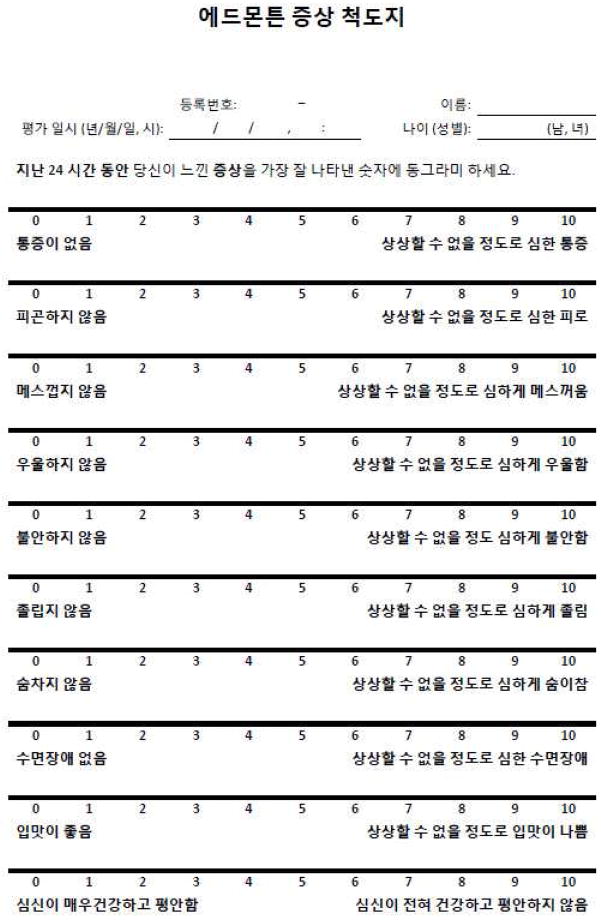
Objectives: To develop a Korean version of the ESAS (K-ESAS) and to perform a psychometric analysis in Korean patients with advanced cancer.
Methods: We tested the K-ESAS in two pilot studies with 15 patients each. We assessed internal consistency, test-retest reliability, and concurrent validity in 163 Korean patients, who completed the K-ESAS along with the Korean versions of the M. D. Anderson Symptom Inventory (K-MDASI) and the Hospital Anxiety and Depression Scale (K-HADS) twice. A total of 38 patients completed the questionnaires again seven days later to assess responsiveness.
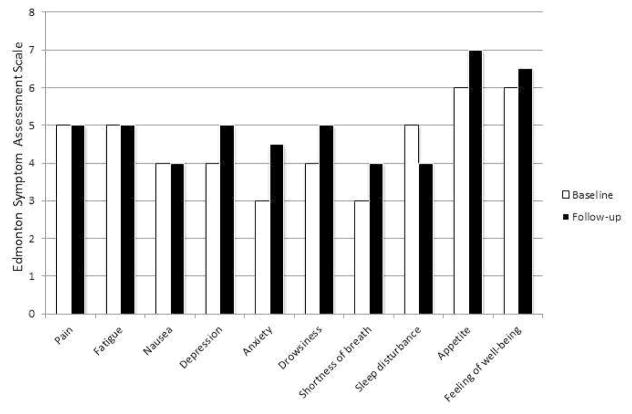
Results: The K-ESAS scores had good internal consistency, with a Cronbach's alpha coefficient of 0.88, indicating that no questions had undue influence on the score. Pearson correlation coefficients for K-ESAS symptom scores between baseline and after two to four hours ranged from 0.72 (95% CI 0.64-0.79) to 0.87 (95% CI 0.82-0.90), indicating strong test-retest reliability. For concurrent validity, Pearson correlation coefficients between K-ESAS symptom scores and corresponding K-MDASI symptom scores ranged from 0.70 (95% CI 0.62-0.77) to 0.83 (95% CI 0.77-0.87), indicating good concurrent validity. For the K-HADS, concurrent validity was good for anxiety (r=0.73, 95% CI 0.65-0.79) but moderate for depression (r=0.4, 95% CI 0.26-0.52). For responsiveness, changes in K-ESAS scores after seven days were moderately correlated with changes in K-MDASI scores but weakly correlated with changes in K-HADS scores.
Conclusion: The K-ESAS is a valid and reliable tool for measuring multidimensional symptoms in Korean patients with cancer.
Keywords: Advanced cancer; ESAS; Edmonton Symptom Assessment System; Korea.
Copyright © 2013 U.S. Cancer Pain Relief Committee. Published by Elsevier Inc. All rights reserved.
Conflict of interest statement
The authors declare no conflicts of interest.
Figures
References
-
- Curtis EB, Krech R, Walsh TD. Common symptoms in patients with advanced cancer. J Palliat Care. 1991;7:25–29. - PubMed
-
- Cleeland CS. Symptom burden: multiple symptoms and their impact as patient-reported outcomes. J Natl Cancer Inst Monogr. 2007;37:16–21. - PubMed
-
- Walsh D, Donnelly S, Rybicki L. The symptoms of advanced cancer: relationship to age, gender, and performance status in 1,000 patients. Support Care Cancer. 2000;8:175–179. - PubMed
-
- Carvajal A, Centeno C, Watson R, Bruera E. A comprehensive study of psychometric properties of the Edmonton Symptom Assessment System (ESAS) in Spanish advanced cancer patients. Eur J Cancer. 2011;47:1863–1872. - PubMed
-
- Stiel S, Matthes ME, Bertram L, et al. [Validation of the new version of the minimal documentation system (MIDOS) for patients in palliative careý: the German version of the Edmonton Symptom Assessment Scale (ESAS)] [in German] Schmerz. 2010;24:596–604. - PubMed
Publication types
MeSH terms
Grants and funding
LinkOut - more resources
Full Text Sources
Other Literature Sources
