


Can a weight loss of one pound a week be achieved with a 3500-kcal deficit? Commentary on a commonly accepted rule
- PMID: 23628852
- PMCID: PMC4024447
- DOI: 10.1038/ijo.2013.51
Can a weight loss of one pound a week be achieved with a 3500-kcal deficit? Commentary on a commonly accepted rule
Abstract
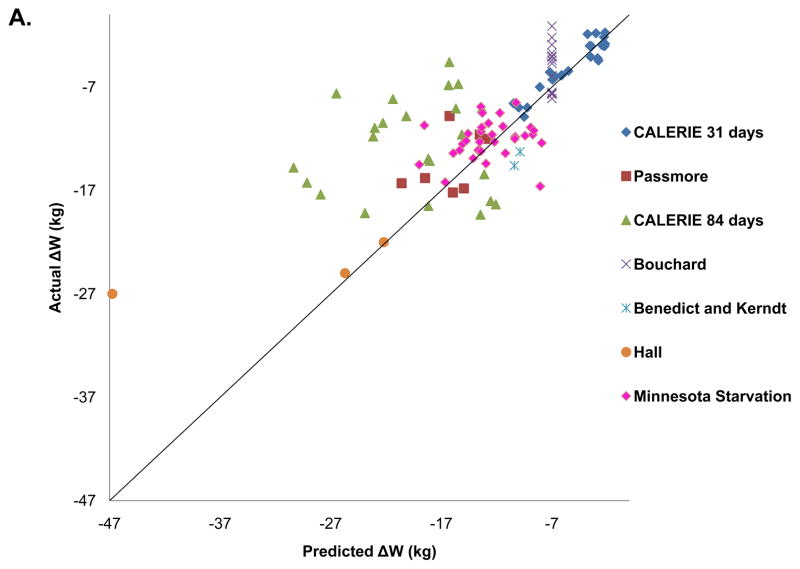
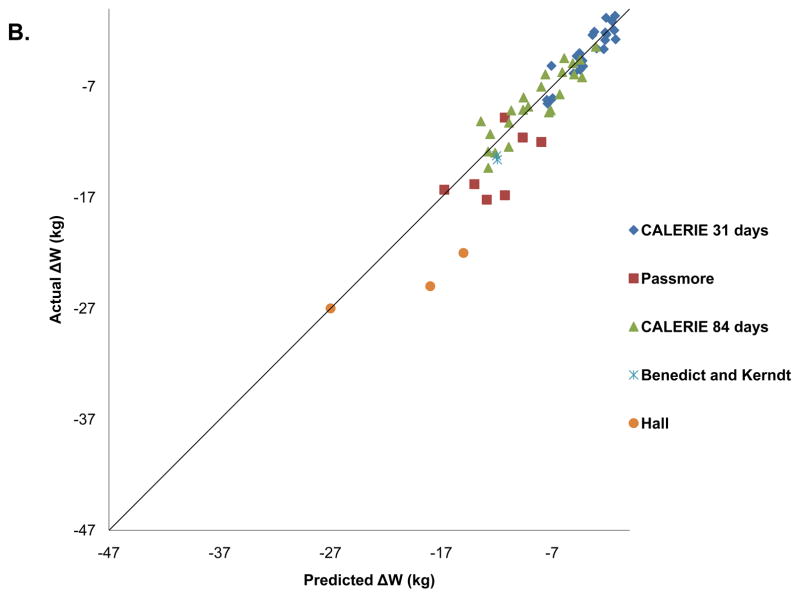
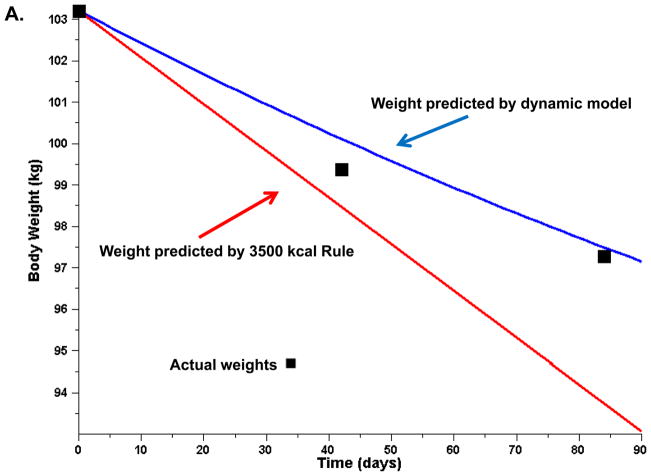
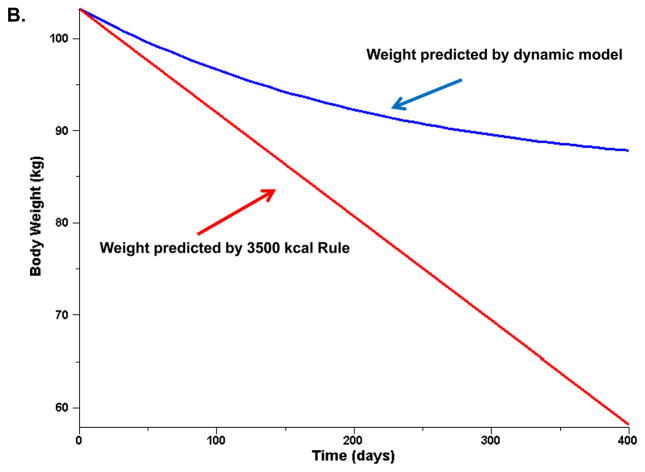
Despite theoretical evidence that the model commonly referred to as the 3500-kcal rule grossly overestimates actual weight loss, widespread application of the 3500-kcal formula continues to appear in textbooks, on respected government- and health-related websites, and scientific research publications. Here we demonstrate the risk of applying the 3500-kcal rule even as a convenient estimate by comparing predicted against actual weight loss in seven weight loss experiments conducted in confinement under total supervision or objectively measured energy intake. We offer three newly developed, downloadable applications housed in Microsoft Excel and Java, which simulates a rigorously validated, dynamic model of weight change. The first two tools available at http://www.pbrc.edu/sswcp, provide a convenient alternative method for providing patients with projected weight loss/gain estimates in response to changes in dietary intake. The second tool, which can be downloaded from the URL http://www.pbrc.edu/mswcp, projects estimated weight loss simultaneously for multiple subjects. This tool was developed to inform weight change experimental design and analysis. While complex dynamic models may not be directly tractable, the newly developed tools offer the opportunity to deliver dynamic model predictions as a convenient and significantly more accurate alternative to the 3500-kcal rule.
Conflict of interest statement
Diana Thomas is a consultant for Jenny Craig.
Figures
Comment in
-
Why is the 3500 kcal per pound weight loss rule wrong?Int J Obes (Lond). 2013 Dec;37(12):1614. doi: 10.1038/ijo.2013.112. Epub 2013 Jun 18. Int J Obes (Lond). 2013. PMID: 23774459 Free PMC article. No abstract available.
-
Response to 'Why is the 3500 kcal per pound weight loss rule wrong?'.Int J Obes (Lond). 2013 Dec;37(12):1614-5. doi: 10.1038/ijo.2013.113. Epub 2013 Jun 18. Int J Obes (Lond). 2013. PMID: 23774461 No abstract available.
References
-
- Wishnofsky M. Caloric equivalents of gained or lost weight. Am J Clin Nutr. 1958 Sep-Oct;6(5):542–6. - PubMed
-
- Brown SP. Introduction to exercise science. Philadelphia, PA: Lippincott Williams & Wilkins; 2001.
-
- Katch FI, McArdle WD. Introduction to nutrition, exercise, and health. 4. Philadelphia: Lea & Febiger; 1993.
Publication types
MeSH terms
Grants and funding
LinkOut - more resources
Full Text Sources
Other Literature Sources
Medical
