


US valuation of the SF-6D
- PMID: 23629865
- PMCID: PMC3740344
- DOI: 10.1177/0272989X13482524
US valuation of the SF-6D
Abstract
Background: The original SF-6D valuation study collected 3503 standard gambled responses from 611 UK respondents to predict quality-adjusted life year (QALY) values.
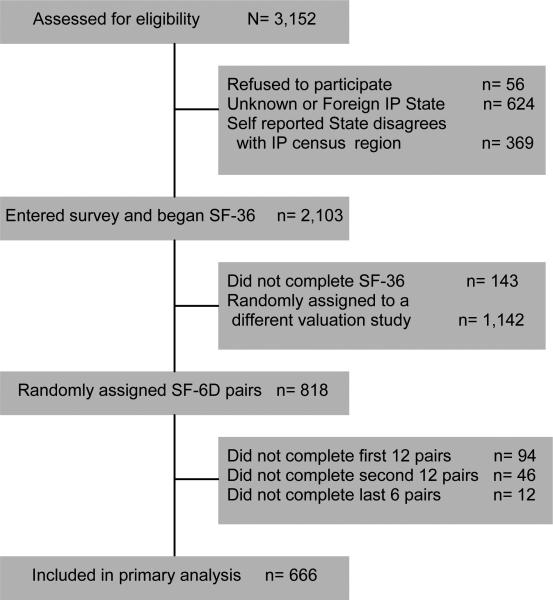
Methods: Using 19,980 paired comparison responses from 666 US respondents and a stacked probit model, the 25 coefficients of the original SF-6D multiattribute utility (MAU) regression were estimated, such that each coefficient represents a QALY decrement. The US QALY predictions were compared with UK predictions using 8428 SF-6D states in the US Medicare Health Outcomes Survey (MHOS), 1998 to 2003.
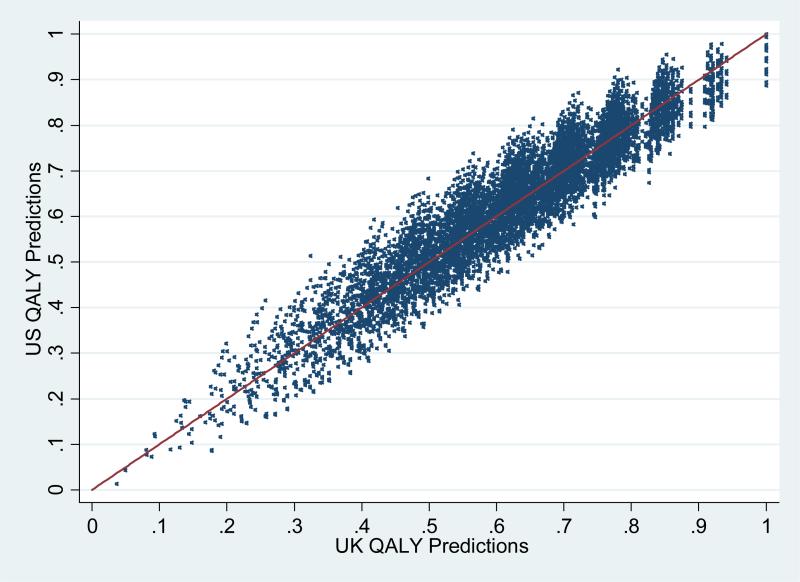
Results: Twenty-two of the 25 decrements in the SF-6D MAU regression are statistically significant. The remaining decrements are insignificant based on US and UK results. The US and UK QALY predictions for the MHOS SF-6D states are remarkably similar given differences in experimental design, format, and sampling (Lin's coefficient of agreement, 0.941; absolute mean difference, 0.043). Limitations. The underlying theoretical framework for the
Study design: and econometric analysis builds from the episodic random utility model and the concept of QALYs and inherits their limitations.
Conclusions: This study enhances the potential for US comparative effectiveness research by translating SF-6D states into US QALYs as well as improves upon discrete choice experiment design and econometric methods for health valuation.
Keywords: decision analysis; econometric methods; mathematical models; preferences and quality of life; statistical methods.
Figures
References
-
- Drummond M, Brixner D, Gold M, Kind P, McGuire A, Nord E, et al. Toward a Consensus on the QALY. Value Health. 2009;12:S31–S5. - PubMed
-
- Brooks R. EuroQol: the current state of play. Health Policy. 1996;37(1):53–72. - PubMed
-
- Hays RD, Sherbourne CD, Mazel R. User's Manual for the Medical Outcomes Study (MOS) Core Measures of Health-Related Quality of Life. RAND Corporation; Santa Monica, CA: 1995.
-
- Ware JE, Gandek B. Overview of the SF-36 Health Survey and the International Quality of Life Assessment (IQOLA) Project. J Clin Epidemiol. 1998;51(11):903–12. - PubMed
Publication types
MeSH terms
Grants and funding
LinkOut - more resources
Full Text Sources
Other Literature Sources
