


Review
doi: 10.1189/jlb.1112596.
Epub 2013 Apr 29.
The B cell helper side of neutrophils
Affiliations
- PMID: 23630389
- PMCID: PMC3774846
- DOI: 10.1189/jlb.1112596
Item in Clipboard
Review
The B cell helper side of neutrophils
J Leukoc Biol.
2013 Oct.
Abstract
Neutrophils use opsonizing antibodies to enhance the clearance of intruding microbes. Recent studies indicate that splenic neutrophils also induce antibody production by providing helper signals to B cells lodged in the MZ of the spleen. Here, we discuss the B cell helper function of neutrophils in the context of growing evidence indicating that neutrophils function as sophisticated regulators of innate and adaptive immune responses.
Keywords: antibody production; granulocytes; innate immunity.
Figures
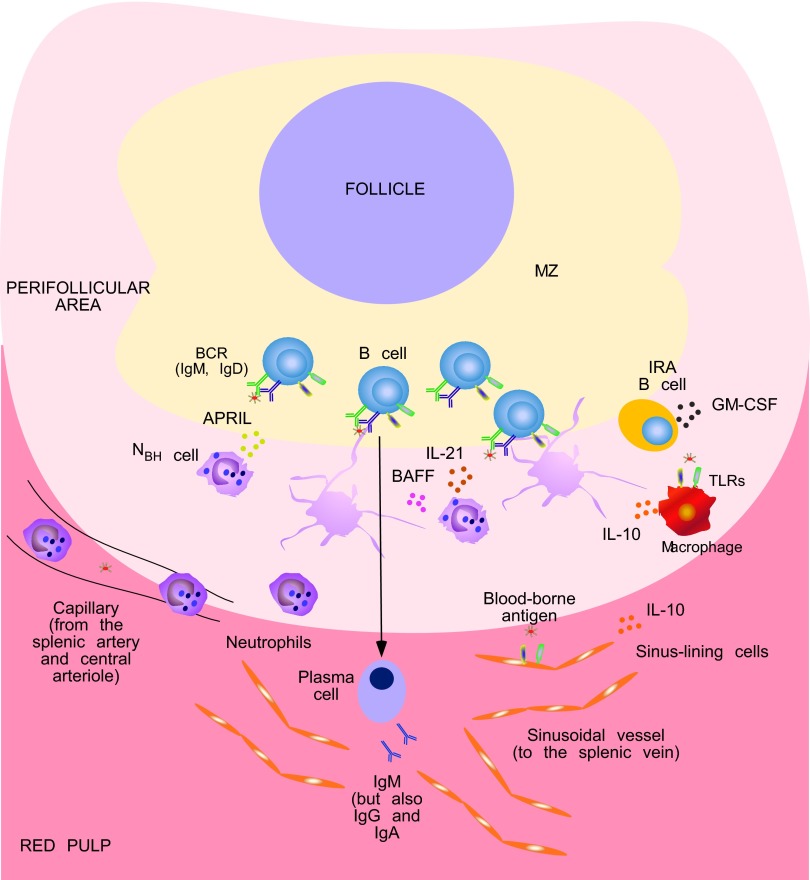
. Conventional circulating neutrophils may home to the perifollicular area of the human spleen by following chemotactic gradients, possibly generated by resident, sinus-lining cells and macrophages in response to blood-borne antigens, including antigens containing TLR ligands. Sinus-lining cells and macrophages also release IL-10, which contributes to the reprogramming of circulating neutrophils into splenic NBH cells. Neutrophils may receive additional reprogramming signals as well as survival and activating signals from GM-CSF produced by local IRA B cells. NBH cells induce antibody class-switching, plasma cell differentiation, and secretion of preimmune IgM, as well as IgG and IgA, by stimulating a fraction of MZ B cells via BAFF, APRIL, and IL-21. These cytokines also stimulate MZ B cell and plasma cell survival. NBH cells might further stimulate local antibody responses by making available antigenic determinants to surface BCR (B cell antigen receptor, mostly IgM but also IgD) and TLR molecules expressed on the surface of MZ B cells. Indeed, some NBH cells interact with MZ B cells by forming antigen-trapping, NET-like projections after undergoing apoptosis.
References
-
- Nathan C. (2006) Neutrophils and immunity: challenges and opportunities. Nat. Rev. Immunol. 6, 173–182 - PubMed
-
- Mantovani A., Cassatella M. A., Costantini C., Jaillon S. (2011) Neutrophils in the activation and regulation of innate and adaptive immunity. Nat. Rev. Immunol. 11, 519–531 - PubMed
-
- Monteiro R. C., Van De Winkel J. G. (2003) IgA Fc receptors. Annu. Rev. Immunol. 21, 177–204 - PubMed
-
- Nimmerjahn F., Ravetch J. V. (2008) Fcγ receptors as regulators of immune responses. Nat. Rev. Immunol. 8, 34–47 - PubMed
Publication types
MeSH terms
Substances
Grants and funding
LinkOut - more resources
Full Text Sources
Other Literature Sources
