


Cytoskeleton and regulation of mitochondrial function: the role of beta-tubulin II
- PMID: 23630499
- PMCID: PMC3631707
- DOI: 10.3389/fphys.2013.00082
Cytoskeleton and regulation of mitochondrial function: the role of beta-tubulin II
Abstract
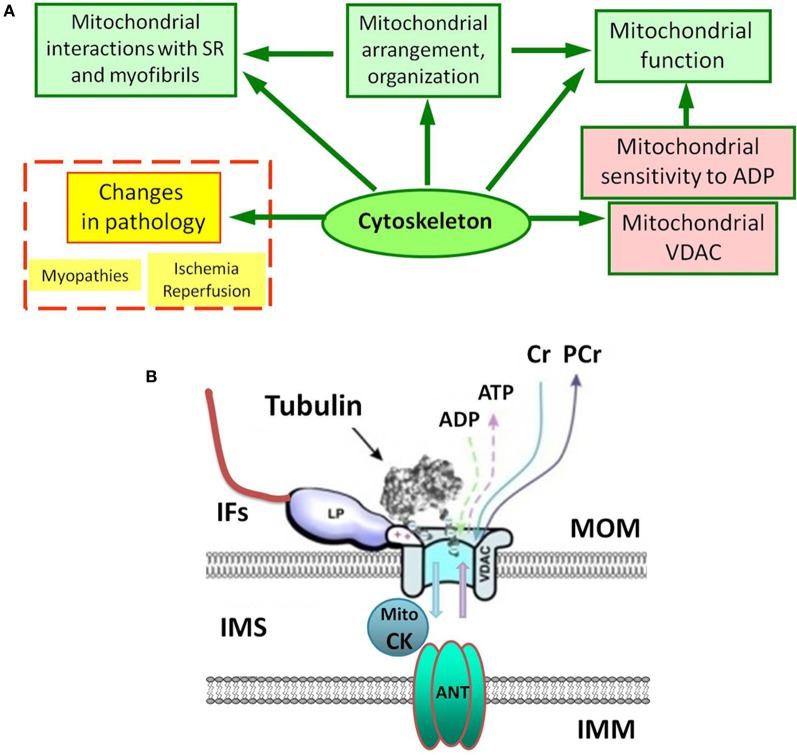
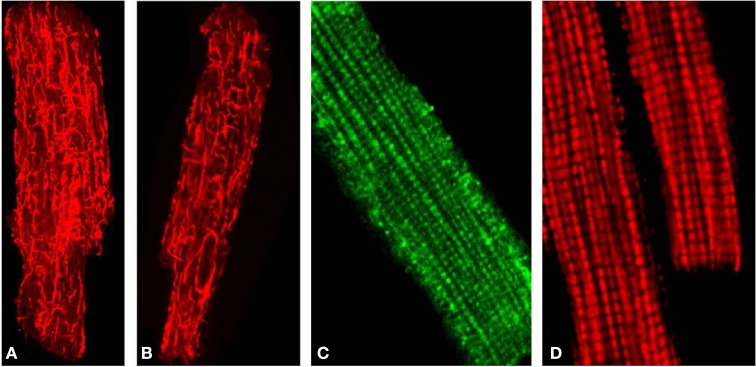
The control of mitochondrial function is a cardinal issue in the field of cardiac bioenergetics, and the analysis of mitochondrial regulations is central to basic research and in the diagnosis of many diseases. Interaction between cytoskeletal proteins and mitochondria can actively participate in mitochondrial regulation. Potential candidates for the key roles in this regulation are the cytoskeletal proteins plectin and tubulin. Analysis of cardiac cells has revealed regular arrangement of β-tubulin II, fully co-localized with mitochondria. β-Tubulin IV demonstrated a characteristic staining of branched network, β-tubulin III was matched with Z-lines, and β-tubulin I was diffusely spotted and fragmentary polymerized. In contrast, HL-1 cells were characterized by the complete absence of β-tubulin II. Comparative analysis of cardiomyocytes and HL-1 cells revealed a dramatic difference in the mechanisms of mitochondrial regulation. In the heart, colocalization of β-tubulin isotype II with mitochondria suggests that it can participate in the coupling of ATP-ADP translocase (ANT), mitochondrial creatine kinase (MtCK), and VDAC (ANT-MtCK-VDAC). This mitochondrial supercomplex is responsible for the efficient intracellular energy transfer via the phosphocreatine pathway. Existing data suggest that cytoskeletal proteins may control the VDAC, contributing to maintenance of mitochondrial and cellular physiology.
Keywords: HL-1 cells; VDAC; beta tubulin isotypes; cardiomyocytes; confocal microscopy; creatine kinase; mitochondria-cytoskeleton interactions; mitochondrial regulation.
Figures
References
-
- Anmann T., Guzun R., Beraud N., Pelloux S., Kuznetsov A. V., Kogerman L., et al. (2006). Different kinetics of the regulation of respiration in permeabilized cardiomyocytes and in HL-1 cardiac cells. Importance of cell structure/organization for respiration regulation. Biochim. Biophys. Acta 1757, 1597–1606 10.1016/j.bbabio.2006.09.008 - DOI - PubMed
-
- Appaix F., Kuznetsov A. V., Usson Y., Kay L., Andrienko T., Olivares J., et al. (2003). Possible role of cytoskeleton in intracellular arrangement and regulation of mitochondria. Exp. Physiol. 88, 175–190 - PubMed
-
- Balaban R. S. (1990). Regulation of oxidative phosphorylation in the mammalian cell. Am. J. Physiol. 258, C377–C389 - PubMed
Grants and funding
LinkOut - more resources
Full Text Sources
Other Literature Sources
