


Investigation of the function of Candida albicans Als3 by heterologous expression in Candida glabrata
- PMID: 23630968
- PMCID: PMC3697595
- DOI: 10.1128/IAI.00013-13
Investigation of the function of Candida albicans Als3 by heterologous expression in Candida glabrata
Abstract
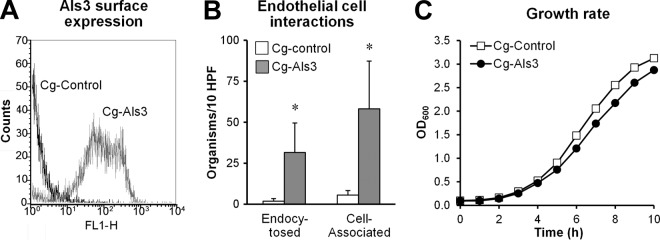
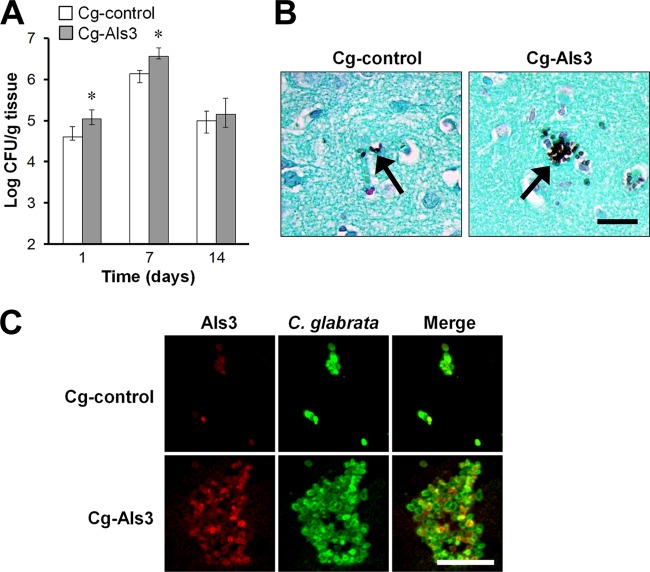
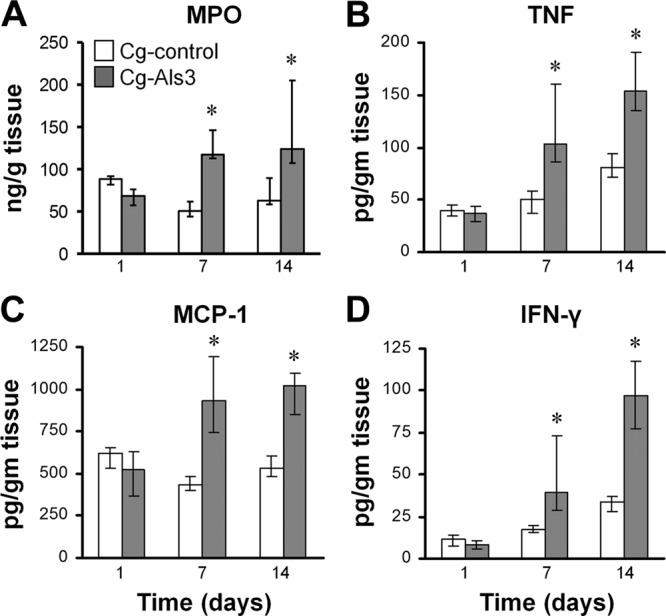
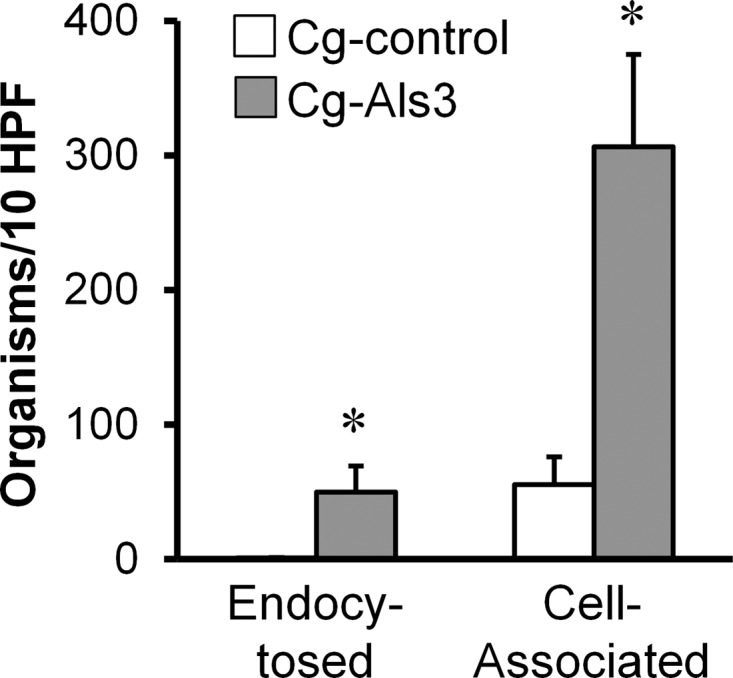
During hematogenously disseminated infection, blood-borne Candida albicans invades the endothelial cell lining of the vasculature to invade the deep tissues. Although the C. albicans Als3 invasin is critical for invasion and damage of endothelial cells in vitro, a C. albicans als3Δ/Δ mutant has normal virulence in the mouse model of disseminated infection. We hypothesized that the contribution of Als3 to virulence is obscured by the presence of additional C. albicans invasins. To elucidate the in vivo function of Als3, we heterologously expressed C. albicans ALS3 in Candida glabrata, a yeast that lacks a close ALS3 ortholog and has low virulence in mice. We found that following intravenous inoculation into mice, the ALS3-expressing strain preferentially trafficked to the brain, where it induced significantly elevated levels of myeloperoxidase, tumor necrosis factor, monocyte chemoattractant protein 1, and gamma interferon. Also, the ALS3-expressing strain had enhanced adherence to and invasion of human brain microvascular endothelial cells in vitro, demonstrating a potential mechanism for ALS3-mediated neurotropism. In addition, upon initiation of infection, the ALS3-expressing strain had increased trafficking to the cortex of the kidneys. With prolonged infection, this strain persisted in the kidneys at significantly higher levels than the control strain but did not induce an elevated inflammatory response. Finally, the ALS3-expressing strain had increased resistance to neutrophil killing in vitro. These results indicate that during disseminated infection, Als3 mediates initial trafficking to the brain and renal cortex and contributes to fungal persistence in the kidneys.
Figures
References
-
- Phan QT, Fratti RA, Prasadarao NV, Edwards JE, Jr, Filler SG. 2005. N-cadherin mediates endocytosis of Candida albicans by endothelial cells. J. Biol. Chem. 280:10455–10461 - PubMed
-
- Oh SH, Cheng G, Nuessen JA, Jajko R, Yeater KM, Zhao X, Pujol C, Soll DR, Hoyer LL. 2005. Functional specificity of Candida albicans Als3p proteins and clade specificity of ALS3 alleles discriminated by the number of copies of the tandem repeat sequence in the central domain. Microbiology 151:673–681 - PubMed
Publication types
MeSH terms
Substances
Grants and funding
LinkOut - more resources
Full Text Sources
Other Literature Sources
Molecular Biology Databases
Research Materials
