


Near-infrared spectroscopy versus magnetic resonance imaging to study brain perfusion in newborns with hypoxic-ischemic encephalopathy treated with hypothermia
- PMID: 23631990
- PMCID: PMC4487623
- DOI: 10.1016/j.neuroimage.2013.04.072
Near-infrared spectroscopy versus magnetic resonance imaging to study brain perfusion in newborns with hypoxic-ischemic encephalopathy treated with hypothermia
Abstract
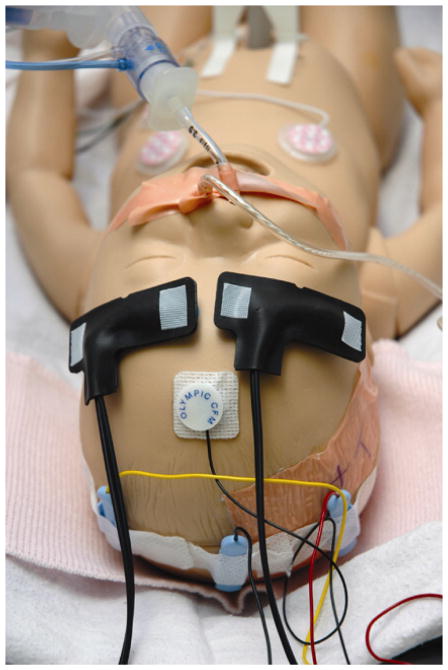
Background: The measurement of brain perfusion may provide valuable information for assessment and treatment of newborns with hypoxic-ischemic encephalopathy (HIE). While arterial spin labeled perfusion (ASL) magnetic resonance imaging (MRI) provides noninvasive and direct measurements of regional cerebral blood flow (CBF) values, it is logistically challenging to obtain. Near-infrared spectroscopy (NIRS) might be an alternative, as it permits noninvasive and continuous monitoring of cerebral hemodynamics and oxygenation at the bedside.
Objective: The purpose of this study is to determine the correlation between measurements of brain perfusion by NIRS and by MRI in term newborns with HIE treated with hypothermia.
Design/methods: In this prospective cohort study, ASL-MRI and NIRS performed during hypothermia were used to assess brain perfusion in these newborns. Regional cerebral blood flow (CBF) values, measured from 1-2 MRI scans for each patient, were compared to mixed venous saturation values (SctO2) recorded by NIRS just before and after each MRI. Analysis included groupings into moderate versus severe HIE based on their initial background pattern of amplitude-integrated electroencephalogram.
Results: Twelve concomitant recordings were obtained of seven neonates. Strong correlation was found between SctO2 and CBF in asphyxiated newborns with severe HIE (r=0.88; p value=0.0085). Moreover, newborns with severe HIE had lower CBF (likely lower oxygen supply) and extracted less oxygen (likely lower oxygen demand or utilization) when comparing SctO2 and CBF to those with moderate HIE.
Conclusions: NIRS is an effective bedside tool to monitor and understand brain perfusion changes in term asphyxiated newborns, which in conjunction with precise measurements of CBF obtained by MRI at particular times, may help tailor neuroprotective strategies in term newborns with HIE.
Keywords: Amplitude-Integrated Electroencephalogram; Brain; CBF; Cerebral Blood Flow; HIE; Hypoxic–Ischemic Encephalopathy; Hypoxic–ischemic encephalopathy; MRI; Magnetic Resonance Imaging; Magnetic resonance imaging; Mixed Venous Saturation; NICU; NIRS; Near-Infrared Spectroscopy; Near-infrared spectroscopy; Neonatal Intensive Care Unit; Newborn; PASL; Perfusion; Pulsed Arterial Spin Labeling; SctO(2); aEEG.
Copyright © 2013 Elsevier Inc. All rights reserved.
Conflict of interest statement
Figures


References
-
- Al Naqeeb N, Edwards AD, Cowan FM, Azzopardi D. Assessment of neonatal encephalopathy by amplitude-integrated electroencephalography. Pediatrics. 1999;103:1263–1271. - PubMed
-
- Ancora G, Maranella E, Locatelli C, Pierantoni L, Faldella G. Changes in cerebral hemodynamics and amplitude integrated EEG in an asphyxiated newborn during and after cool cap treatment. Brain Dev. 2009;31:442–444. - PubMed
-
- Ancora G, Maranella E, Grandi S, Sbravati F, Coccolini E, Savini S, Faldella G. Early predictors of short-term neurodevelopmental outcome in asphyxiated cooled infants. A combined brain amplitude-integrated electroencephalography and near infrared spectroscopy study. Brain Dev 2011 - PubMed
-
- Archer LN, Levene MI, Evans DH. Cerebral artery doppler ultrasonography for prediction of outcome after perinatal asphyxia. Lancet. 1986;2:1116–1118. - PubMed
-
- Azzopardi DV, Strohm B, Edwards AD, Dyet L, Halliday HL, Juszczak E, Kapellou O, Levene M, Marlow N, Porter E, Thoresen M, Whitelaw A, Brocklehurst P TOBY Study Group . Moderate hypothermia to treat perinatal asphyxial encephalopathy. N Engl J Med. 2009;361:1349–1358. - PubMed
Publication types
MeSH terms
Substances
Grants and funding
LinkOut - more resources
Full Text Sources
Other Literature Sources
Medical
