


Exercise attenuates PCB-induced changes in the mouse gut microbiome
- PMID: 23632211
- PMCID: PMC3672930
- DOI: 10.1289/ehp.1306534
Exercise attenuates PCB-induced changes in the mouse gut microbiome
Abstract
Background: The gut microbiome, a dynamic bacterial community that interacts with the host, is integral to human health because it regulates energy metabolism and immune functions. The gut microbiome may also play a role in risks from environmental toxicants.
Objectives: We investigated the effects of polychlorinated biphenyls (PCBs) and exercise on the composition and structure of the gut microbiome in mice.
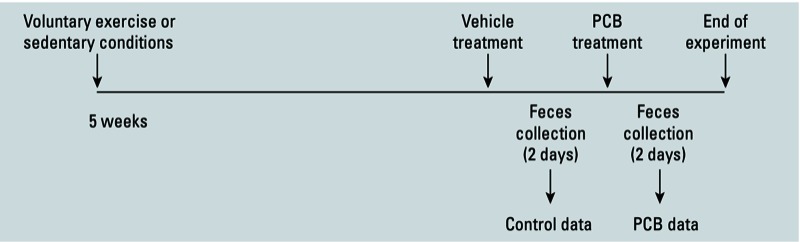
Methods: After mice exercised voluntarily for 5 weeks, they were treated by oral gavage with a mixture of environmentally relevant PCB congeners (PCB153, PCB138, and PCB180; total PCB dose, 150 µmol/kg) for 2 days. We then assessed the microbiome by determination of 16S rRNA using microarray analysis.
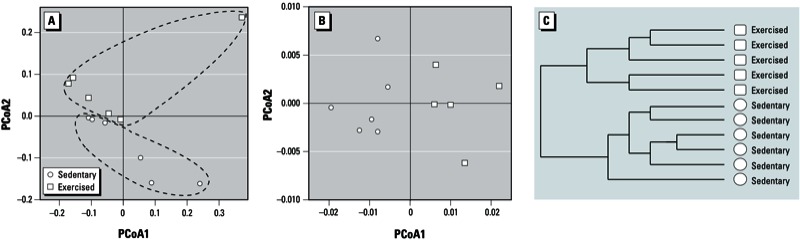
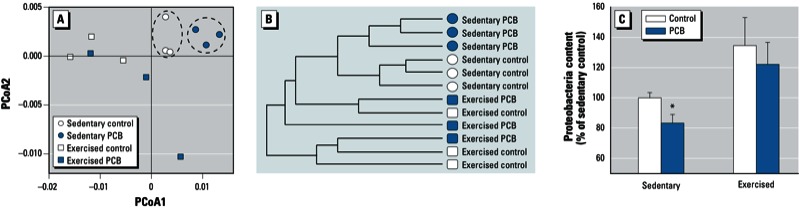
Results: Oral exposure to PCBs significantly altered the abundance of the gut microbiome in mice primarily by decreasing the levels of Proteobacteria. The activity level of the mice correlated with a substantial shift in abundance, biodiversity, and composition of the microbiome. Importantly, exercise attenuated PCB-induced changes in the gut microbiome.
Conclusions: Our results show that oral exposure to PCBs can induce substantial changes in the gut microbiome, which may then influence their systemic toxicity. These changes can be attenuated by behavioral factors, such as voluntary exercise.
Conflict of interest statement
The authors declare they have no actual or potential competing financial interests.
Figures
Comment in
-
Running interference? Exercise and PCB-induced changes in the gut microbiome.Environ Health Perspect. 2013 Jun;121(6):A199. doi: 10.1289/ehp.121-a199. Environ Health Perspect. 2013. PMID: 23732946 Free PMC article. No abstract available.
References
-
- Armougom F, Henry M, Vialettes B, Raccah D, Raoult D.2009Monitoring bacterial community of human gut microbiota reveals an increase in Lactobacillus in obese patients and Methanogens in anorexic patients. PLoS One 4e7125; doi: 10.1371/journal.pone.0007125[Online 23 September 2009] - DOI - PMC - PubMed
-
- Ashley TFJ, Secor HD, Zlokovitz E, Wales QS, Baker EJ. Linking habitat use of Hudson River striped bass to accumulation of polychlorinated biphenyl congeners. Environ Sci Technol. 2000;34:1023–1029.
Publication types
MeSH terms
Substances
Grants and funding
LinkOut - more resources
Full Text Sources
Other Literature Sources